
Vegetable Pulao
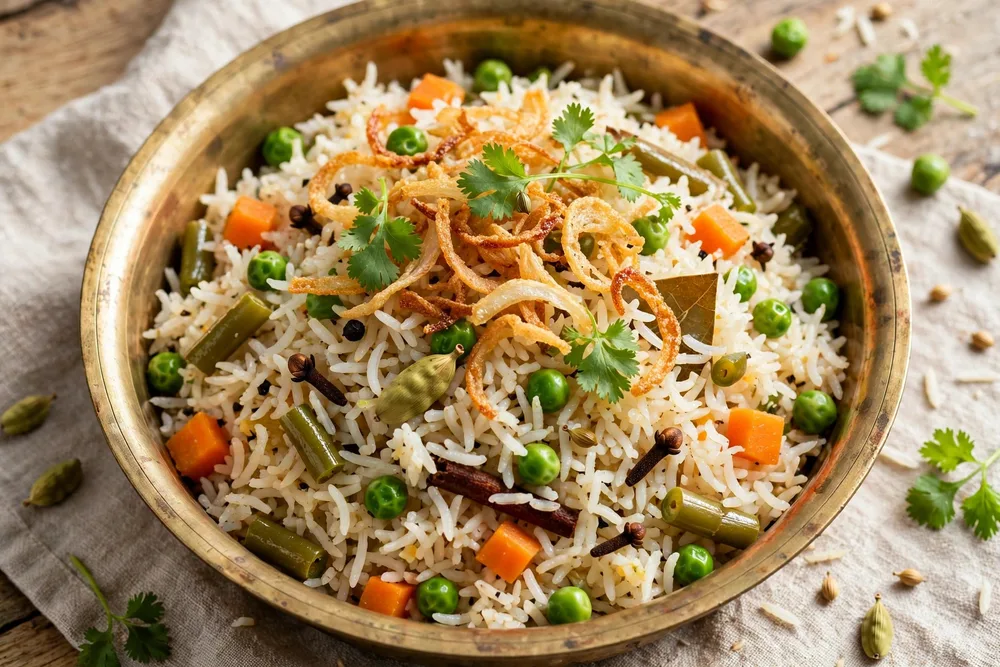
Fragrant basmati rice cooked with mixed vegetables and whole spices, finished with fried onions. The vegetarian rice main that stands on its own on a wedding menu.
Base Batch
10 Pax
220 g
Prep / Cook
40m
25 min
Difficulty
easy
Commercial Standard
Cost / Portion
₹20.04
Illustrative Book Rate
Section 1 · At a Glance
Ingredients & Dynamic Pax Scaling Lab
Base formulated for 10 portions. Calibrate guest count, adjust catering buffer, or search specific ingredients below.
Batch Ingredient Cost
₹200
10 portions @ ₹20.04
Raw Batch Weight
~3.01 kg
Total raw commodities
Equipment Capacity
1 × GN 1/1
Standard chafing inserts
Scaling Factor
1.0× Base
10 Pax reference base
* Scaling is linear from the base 10-portion quantities (×5, ×10, ×50). Quantities of 1,000 g or more are shown as kg; 1,000 ml or more as L.
* Salt, spice, chilli and water do not scale perfectly — always taste and adjust; never scale salt blindly.
Step-by-Step Method & Critical Control Points (CCP)
Standard operating procedures with highlighted CCP warnings where execution failure compromises texture or food safety.
Soak the rice. Rinse the basmati until the water runs clear; soak 30 minutes, then drain.
Temper. Heat the ghee; add cumin, bay leaves, cardamoms, cinnamon and cloves; fry until fragrant.
Cook the vegetables. Add the onions and ginger-garlic paste; cook until soft. Add the carrots, beans, cauliflower and potato; cook 3–4 minutes.
Add the rice. Add the drained rice, peas, green chillies and salt; stir gently 1 minute.
Cook. Add the 1.2 L water; bring to the boil, then cover and cook on low heat 12–15 minutes until the water is absorbed — **⚠ CCP:** do not lift the lid or stir while the rice cooks.
Rest. Take the pan off the heat and rest, covered, 10 minutes.
Serve. Fluff gently with a fork; garnish with fried onions, coriander and mint. Serve hot, 220 g per portion. Done when: long, separate grains, vegetables tender, fragrant with whole spices.
ℹ CCP = critical control point — the moment where getting it wrong spoils the dish or makes it unsafe.
Tips & Tricks + Common Mistakes to Avoid
- •Cut the vegetables even — small, even pieces cook at the same rate as the rice.
- •Do not overcook the vegetables before adding the rice; they finish cooking with it.
- •Rest the pulao after cooking; the grains separate as it rests.
- •Mushy pulao — too much water, or the rice stirred while cooking.
- •Hard vegetables — cut too large, or added too late.
- •Bland pulao — whole spices not fried until fragrant.
Section 5 · Nutrition — (220 g)
Standard food-composition estimates derived from the raw ingredient list.
Energy
290 kcal
Avg: 259 kcal
Protein
6 g
Avg: 10 g
Carbohydrate
56 g
Avg: 33 g
Fat
7 g
Avg: 10 g
Fibre
2 g
Avg: 2 g
Sodium
500 mg
Avg: 434 mg
72%
56 g
8%
6 g
20%
7 g
Energy split: carbohydrate 72% · protein 8% · fat 20%.
Check: 4 × 6 g protein + 4 × 56 g carbohydrate + 9 × 7 g fat = 311 kcal, close to the stated 290 kcal (rounded estimate).
Section 6 · Fun Fact & Origin
Origin: not documented — no reliable source found for a single place, person or date of first creation. Vegetable pulao is an everyday North Indian rice dish.
Section 7 · Regional Traditions
Vegetable pulao is the vegetarian rice main of North India — the rice dish that stands on its own at weddings and festivals, served with raita and pickle. It is the caterer's answer when a guest wants a complete vegetarian plate without a gravy.
Three Commercial Variations
add saffron-soaked milk and extra fried onions on top.
use more potato and carrot and fewer peas; the character stays the same.
use less ghee and add more vegetables.
Production Intelligence & Banquet Logistics
Batch Yield
10 portions × 220 g = 2.2 kg finished.
Prep Schedule
Morning: soak the rice 30 minutes ahead; cut vegetables. Cook in batches close to service.
Portion Control
220 g per portion by a weighed ladle or a standard rice scoop.
Holding Limits
Hot hold 65°C
- Yield: 10 portions × 220 g = 2.2 kg finished.
- Prep schedule: Morning: soak the rice 30 minutes ahead; cut vegetables. Cook in batches close to service.
- Portion control: 220 g per portion by a weighed ladle or a standard rice scoop.
- Holding and service risks: Holds hot and covered for about 45 minutes; cook fresh batches rather than holding through a service.
Food Safety, Allergens & Thermal Holding
Allergen Classification (Chapter 4 Matrix)
Contains — Milk. Not present — Wheat, Egg, Fish, Nuts, Soy, Mustard, Sesame. Diet: Veg.
Ingredient Costing, Pairings & Waste Reduction
Per Portion Cost
₹20.04
Cost per portion = (sum of ingredient quantity × rate) ÷ portions. Ingredient cost only — water, cooking fuel, transport, labour, and commercial overheads are not included. All rates are illustrative book planning benchmarks; replace with your live mandi rates.
Cost Driver Composition
Interactive Margin & Profit Simulator
Calibrate your catering client quote to verify commercial profit margins.
Quoted Revenue
₹6,000
Food Cost
₹2,004
Gross Profit
₹3,996
Profitable Menu Pairings
Kitchen Waste Reduction & Yield Strategy
Leftover pulao becomes a fried-rice service the same day; vegetable trimmings go into the stock pot.