
Jeera Rice
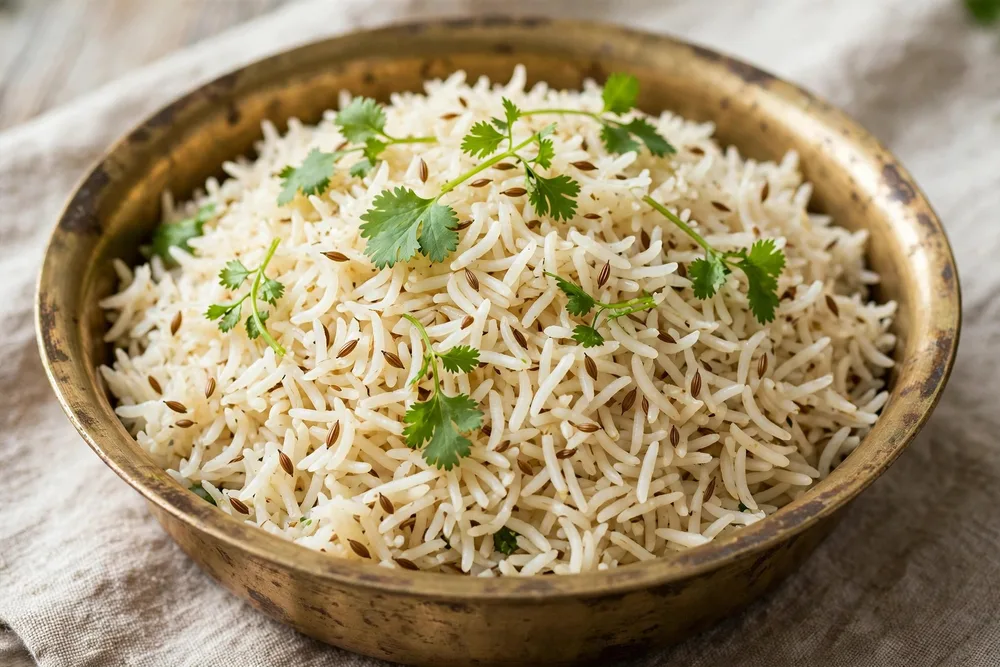
Fluffy basmati rice tempered with cumin seeds in ghee. The rice that goes with every North Indian gravy — simple, fragrant, and the highest-margin rice on the menu.
Base Batch
10 Pax
200 g
Prep / Cook
30m
20 min
Difficulty
easy
Commercial Standard
Cost / Portion
₹13.45
Illustrative Book Rate
Section 1 · At a Glance
Ingredients & Dynamic Pax Scaling Lab
Base formulated for 10 portions. Calibrate guest count, adjust catering buffer, or search specific ingredients below.
Batch Ingredient Cost
₹135
10 portions @ ₹13.45
Raw Batch Weight
~2.06 kg
Total raw commodities
Equipment Capacity
1 × GN 1/1
Standard chafing inserts
Scaling Factor
1.0× Base
10 Pax reference base
* Scaling is linear from the base 10-portion quantities (×5, ×10, ×50). Quantities of 1,000 g or more are shown as kg; 1,000 ml or more as L.
* Salt, spice, chilli and water do not scale perfectly — always taste and adjust; never scale salt blindly.
Step-by-Step Method & Critical Control Points (CCP)
Standard operating procedures with highlighted CCP warnings where execution failure compromises texture or food safety.
Soak the rice. Rinse the basmati until the water runs clear; soak 30 minutes, then drain — **⚠ CCP:** soaking gives long, separate grains; unsoaked rice cooks unevenly.
Temper. Heat the ghee; add cumin, bay leaves and cardamoms; fry until the cumin crackles and smells fragrant.
Add the rice. Add the drained rice and salt; stir gently 1 minute so every grain is coated.
Cook. Add the 1.2 L water; bring to the boil, then cover and cook on low heat 12–15 minutes until the water is absorbed — **⚠ CCP:** do not lift the lid or stir while the rice cooks; steam does the work.
Rest. Take the pan off the heat and rest, covered, 10 minutes.
Fluff. Fluff gently with a fork, lifting the grains — never mash with a ladle.
Serve. Garnish with coriander leaves; serve hot, 200 g per portion. Done when: long, separate, fluffy grains, fragrant with cumin.
ℹ CCP = critical control point — the moment where getting it wrong spoils the dish or makes it unsafe.
Tips & Tricks + Common Mistakes to Avoid
- •Rinse until the water runs clear — surface starch is what makes rice sticky.
- •Rest the rice after cooking; it finishes steaming and the grains separate.
- •Fluff with a fork, never a ladle, which breaks the grains.
- •Sticky rice — not rinsed, or stirred while cooking.
- •Broken grains — rice stirred with a ladle, or cooked on too high a heat.
- •Bland rice — cumin not fried until fragrant.
Section 5 · Nutrition — (200 g)
Standard food-composition estimates derived from the raw ingredient list.
Energy
280 kcal
Avg: 259 kcal
Protein
5 g
Avg: 10 g
Carbohydrate
58 g
Avg: 33 g
Fat
5 g
Avg: 10 g
Fibre
1 g
Avg: 2 g
Sodium
480 mg
Avg: 434 mg
78%
58 g
7%
5 g
15%
5 g
Energy split: carbohydrate 78% · protein 7% · fat 15%.
Check: 4 × 5 g protein + 4 × 58 g carbohydrate + 9 × 5 g fat = 297 kcal, close to the stated 280 kcal (rounded estimate).
Section 6 · Fun Fact & Origin
Origin: not documented — no reliable source found for a single place, person or date of first creation. Cumin-tempered rice is an everyday North Indian accompaniment.
Section 7 · Regional Traditions
Jeera rice is the everyday rice of North India — the rice served with dal, rajma, chole and every gravy on a wedding menu. It is the caterer's most reliable rice: cheap, quick, and liked by every guest.
Three Commercial Variations
add a little extra ghee and a saffron soak for colour.
the recipe as written is already low-cost; use a smaller quantity of ghee.
use less ghee and add more cumin and coriander for flavour.
Production Intelligence & Banquet Logistics
Batch Yield
10 portions × 200 g = 2.0 kg cooked rice, from 800 g raw rice.
Prep Schedule
Morning: soak the rice 30 minutes ahead. Cook in batches close to service; each batch takes about 20 minutes.
Portion Control
200 g per portion by a weighed ladle or a standard rice scoop.
Holding Limits
Hot hold 65°C
- Yield: 10 portions × 200 g = 2.0 kg cooked rice, from 800 g raw rice.
- Prep schedule: Morning: soak the rice 30 minutes ahead. Cook in batches close to service; each batch takes about 20 minutes.
- Portion control: 200 g per portion by a weighed ladle or a standard rice scoop.
- Holding and service risks: Holds hot and covered for about 45 minutes; after that the grains dry out. Cook fresh batches rather than holding through a service.
Food Safety, Allergens & Thermal Holding
Allergen Classification (Chapter 4 Matrix)
Contains — Milk. Not present — Wheat, Egg, Fish, Nuts, Soy, Mustard, Sesame. Diet: Veg.
Ingredient Costing, Pairings & Waste Reduction
Per Portion Cost
₹13.45
Cost per portion = (sum of ingredient quantity × rate) ÷ portions. Ingredient cost only — water, cooking fuel, transport, labour, and commercial overheads are not included. All rates are illustrative book planning benchmarks; replace with your live mandi rates.
Cost Driver Composition
Interactive Margin & Profit Simulator
Calibrate your catering client quote to verify commercial profit margins.
Quoted Revenue
₹4,000
Food Cost
₹1,345
Gross Profit
₹2,655
Profitable Menu Pairings
Kitchen Waste Reduction & Yield Strategy
Leftover rice becomes a fried-rice service or a pulao the same day; rice soaking water is used for cooking, not thrown away.