
Mixed Pickle
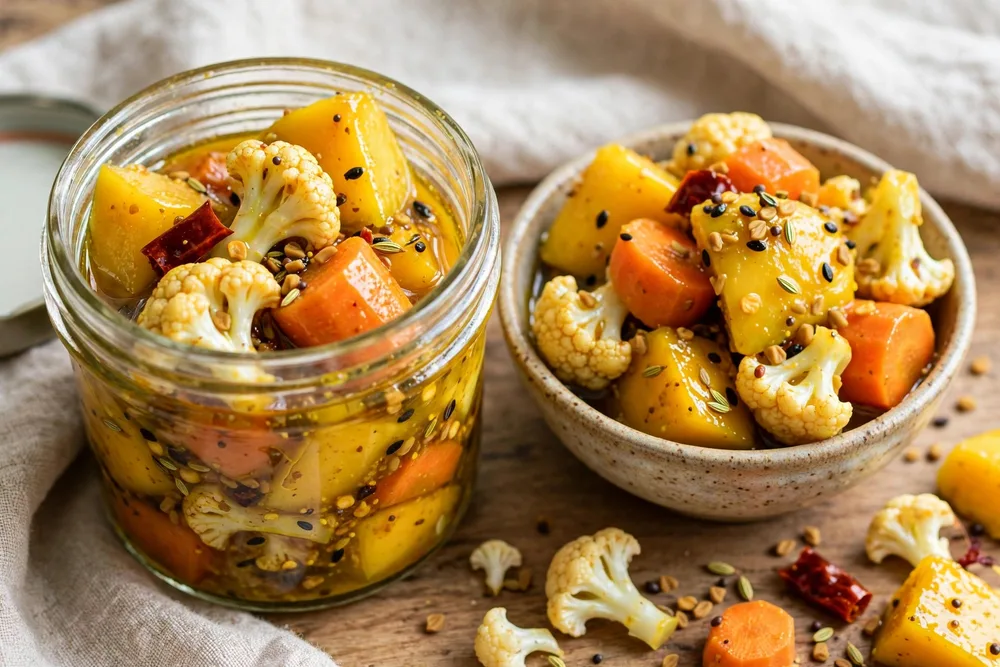
Tangy, spicy mixed-vegetable pickle in mustard oil. The sharp, salty-sour condiment that wakes up a North Indian plate — made ahead, matured for two days, and served in small portions.
Base Batch
10 Pax
20 g per portion
Prep / Cook
20m
No cooking
Difficulty
easy
Commercial Standard
Cost / Portion
₹2.50
Illustrative Book Rate
Section 1 · At a Glance
Ingredients & Dynamic Pax Scaling Lab
Base formulated for 10 portions. Calibrate guest count, adjust catering buffer, or search specific ingredients below.
Batch Ingredient Cost
₹25
10 portions @ ₹2.50
Raw Batch Weight
~0.82 kg
Total raw commodities
Equipment Capacity
1 × GN 1/1
Standard chafing inserts
Scaling Factor
1.0× Base
10 Pax reference base
* Scaling is linear from the base 10-portion quantities (×5, ×10, ×50). Quantities of 1,000 g or more are shown as kg; 1,000 ml or more as L.
* Salt, spice, chilli and water do not scale perfectly — always taste and adjust; never scale salt blindly.
Step-by-Step Method & Critical Control Points (CCP)
Standard operating procedures with highlighted CCP warnings where execution failure compromises texture or food safety.
Dry the vegetables. Wash and dry the mango, carrot, cauliflower, green chillies and lemon fully — **⚠ CCP:** any water in the pickle spoils it; dry every piece.
Mix the spices. Mix the ground mustard, fenugreek and fennel seeds with turmeric, red chilli powder, asafoetida and salt.
Heat the oil. Heat the mustard oil until it just smokes, then cool it fully — **⚠ CCP:** hot oil poured on the pickle cooks it; the oil must be cool.
Combine. Toss the vegetables with the spice mix, then pour over the cooled oil and mix well.
Jar. Pack into a clean, dry glass jar; press down so the oil covers the vegetables.
Mature. Keep the jar in a cool, dry place for 2 days, shaking once a day, before serving.
Serve. Serve 20 g per portion in a small bowl. Done when: tangy, spicy, vegetables firm and coated in spiced oil.
ℹ CCP = critical control point — the moment where getting it wrong spoils the dish or makes it unsafe.
Tips & Tricks + Common Mistakes to Avoid
- •Dry every piece — water is what spoils a pickle.
- •Cool the oil fully before pouring; hot oil cooks the vegetables.
- •Use a clean, dry jar and a clean, dry spoon every time.
- •Spoiled pickle — water left on the vegetables, or a wet spoon used.
- •Soft vegetables — oil poured hot, or the pickle matured too long in the heat.
- •Bitter pickle — too much fenugreek, or the mustard oil not heated.
Section 5 · Nutrition — (20 g per portion)
Standard food-composition estimates derived from the raw ingredient list.
Energy
45 kcal
Avg: 259 kcal
Protein
1 g
Avg: 10 g
Carbohydrate
5 g
Avg: 33 g
Fat
3 g
Avg: 10 g
Fibre
1 g
Avg: 2 g
Sodium
420 mg
Avg: 434 mg
39%
5 g
8%
1 g
53%
3 g
Energy split: carbohydrate 39% · protein 8% · fat 53%.
Check: 4 × 1 g protein + 4 × 5 g carbohydrate + 9 × 3 g fat = 51 kcal, close to the stated 45 kcal (rounded estimate).
Section 6 · Fun Fact & Origin
Origin: not documented — no reliable source found for a single place, person or date of first creation. Mixed pickle is a long-standing North Indian preserving tradition.
Section 7 · Regional Traditions
Mixed pickle is the preserving tradition of North India — summer vegetables and raw mango packed in spiced mustard oil, made in bulk and matured in jars. At weddings it is served in small portions beside the main plate; a little goes a long way.
Three Commercial Variations
the recipe as written — serve in a small bowl with the oil glistening on top.
the recipe as written is already low-cost; use seasonal vegetables.
serve a smaller portion; the pickle is a condiment, not a main.
Production Intelligence & Banquet Logistics
Batch Yield
10 portions × 20 g = 200 g finished (the recipe makes about 800 g; portion from the jar).
Prep Schedule
Two days before: make the pickle and mature it. On the day: portion into small bowls at service.
Portion Control
20 g per portion by a small spoon.
Holding Limits
Hot hold 65°C
- Yield: 10 portions × 20 g = 200 g finished (the recipe makes about 800 g; portion from the jar).
- Prep schedule: Two days before: make the pickle and mature it. On the day: portion into small bowls at service.
- Portion control: 20 g per portion by a small spoon.
- Holding and service risks: The pickle keeps for weeks in a cool, dry place in a sealed jar; use a clean, dry spoon every time. Once opened at a buffet, use the portioned bowls the same day.
Food Safety, Allergens & Thermal Holding
Allergen Classification (Chapter 4 Matrix)
Contains — Mustard. Not present — Milk, Wheat, Egg, Fish, Nuts, Soy, Sesame. Diet: Veg.
Ingredient Costing, Pairings & Waste Reduction
Per Portion Cost
₹2.50
Cost per portion = (sum of ingredient quantity × rate) ÷ portions. Ingredient cost only — water, cooking fuel, transport, labour, and commercial overheads are not included. All rates are illustrative book planning benchmarks; replace with your live mandi rates.
Cost Driver Composition
Interactive Margin & Profit Simulator
Calibrate your catering client quote to verify commercial profit margins.
Quoted Revenue
₹1,500
Food Cost
₹250
Gross Profit
₹1,250
The illustrative table totals ₹100.20 for 40 portions of 20 g each, or ₹2.50 per portion after rounding.
Profitable Menu Pairings
Kitchen Waste Reduction & Yield Strategy
Vegetable trimmings go into the stock pot; the spiced oil left in the jar flavours the next batch of pickle. The base recipe makes about 800 g; cost is shown per 10 portions (200 g) from that batch.