
Solkadhi
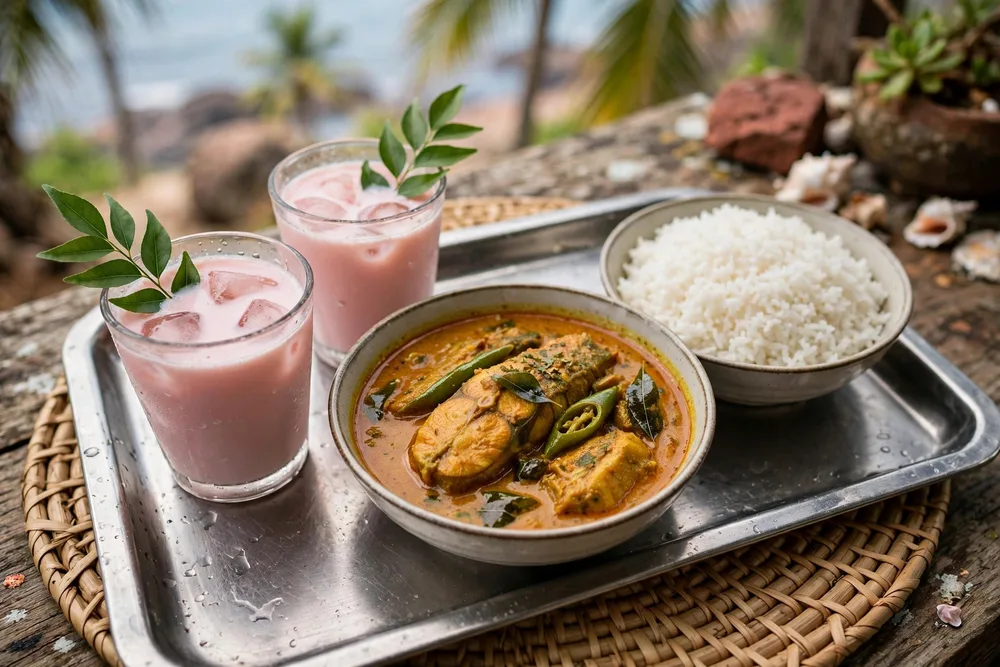
The Konkan coast's pink welcome drink — kokum and coconut milk, chilled, with garlic and green chilli. The cooler that follows a fish curry.
Base Batch
10 Pax
150 ml
Prep / Cook
75m
None
Difficulty
easy
Commercial Standard
Cost / Portion
₹4.20
Illustrative Book Rate
Section 1 · At a Glance
Ingredients & Dynamic Pax Scaling Lab
Base formulated for 10 portions. Calibrate guest count, adjust catering buffer, or search specific ingredients below.
Batch Ingredient Cost
₹42
10 portions @ ₹4.20
Raw Batch Weight
~1.87 kg
Total raw commodities
Equipment Capacity
1 × GN 1/1
Standard chafing inserts
Scaling Factor
1.0× Base
10 Pax reference base
* Scaling — linear from base 10 (×5, ×10, ×50). Above 1,000 g shown as kg; above 1,000 ml as L. Coconut milk: 300 g coconut
* with 600 ml warm water gives about 600 ml first-press milk; with the 200 ml kokum water and 700 ml chilled top-up water the
* recipe reaches 1.5 L. For 50+ portions, extract the milk in separate 50-portion batches — one very large batch extracts unevenly.
Step-by-Step Method & Critical Control Points (CCP)
Standard operating procedures with highlighted CCP warnings where execution failure compromises texture or food safety.
Soak the kokum. Soak the kokum petals in the 200 ml warm water for 30 minutes until the water turns deep pink. Squeeze the petals and discard them, keeping the pink water.
Extract the coconut milk. Grind the grated coconut with the 600 ml warm water, then squeeze through a muslin cloth to extract the milk. **⚠ CCP—** extraction: squeeze firmly and twice; weak extraction gives a thin, watery solkadhi.
Combine. Mix the coconut milk with the pink kokum water and the 700 ml chilled top-up water. Stir in the crushed garlic, green chillies, salt, sugar and asafoetida.
Taste and adjust. **⚠ CCP—** balance: pink, tangy, lightly garlicky, with a little heat; add kokum water for more tang, or a pinch more sugar if it is too sharp. Do not add more coconut milk to fix tang — it dulls the colour.
Chill. Cover and chill at least 1 hour. Serve chilled. Done when: pink, smooth, tangy and cool, garlic and chilli present but not harsh.
Serve. 150 ml per portion in a small glass. Serve as a welcome drink or alongside a fish curry.
ℹ CCP = critical control point — the moment where getting it wrong spoils the dish or makes it unsafe.
Tips & Tricks + Common Mistakes to Avoid
- •Soak the kokum until the water is deep pink — pale kokum water makes a pale solkadhi.
- •Squeeze the coconut twice; the second press adds body.
- •Chill it properly — solkadhi served warm tastes flat and oily.
- •Too little kokum — a pale, milky drink with no tang.
- •Warm serving — it tastes flat and oily instead of cool and tangy.
- •Too much garlic — it overpowers the kokum; crush, do not blend, the garlic.
Section 5 · Nutrition — (150 ml)
Standard food-composition estimates derived from the raw ingredient list.
Energy
92 kcal
Avg: 259 kcal
Protein
1 g
Avg: 10 g
Carbohydrate
5 g
Avg: 33 g
Fat
8 g
Avg: 10 g
Fibre
1 g
Avg: 2 g
Sodium
300 mg
Avg: 434 mg
21%
5 g
4%
1 g
75%
8 g
Energy split: carbohydrate 21% · protein 4% · fat 75%.
Check: 1×4 + 5×4 + 8×9 = 96 kcal, stated 92 kcal (rounded estimate).
Section 6 · Fun Fact & Origin
Solkadhi is the Konkan coast's drink — kokum water mixed with fresh coconut milk, served chilled. Origin: not documented — no reliable source found for a single inventor, place or date.
Section 7 · Regional Traditions
Solkadhi belongs to Goa and the Konkan coast, where kokum and coconut are the everyday staples of the coastal kitchen. It is the welcome drink at Goan weddings and the cooler that follows a fish curry — served in small glasses, chilled, at the welcome-drink station and at the buffet.
Three Commercial Variations
Serve in a small chilled glass with a curry leaf floated on top and a green chilli slit on the rim.
Use 200 g coconut with 100 ml bought coconut milk to top up the extraction.
Skip the sugar and use thin coconut milk (second press) only.
Production Intelligence & Banquet Logistics
Batch Yield
10 portions × 150 ml = 1.5 L from 300 g coconut + 800 ml water.
Prep Schedule
Standard prep
Portion Control
pour 150 ml per glass with a measured jug; check the first five glasses.
Holding Limits
Hot hold 65°C
- Yield: 10 portions × 150 ml = 1.5 L from 300 g coconut + 800 ml water.
- Prep schedule (100 portions): soak the kokum and extract the coconut milk the morning of the event; mix and chill in the afternoon; pour into glasses at the station just before service opens.
- Portion control: pour 150 ml per glass with a measured jug; check the first five glasses.
- Holding and service risks: mix in small batches; keep the station stocked and glasses replenished. mix no more than 2 hours before service, keep it chilled, and do not top up a nearly empty vessel with a fresh batch; finish the old batch first.
Food Safety, Allergens & Thermal Holding
Allergen Classification (Chapter 4 Matrix)
Contains — Nuts. Not present — Milk, Wheat, Egg, Fish, Soy, Mustard, Sesame. Diet: Veg.
Ingredient Costing, Pairings & Waste Reduction
Per Portion Cost
₹4.20
Cost per portion = (sum of ingredient quantity × rate) ÷ portions. Ingredient cost only — water, cooking fuel, transport, labour, and commercial overheads are not included. All rates are illustrative book planning benchmarks; replace with your live mandi rates.
Cost Driver Composition
Interactive Margin & Profit Simulator
Calibrate your catering client quote to verify commercial profit margins.
Quoted Revenue
₹1,500
Food Cost
₹420
Gross Profit
₹1,080
Profitable Menu Pairings
Kitchen Waste Reduction & Yield Strategy
The biggest waste is a batch mixed far ahead and gone sour, and a station run dry mid-service. Mix in small batches no more than 2 hours before service, keep it chilled, and track glasses poured against glasses mixed — a 10-portion overmix is 1.5 L.