
Goan Fish Curry
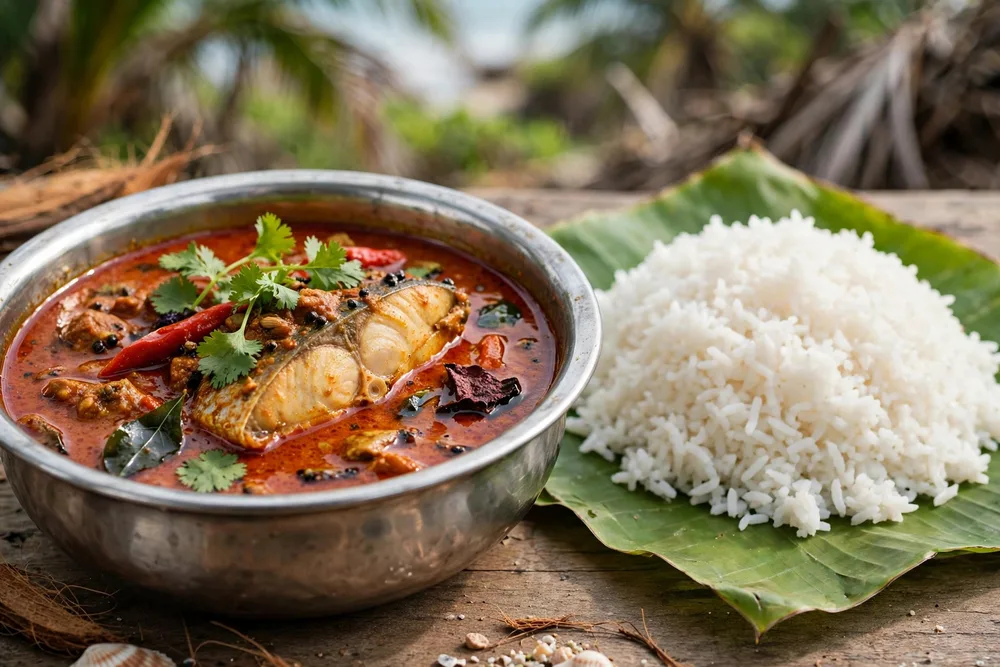
Goa's coconut-and-kokum fish curry — tangy, red, and made for steamed rice. The dish that defines a Goan lunch.
Base Batch
10 Pax
210 g (100 g fish + gravy)
Prep / Cook
55m
30 min
Difficulty
medium–high
Commercial Standard
Cost / Portion
₹65.85
Illustrative Book Rate
Section 1 · At a Glance
Ingredients & Dynamic Pax Scaling Lab
Base formulated for 10 portions. Calibrate guest count, adjust catering buffer, or search specific ingredients below.
Batch Ingredient Cost
₹659
10 portions @ ₹65.85
Raw Batch Weight
~2.44 kg
Total raw commodities
Equipment Capacity
1 × GN 1/1
Standard chafing inserts
Scaling Factor
1.0× Base
10 Pax reference base
* Scaling — linear from base 10 (×5, ×10, ×50). Above 1,000 g shown as kg; above 1,000 ml as L. For 50+ portions, grind the
* coconut masala and cook the gravy in separate 50-portion vessels — one very large pot cooks the fish unevenly and the pieces break.
Step-by-Step Method & Critical Control Points (CCP)
Standard operating procedures with highlighted CCP warnings where execution failure compromises texture or food safety.
Prep the fish. Cut the fish into 10 equal pieces (about 100 g each). Rub with the 5 g turmeric and 8 g salt; rest 15 minutes. **⚠ CCP—** freshness: the fish must smell of the sea, not sour; reject any piece that smells off.
Grind the masala. Grind coconut, dried red chillies, coriander seeds, cumin, turmeric, onion, garlic and ginger with a little water to a smooth paste.
Cook the gravy. Heat the oil; add the ground masala and fry 5–6 minutes until fragrant and the oil separates. Add the 800 ml water, kokum and tamarind; simmer 10 minutes. **⚠ CCP—** sourness: taste it; add the tamarind.
Add the fish. Slide the fish pieces in, spoon gravy over them, and simmer on low heat 8–10 minutes. **⚠ CCP—** the fish: never boil hard and never stir; shake the vessel instead. Done when it flakes easily and is opaque right through.
Finish. Add green chillies and salt to taste; rest covered 5 minutes. Garnish with coriander. Done when: gravy red and tangy, fish whole and flaking, no raw-coconut taste.
Serve. 210 g per portion (one 100 g fish piece + gravy). Serve hot with steamed rice.
ℹ CCP = critical control point — the moment where getting it wrong spoils the dish or makes it unsafe.
Tips & Tricks + Common Mistakes to Avoid
- •Use firm white fish — kingfish or pomfret hold their shape; soft fish breaks in the gravy.
- •Grind the masala smooth; a coarse masala makes a gritty gravy.
- •Never stir after the fish goes in — shake the vessel or spoon gravy over the pieces.
- •Boiling the curry hard — the fish breaks and the coconut gravy can split.
- •Too much tamarind — it overpowers the kokum and turns the gravy harsh.
- •Undercooked fish — the centre stays translucent; check the thickest piece.
Section 5 · Nutrition — (210 g (100 g fish + gravy)
Standard food-composition estimates derived from the raw ingredient list.
Energy
208 kcal
Avg: 259 kcal
Protein
18 g
Avg: 10 g
Carbohydrate
7 g
Avg: 33 g
Fat
12 g
Avg: 10 g
Fibre
2 g
Avg: 2 g
Sodium
670 mg
Avg: 434 mg
13%
7 g
35%
18 g
52%
12 g
Energy split: carbohydrate 13% · protein 35% · fat 52%.
Check: 18×4 + 7×4 + 12×9 = 208 kcal, stated 208 kcal (rounded estimate).
Section 6 · Fun Fact & Origin
Kokum is the souring agent of the Konkan coast — the dried rind of the Garcinia fruit, used in Goan cooking instead of, or alongside, tamarind. Origin: not documented — no reliable source found for a single inventor, place or date.
Section 7 · Regional Traditions
Goan fish curry belongs to Goa and the Konkan coast, where fish, coconut and kokum are the everyday staples of the Hindu and Catholic kitchens alike. It is the lunch of Goa — fish curry and rice, every day — and at weddings it is the non-vegetarian centrepiece, served with steamed rice and solkadhi on the side.
Three Commercial Variations
Use pomfret steaks and finish with a spoon of coconut milk swirled in off the heat.
Use a cheaper firm fish such as mackerel and cut the coconut to 200 g. The coconut saving alone is ₹0.80 per portion.
Cut the oil to 15 ml and use 200 g coconut with 100 ml thin coconut milk.
Production Intelligence & Banquet Logistics
Batch Yield
10 portions × 210 g = 2.1 kg (1 kg fish + gravy).
Prep Schedule
Standard prep
Portion Control
one fish piece (about 100 g) + one 150 ml ladle of gravy per portion.
Holding Limits
Hot hold 65°C
- Yield: 10 portions × 210 g = 2.1 kg (1 kg fish + gravy).
- Prep schedule (100 portions): grind the coconut masala the morning of the event; cook the gravy in two 50-portion vessels, adding the fish only in the last 10 minutes before service in each vessel.
- Portion control: one fish piece (about 100 g) + one 150 ml ladle of gravy per portion.
- Holding and service risks: hold covered in service vessels; keep vegetarian and non-vegetarian service strictly separate — separate vessels, ladles and counters. Replenish in small batches; check the thickest piece in each vessel.
Food Safety, Allergens & Thermal Holding
Allergen Classification (Chapter 4 Matrix)
Contains — Fish, Nuts. Not present — Milk, Wheat, Egg, Soy, Mustard, Sesame. Diet: Non-veg.
Ingredient Costing, Pairings & Waste Reduction
Per Portion Cost
₹65.85
Cost per portion = (sum of ingredient quantity × rate) ÷ portions. Ingredient cost only — water, cooking fuel, transport, labour, and commercial overheads are not included. All rates are illustrative book planning benchmarks; replace with your live mandi rates.
Cost Driver Composition
Interactive Margin & Profit Simulator
Calibrate your catering client quote to verify commercial profit margins.
Quoted Revenue
₹19,800
Food Cost
₹6,585
Gross Profit
₹13,215
Profitable Menu Pairings
Kitchen Waste Reduction & Yield Strategy
The biggest waste is fish broken by stirring or overcooked in a large vessel. Cook the gravy ahead, add the fish only near service in 50-portion vessels, and never stir after it goes in.