
Aamras
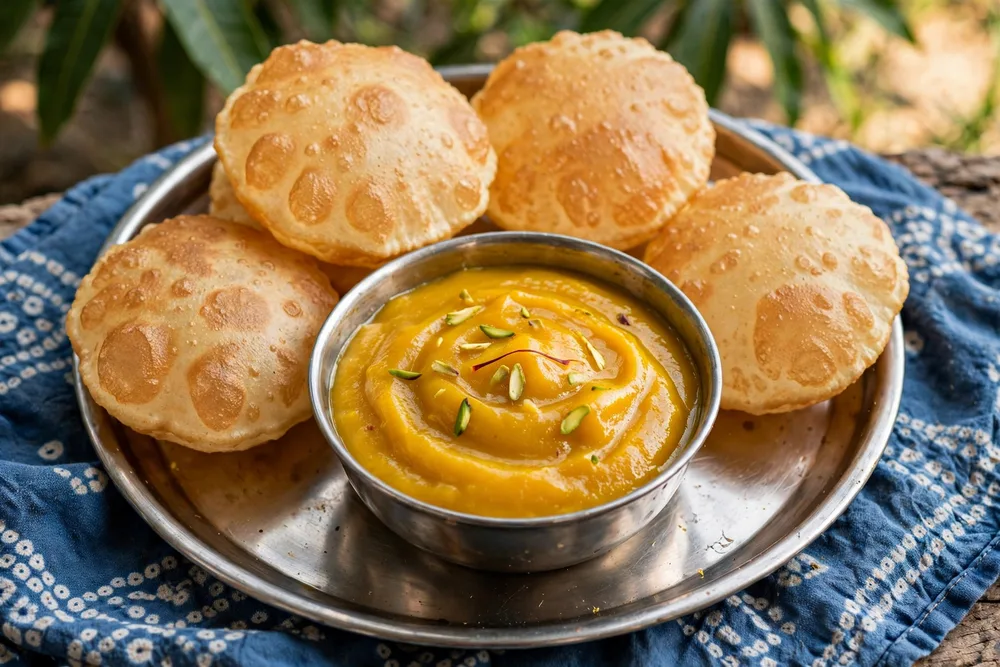
Gujarat's mango pulp — Alphonso mangoes, a little sugar, nothing else. The taste of a Gujarati summer, served with hot puris.
Base Batch
10 Pax
150 g
Prep / Cook
80m
None
Difficulty
easy
Commercial Standard
Cost / Portion
₹47.23
Illustrative Book Rate
Section 1 · At a Glance
Ingredients & Dynamic Pax Scaling Lab
Base formulated for 10 portions. Calibrate guest count, adjust catering buffer, or search specific ingredients below.
Batch Ingredient Cost
₹472
10 portions @ ₹47.23
Raw Batch Weight
~2.19 kg
Total raw commodities
Equipment Capacity
1 × GN 1/1
Standard chafing inserts
Scaling Factor
1.0× Base
10 Pax reference base
* Scaling — linear from base 10 (×5, ×10, ×50). Above 1,000 g shown as kg; above 1,000 ml as L. Mango pulp: 2 kg mangoes
* give about 1.4 kg pulp after peeling and stoning, plus sugar and milk to about 1.5 kg total. Mango size and ripeness vary, so
* weigh the pulp, not the whole fruit, when scaling — for 50 portions, start from 7 kg pulp.
Step-by-Step Method & Critical Control Points (CCP)
Standard operating procedures with highlighted CCP warnings where execution failure compromises texture or food safety.
Pick ripe mangoes. Use fully ripe Alphonso mangoes — they should give slightly when pressed and smell sweet at the stem. **⚠ CCP—** ripeness: under-ripe mangoes make a sour, fibrous aamras that sugar cannot fix; reject any mango that is hard or smells green.
Peel and pulp. Peel the mangoes, cut the flesh from the stone, and blend to a smooth pulp. Pass through a sieve if the mangoes are fibrous.
Sweeten. Stir in the sugar, cardamom and saffron milk. Taste — Alphonso mangoes vary, so add sugar. **⚠ CCP—** sweetness: sweet first, then mango; if it tastes of sugar, too much went in.
Thin if needed. If the pulp is too thick to pour, stir in the chilled milk until it flows slowly off a spoon. Do not add water — water thins the flavour as well as the pulp.
Chill. Cover and chill at least 1 hour. Serve chilled. Done when: thick, smooth, deep yellow, sweet with cardamom, no fibres, no sour note.
Serve. 150 g per portion in a small bowl, scattered with pistachio and almond. Serve with hot puris.
ℹ CCP = critical control point — the moment where getting it wrong spoils the dish or makes it unsafe.
Tips & Tricks + Common Mistakes to Avoid
- •Use Alphonso mangoes — other varieties make a different, thinner aamras.
- •Taste before adding sugar; a ripe Alphonso often needs less than the recipe says.
- •Sieve the pulp if the mangoes are fibrous — fibres in the bowl are the commonest complaint.
- •Under-ripe mangoes — sour and fibrous, and no amount of sugar fixes it.
- •Too much sugar — it tastes of sugar, not of mango.
- •Adding water to thin it — it thins the flavour as well as the pulp.
Section 5 · Nutrition — (150 g)
Standard food-composition estimates derived from the raw ingredient list.
Energy
148 kcal
Avg: 259 kcal
Protein
1 g
Avg: 10 g
Carbohydrate
34 g
Avg: 33 g
Fat
1 g
Avg: 10 g
Fibre
2 g
Avg: 2 g
Sodium
40 mg
Avg: 434 mg
91%
34 g
3%
1 g
6%
1 g
Energy split: carbohydrate 91% · protein 3% · fat 6%.
Check: 1×4 + 34×4 + 1×9 = 149 kcal, stated 148 kcal (rounded estimate).
Section 6 · Fun Fact & Origin
Aamras is the simplest dish in this book: mango pulp, a little sugar, cardamom, nothing else — and it is served with hot puris, not as a dessert after the meal but as part of it. In a Gujarati summer, aamras and puri is the meal. Origin: not documented — no reliable source found for a single inventor, place or date.
Section 7 · Regional Traditions
Aamras belongs to Gujarat and Maharashtra, where the Alphonso mango is the summer king and aamras is the summer meal — served at lunch and dinner in mango season, at weddings and at home, always with hot puris. It is seasonal by definition: outside mango season there is no aamras, and the menu says so.
Three Commercial Variations
Serve in a small earthen bowl with a saffron strand on top and hot puris on the side.
Use a cheaper mango variety such as Kesar or Dasheri and halve the saffron milk to 10 ml.
Skip the sugar entirely and use only fully ripe mangoes; skip the milk and serve the pulp as it is.
Production Intelligence & Banquet Logistics
Batch Yield
10 portions × 150 g = 1.5 kg from 2 kg mangoes (about 1.4 kg pulp) + sugar + milk.
Prep Schedule
Standard prep
Portion Control
portion 150 g into bowls before service opens with a weighed ladle.
Holding Limits
Hot hold 65°C
- Yield: 10 portions × 150 g = 1.5 kg from 2 kg mangoes (about 1.4 kg pulp) + sugar + milk.
- Prep schedule (100 portions): pulp the mangoes the morning of the event; chill in the afternoon; portion into bowls before service opens so the dessert counter never queues.
- Portion control: portion 150 g into bowls before service opens with a weighed ladle.
- Holding and service risks: hold covered and chilled; portion ahead where possible to avoid a queue. hold back a reserve batch and release it only when the first batch is nearly gone. Mango season is short: confirm the mango supply before putting aamras on the menu.
Food Safety, Allergens & Thermal Holding
Allergen Classification (Chapter 4 Matrix)
Contains — Milk, Nuts. Not present — Wheat, Egg, Fish, Soy, Mustard, Sesame. Diet: Veg.
Ingredient Costing, Pairings & Waste Reduction
Per Portion Cost
₹47.23
Cost per portion = (sum of ingredient quantity × rate) ÷ portions. Ingredient cost only — water, cooking fuel, transport, labour, and commercial overheads are not included. All rates are illustrative book planning benchmarks; replace with your live mandi rates.
Cost Driver Composition
Interactive Margin & Profit Simulator
Calibrate your catering client quote to verify commercial profit margins.
Quoted Revenue
₹14,200
Food Cost
₹4,723
Gross Profit
₹9,477
Profitable Menu Pairings
Kitchen Waste Reduction & Yield Strategy
The biggest waste is aamras made from under-ripe mangoes and thrown away, and a sweet that ran out first. Check every mango for ripeness before pulping, and hold back a reserve batch.