
Neer Dosa
Paper-thin, soft rice crepe from coastal Karnataka — no fermentation, just rice, water and a hot griddle.
Base Batch
10 Pax
3 dosas (150 g)
Prep / Cook
22m
12 min
Difficulty
easy
Commercial Standard
Cost / Portion
₹3.23
Illustrative Book Rate
Section 1 · At a Glance
Ingredients & Dynamic Pax Scaling Lab
Base formulated for 10 portions. Calibrate guest count, adjust catering buffer, or search specific ingredients below.
Batch Ingredient Cost
₹32
10 portions @ ₹3.23
Raw Batch Weight
~1.27 kg
Total raw commodities
Equipment Capacity
1 × GN 1/1
Standard chafing inserts
Scaling Factor
1.0× Base
10 Pax reference base
* Salt, spice, chilli and water do not scale perfectly — taste and adjust at every scale; never scale salt blindly.
* Scaling — linear from base 10 (×5, ×10, ×50). Above 1,000 g shown as kg; above 1,000 ml as L.
Step-by-Step Method & Critical Control Points (CCP)
Standard operating procedures with highlighted CCP warnings where execution failure compromises texture or food safety.
Soak the rice for 30 minutes. Grind it with the grated coconut and water to a very thin, smooth batter — **⚠ CCP:** the batter must be as thin as water; thick batter will not spread into a lacy sheet.
Stir in the salt. Stir well before every dosa; the rice settles fast.
Heat the griddle on medium-high and grease it very lightly with oil. Pour a ladle of batter and swirl it quickly into a thin round — do not spread with a ladle.
Cover and cook 1–2 minutes until the dosa is set and soft. Do not flip and do not brown it — neer dosa stays white and soft.
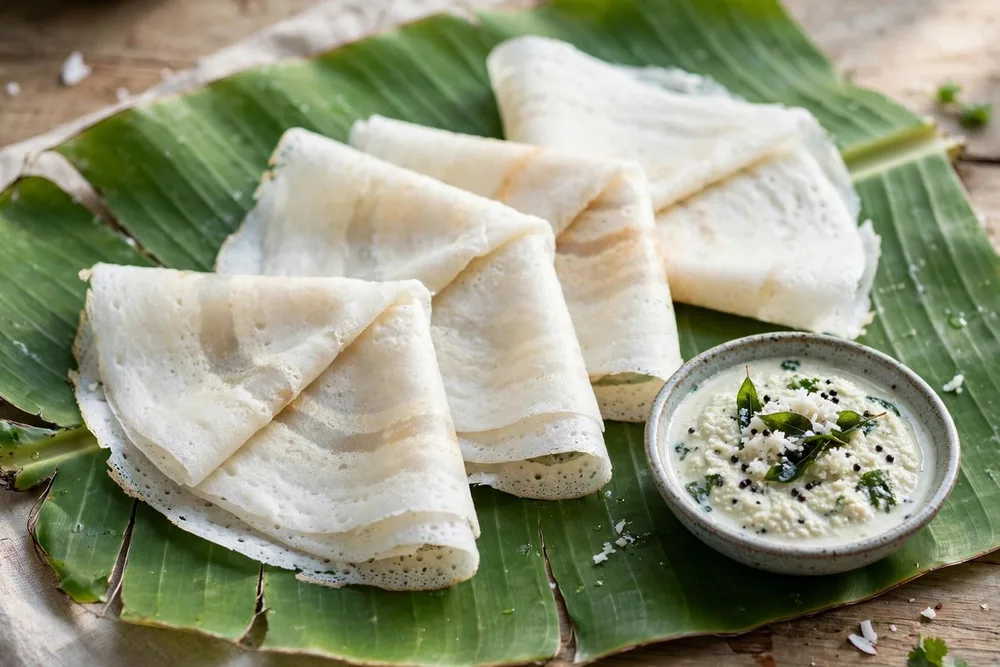
Fold into quarters and serve hot with chutney, or with chicken curry in the coastal style.
ℹ CCP = critical control point — the moment where getting it wrong spoils the dish or makes it unsafe.
Tips & Tricks + Common Mistakes to Avoid
- •Grind the batter very thin — that is the whole dish.
- •Stir between every dosa; settled rice gives a thick dosa.
- •Keep the heat medium — high heat browns the dosa and makes it crisp, which is wrong for neer dosa.
- •Thick batter — a heavy pancake, not a neer dosa.
- •Browning the dosa — it should stay white and soft.
- •Spreading with a ladle — the dosa tears.
Section 5 · Nutrition — (3 dosas (150 g)
Standard food-composition estimates derived from the raw ingredient list.
Energy
210 kcal
Avg: 259 kcal
Protein
6 g
Avg: 10 g
Carbohydrate
42 g
Avg: 33 g
Fat
2 g
Avg: 10 g
Fibre
1 g
Avg: 2 g
Sodium
310 mg
Avg: 434 mg
80%
42 g
11%
6 g
9%
2 g
Energy split: carbohydrate 80% · protein 11% · fat 9%.
Check: 6×4 + 42×4 + 2×9 = 210 kcal, shown as 210 kcal (rounded). Sodium 310 mg comes from 0.8 g salt per portion.
Section 6 · Fun Fact & Origin
Fun fact: Neer means water in Kannada — neer dosa is named for its batter, which is as thin as water. Origin: not documented — no reliable source found.
Section 7 · Regional Traditions
Neer dosa belongs to coastal Karnataka, served at breakfast with coconut chutney and, in the coastal style, with chicken curry. It is a tiffin-room favourite and a wedding-breakfast item, folded into quarters on a banana leaf.
Three Commercial Variations
Serve with coconut chutney and a small bowl of chicken curry for dipping.
Leave out the coconut and serve with sambar.
The recipe as written is already light — use minimal oil and serve with vegetable curry.
Production Intelligence & Banquet Logistics
Batch Yield
10 portions × 3 dosas = 30 dosas, about 1.5 kg.
Prep Schedule
soak and grind the rice 30 minutes before service; cook to order.
Portion Control
one ladle of batter per dosa; serve 3 per portion.
Holding Limits
cook to order. Neer dosas dry out within minutes of leaving the griddle.
- Yield: 10 portions × 3 dosas = 30 dosas, about 1.5 kg.
- Prep schedule: soak and grind the rice 30 minutes before service; cook to order.
- Portion control: one ladle of batter per dosa; serve 3 per portion.
- Holding: cook to order. Neer dosas dry out within minutes of leaving the griddle.
Food Safety, Allergens & Thermal Holding
Allergen Classification (Chapter 4 Matrix)
Contains — Nuts. Not present — Milk, Wheat, Egg, Fish, Soy, Mustard, Sesame. Diet: Veg.
Ingredient Costing, Pairings & Waste Reduction
Per Portion Cost
₹3.23
Cost per portion = (sum of ingredient quantity × rate) ÷ portions. Ingredient cost only — water, cooking fuel, transport, labour, and commercial overheads are not included. All rates are illustrative book planning benchmarks; replace with your live mandi rates.
Cost Driver Composition
Interactive Margin & Profit Simulator
Calibrate your catering client quote to verify commercial profit margins.
Quoted Revenue
₹1,500
Food Cost
₹323
Gross Profit
₹1,177
Profitable Menu Pairings
Kitchen Waste Reduction & Yield Strategy
Batter left over makes the next batch of dosas the same service. Torn dosas are served folded with chutney, never thrown away while fresh.