
Sambar
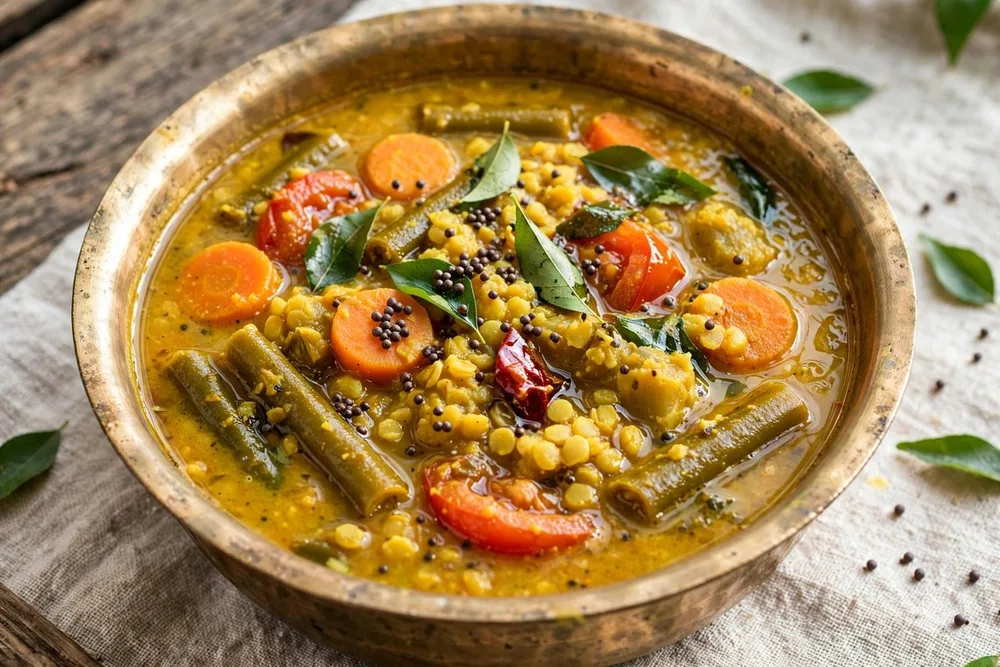
The lentil-and-vegetable stew that anchors every South Indian meal — toor dal, tamarind, vegetables and a fresh tempering.
Base Batch
10 Pax
150 ml
Prep / Cook
45m
30 min
Difficulty
easy
Commercial Standard
Cost / Portion
₹12.38
Illustrative Book Rate
Section 1 · At a Glance
Ingredients & Dynamic Pax Scaling Lab
Base formulated for 10 portions. Calibrate guest count, adjust catering buffer, or search specific ingredients below.
Batch Ingredient Cost
₹124
10 portions @ ₹12.38
Raw Batch Weight
~2.53 kg
Total raw commodities
Equipment Capacity
1 × GN 1/1
Standard chafing inserts
Scaling Factor
1.0× Base
10 Pax reference base
* Salt, spice, chilli and water do not scale perfectly — taste and adjust at every scale; never scale salt blindly.
* Scaling — linear from base 10 (×5, ×10, ×50). Above 1,000 g shown as kg; above 1,000 ml as L.
Step-by-Step Method & Critical Control Points (CCP)
Standard operating procedures with highlighted CCP warnings where execution failure compromises texture or food safety.
Soak the toor dal for 30 minutes. Pressure-cook it with the turmeric and 800 ml water until completely soft, then mash it smooth.
Boil the mixed vegetables and tomatoes in 400 ml water with salt until just tender.
Add the mashed dal, tamarind pulp, sambar powder and jaggery to the vegetables. Simmer 10 minutes — **⚠ CCP:** simmer, do not boil hard, or the dal separates and the vegetables turn to mush.
Heat the oil and temper the mustard seeds, cumin, dry red chillies, curry leaves and asafoetida until the mustard pops.
Pour the tempering over the sambar, add coriander leaves, cover and rest 5 minutes. Taste and adjust salt and tamarind.
ℹ CCP = critical control point — the moment where getting it wrong spoils the dish or makes it unsafe.
Tips & Tricks + Common Mistakes to Avoid
- •Mash the dal fully smooth — lumpy dal makes a thin, uneven sambar.
- •Add the tamarind after the dal, not before, or the dal will not soften.
- •A pinch of jaggery rounds the sourness without making the sambar sweet.
- •Boiling hard after adding dal — the sambar splits and thins.
- •Too much tamarind — sour enough to overpower the meal.
- •Old sambar powder — flat flavour; use fresh powder.
Section 5 · Nutrition — (150 ml)
Standard food-composition estimates derived from the raw ingredient list.
Energy
175 kcal
Avg: 259 kcal
Protein
7 g
Avg: 10 g
Carbohydrate
30 g
Avg: 33 g
Fat
3 g
Avg: 10 g
Fibre
1 g
Avg: 2 g
Sodium
580 mg
Avg: 434 mg
69%
30 g
16%
7 g
15%
3 g
Energy split: carbohydrate 69% · protein 16% · fat 15%.
Check: 7×4 + 30×4 + 3×9 = 175 kcal, shown as 175 kcal (rounded). Sodium 580 mg comes from 1.5 g salt per portion.
Section 6 · Fun Fact & Origin
Fun fact: Sambar is the dish that defines a South Indian meal — no tiffin or wedding lunch is complete without it, and every region argues its version is the right one. Origin: not documented — no reliable source found.
Section 7 · Regional Traditions
Sambar belongs to Tamil Nadu and is now cooked across all of South India. It is served with idli, dosa and pongal at breakfast and with rice at lunch, and at weddings it is the first gravy ladled over rice on the banana leaf.
Three Commercial Variations
Use drumstick and small onions, finish with a second tempering of ghee and curry leaves at the counter.
Use seasonal vegetables and a little less dal; the sambar powder and tempering carry the flavour.
Use more vegetables, less oil in the tempering, and skip the jaggery.
Production Intelligence & Banquet Logistics
Batch Yield
10 portions × 150 ml = 1.5 L, from 400 g dal + 600 g vegetables.
Prep Schedule
soak and cook the dal in the morning; cook the vegetables and finish the sambar in the last hour.
Portion Control
one 150 ml ladle per portion; weigh the first five ladles.
Holding Limits
hold hot and covered; stir every 20 minutes. It thickens on holding — loosen with hot water.
- Yield: 10 portions × 150 ml = 1.5 L, from 400 g dal + 600 g vegetables.
- Prep schedule: soak and cook the dal in the morning; cook the vegetables and finish the sambar in the last hour.
- Portion control: one 150 ml ladle per portion; weigh the first five ladles.
- Holding: hold hot and covered; stir every 20 minutes. It thickens on holding — loosen with hot water.
Food Safety, Allergens & Thermal Holding
Allergen Classification (Chapter 4 Matrix)
Contains — Mustard. Not present — Milk, Wheat, Egg, Fish, Nuts, Soy, Sesame. Diet: Veg.
Ingredient Costing, Pairings & Waste Reduction
Per Portion Cost
₹12.38
Cost per portion = (sum of ingredient quantity × rate) ÷ portions. Ingredient cost only — water, cooking fuel, transport, labour, and commercial overheads are not included. All rates are illustrative book planning benchmarks; replace with your live mandi rates.
Cost Driver Composition
Interactive Margin & Profit Simulator
Calibrate your catering client quote to verify commercial profit margins.
Quoted Revenue
₹3,700
Food Cost
₹1,238
Gross Profit
₹2,462
Profitable Menu Pairings
Kitchen Waste Reduction & Yield Strategy
Vegetable trimmings and drumstick pieces go into the next day's sambar stock. Sambar left over is thinned and served as rasam-style soup for staff meals the same day.