
Chettinad Chicken Curry
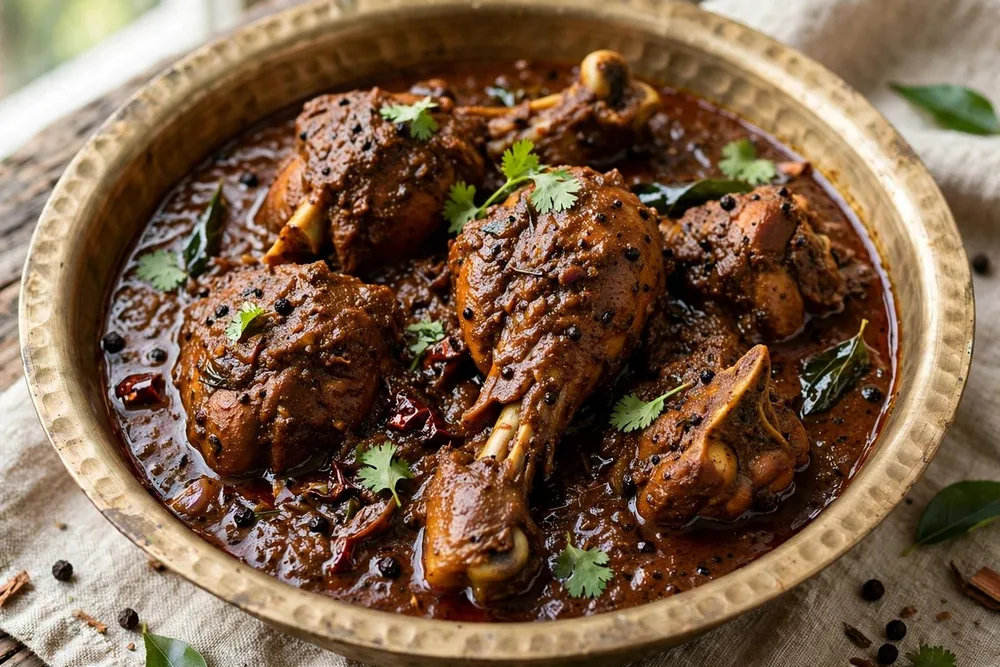
Fiery, peppery chicken curry from Chettinad — roasted spices, black pepper and a dark, fragrant gravy.
Base Batch
10 Pax
200 g
Prep / Cook
70m
40 min
Difficulty
medium–high
Commercial Standard
Cost / Portion
₹56.94
Illustrative Book Rate
Section 1 · At a Glance
Ingredients & Dynamic Pax Scaling Lab
Base formulated for 10 portions. Calibrate guest count, adjust catering buffer, or search specific ingredients below.
Batch Ingredient Cost
₹569
10 portions @ ₹56.94
Raw Batch Weight
~2.38 kg
Total raw commodities
Equipment Capacity
1 × GN 1/1
Standard chafing inserts
Scaling Factor
1.0× Base
10 Pax reference base
* Salt, spice, chilli and water do not scale perfectly — taste and adjust at every scale; never scale salt blindly.
* Scaling — linear from base 10 (×5, ×10, ×50). Above 1,000 g shown as kg; above 1,000 ml as L.
Step-by-Step Method & Critical Control Points (CCP)
Standard operating procedures with highlighted CCP warnings where execution failure compromises texture or food safety.
Marinate the chicken with curd, turmeric and half the salt for 30 minutes.
Dry-roast the peppercorns, cumin, coriander seeds, dry red chillies, fennel, cinnamon, cloves and cardamom until fragrant. Cool and grind to a powder — **⚠ CCP:** roast on medium heat and stop the moment the spices smell fragrant; burnt spices make the curry bitter.
Heat the oil, fry the onions until deep golden, then add ginger-garlic paste and curry leaves and fry until the raw smell goes.
Add the tomatoes and cook until they break down and the oil separates.
Add the marinated chicken and the ground masala. Cook on high heat for 5 minutes, then cover and simmer 25–30 minutes until the chicken is tender and the gravy is dark and thick. Taste and adjust salt.
Rest 10 minutes, garnish with coriander leaves and serve hot.
ℹ CCP = critical control point — the moment where getting it wrong spoils the dish or makes it unsafe.
Tips & Tricks + Common Mistakes to Avoid
- •Roast the spices fresh for every batch — pre-ground masala is never as fragrant.
- •Fry the onions deep golden; pale onions give a pale, sweet gravy.
- •Resting the curry before service lets the flavours settle.
- •Burnt roasted spices — bitter curry, no fix.
- •Too much water — a thin gravy that will not coat the chicken.
- •Undercooked bone-in chicken — check the thickest piece.
Section 5 · Nutrition — (200 g)
Standard food-composition estimates derived from the raw ingredient list.
Energy
330 kcal
Avg: 259 kcal
Protein
24 g
Avg: 10 g
Carbohydrate
18 g
Avg: 33 g
Fat
18 g
Avg: 10 g
Fibre
4 g
Avg: 2 g
Sodium
580 mg
Avg: 434 mg
22%
18 g
29%
24 g
49%
18 g
Energy split: carbohydrate 22% · protein 29% · fat 49%.
Check: 24×4 + 18×4 + 18×9 = 330 kcal, shown as 330 kcal (rounded). Sodium 580 mg comes from 1.5 g salt per portion.
Section 6 · Fun Fact & Origin
Fun fact: Chettinad cooking comes from the Chettiar merchant community of Tamil Nadu — famous for roasted spices, black pepper and curries that are hot without being only about chilli. The Chettinad association is widely documented; no single inventor or date is recorded. Origin: not documented — no reliable source found for a single place, person or date of first creation.
Section 7 · Regional Traditions
Chettinad chicken curry is Tamil Nadu's most famous non-vegetarian curry, served at weddings and festivals with rice, parotta or dosa. It is the dish guests name when they ask for a Chettinad menu, and its heat is balanced on the plate by curd rice or raita.
Three Commercial Variations
Use country chicken and finish with a spoon of ghee and extra cracked pepper at the counter.
Use bone-in broiler chicken and stretch the gravy with a little more onion and tomato.
Use skinless chicken, keep the oil to one tablespoon per 10 portions, and serve with steamed rice.
Production Intelligence & Banquet Logistics
Batch Yield
10 portions × 200 g = 2.0 kg, from 1.5 kg chicken.
Prep Schedule
roast and grind the masala and marinate the chicken the evening before; cook on the day and rest before service.
Portion Control
one weighed 200 g scoop with 2–3 pieces of chicken per portion.
Holding Limits
hold hot and covered; stir every 20 minutes. The curry improves on a short hold — make it an hour before service, not the day before.
- Yield: 10 portions × 200 g = 2.0 kg, from 1.5 kg chicken.
- Prep schedule: roast and grind the masala and marinate the chicken the evening before; cook on the day and rest before service.
- Portion control: one weighed 200 g scoop with 2–3 pieces of chicken per portion.
- Holding: hold hot and covered; stir every 20 minutes. The curry improves on a short hold — make it an hour before service, not the day before.
Food Safety, Allergens & Thermal Holding
Allergen Classification (Chapter 4 Matrix)
Contains — Milk. Not present — Wheat, Egg, Fish, Nuts, Soy, Mustard, Sesame. Diet: Non-veg.
Ingredient Costing, Pairings & Waste Reduction
Per Portion Cost
₹56.94
Cost per portion = (sum of ingredient quantity × rate) ÷ portions. Ingredient cost only — water, cooking fuel, transport, labour, and commercial overheads are not included. All rates are illustrative book planning benchmarks; replace with your live mandi rates.
Cost Driver Composition
Interactive Margin & Profit Simulator
Calibrate your catering client quote to verify commercial profit margins.
Quoted Revenue
₹17,100
Food Cost
₹5,694
Gross Profit
₹11,406
Profitable Menu Pairings
Kitchen Waste Reduction & Yield Strategy
Chicken bones and trimmings make stock for the next gravy. Leftover curry is shredded into sandwiches or rolls for staff meals the same day — never served again as a main.