
Malabar Parotta
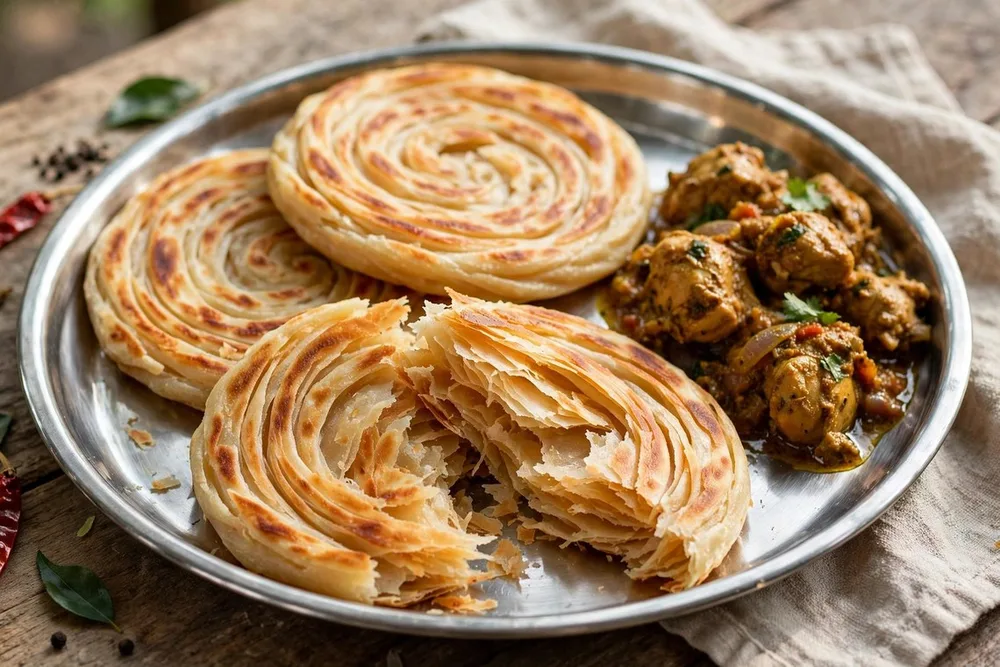
Flaky, layered flatbread from the Malabar coast — stretched thin, folded and beaten soft, made for scooping up curry.
Base Batch
10 Pax
2 parottas (160 g)
Prep / Cook
170m
20 min
Difficulty
advanced
Commercial Standard
Cost / Portion
₹4.97
Illustrative Book Rate
Section 1 · At a Glance
Ingredients & Dynamic Pax Scaling Lab
Base formulated for 10 portions. Calibrate guest count, adjust catering buffer, or search specific ingredients below.
Batch Ingredient Cost
₹50
10 portions @ ₹4.97
Raw Batch Weight
~0.98 kg
Total raw commodities
Equipment Capacity
1 × GN 1/1
Standard chafing inserts
Scaling Factor
1.0× Base
10 Pax reference base
* Salt, spice, chilli and water do not scale perfectly — taste and adjust at every scale; never scale salt blindly.
* Scaling — linear from base 10 (×5, ×10, ×50). Above 1,000 g shown as kg; above 1,000 ml as L.
Step-by-Step Method & Critical Control Points (CCP)
Standard operating procedures with highlighted CCP warnings where execution failure compromises texture or food safety.
Mix the maida, salt, sugar, egg and water into a soft dough. Knead for 10 minutes until smooth and elastic, then coat with oil.
Rest the dough covered for 2 hours — **⚠ CCP:** a short rest makes a dough that tears when stretched; the full rest is what lets it stretch paper-thin.
Divide into balls. Oil the work surface, flatten a ball, then stretch it by hand into a large, thin sheet — so thin you can almost see through it.
Fold the sheet into pleats, roll it into a spiral, flatten gently and roll out to a round.
Cook on a hot griddle with a little oil or ghee until golden spots appear on both sides. Clap the hot parotta between your palms to open the layers. Serve hot.
ℹ CCP = critical control point — the moment where getting it wrong spoils the dish or makes it unsafe.
Tips & Tricks + Common Mistakes to Avoid
- •Rest the dough the full 2 hours — it is the whole secret.
- •Oil the surface well; a dry surface tears the sheet.
- •Clap the parotta while it is hot, or the layers stick together.
- •Short rest — dough that tears instead of stretching.
- •Rolling too thick — a heavy, bread-like parotta with no layers.
- •Skipping the clap — the layers never open.
Section 5 · Nutrition — (2 parottas (160 g)
Standard food-composition estimates derived from the raw ingredient list.
Energy
295 kcal
Avg: 259 kcal
Protein
10 g
Avg: 10 g
Carbohydrate
52 g
Avg: 33 g
Fat
5 g
Avg: 10 g
Fibre
2 g
Avg: 2 g
Sodium
310 mg
Avg: 434 mg
71%
52 g
14%
10 g
15%
5 g
Energy split: carbohydrate 71% · protein 14% · fat 15%.
Check: 10×4 + 52×4 + 5×9 = 293 kcal, shown as 295 kcal (rounded). Sodium 310 mg comes from 0.8 g salt per portion.
Section 6 · Fun Fact & Origin
Fun fact: Malabar parotta is the layered bread of Kerala's coast — stretched, pleated and beaten, so it flakes apart in the hand. Origin: not documented — no reliable source found.
Section 7 · Regional Traditions
Malabar parotta belongs to Kerala's Malabar coast, served with chicken curry, beef fry and egg curry at weddings and festivals. It is cooked live at a counter so guests watch the dough stretched and the hot parotta clapped open.
Three Commercial Variations
Brush with ghee and serve with a bowl of chicken curry for dipping.
Use oil instead of ghee and skip the egg; the layers still form.
Use half whole-wheat flour and cook with minimal oil.
Production Intelligence & Banquet Logistics
Batch Yield
10 portions × 2 parottas = 20 parottas, about 1.6 kg, from 600 g maida.
Prep Schedule
knead and rest the dough in the morning; roll and cook to order in the last hour before service.
Portion Control
one weighed dough ball per parotta; serve 2 per portion.
Holding Limits
cook to order. Parottas dry out and toughen within 20 minutes of cooking.
- Yield: 10 portions × 2 parottas = 20 parottas, about 1.6 kg, from 600 g maida.
- Prep schedule: knead and rest the dough in the morning; roll and cook to order in the last hour before service.
- Portion control: one weighed dough ball per parotta; serve 2 per portion.
- Holding: cook to order. Parottas dry out and toughen within 20 minutes of cooking.
Food Safety, Allergens & Thermal Holding
Allergen Classification (Chapter 4 Matrix)
Contains — Milk, Wheat, Egg. Not present — Fish, Nuts, Soy, Mustard, Sesame. Diet: Veg.
Ingredient Costing, Pairings & Waste Reduction
Per Portion Cost
₹4.97
Cost per portion = (sum of ingredient quantity × rate) ÷ portions. Ingredient cost only — water, cooking fuel, transport, labour, and commercial overheads are not included. All rates are illustrative book planning benchmarks; replace with your live mandi rates.
Cost Driver Composition
Interactive Margin & Profit Simulator
Calibrate your catering client quote to verify commercial profit margins.
Quoted Revenue
₹1,500
Food Cost
₹497
Gross Profit
₹1,003
Profitable Menu Pairings
Kitchen Waste Reduction & Yield Strategy
Dough balls left over are rolled and cooked for staff meals. Parottas that tear are served as kothu parotta — chopped and tossed with curry — rather than thrown away.