
Misal Pav
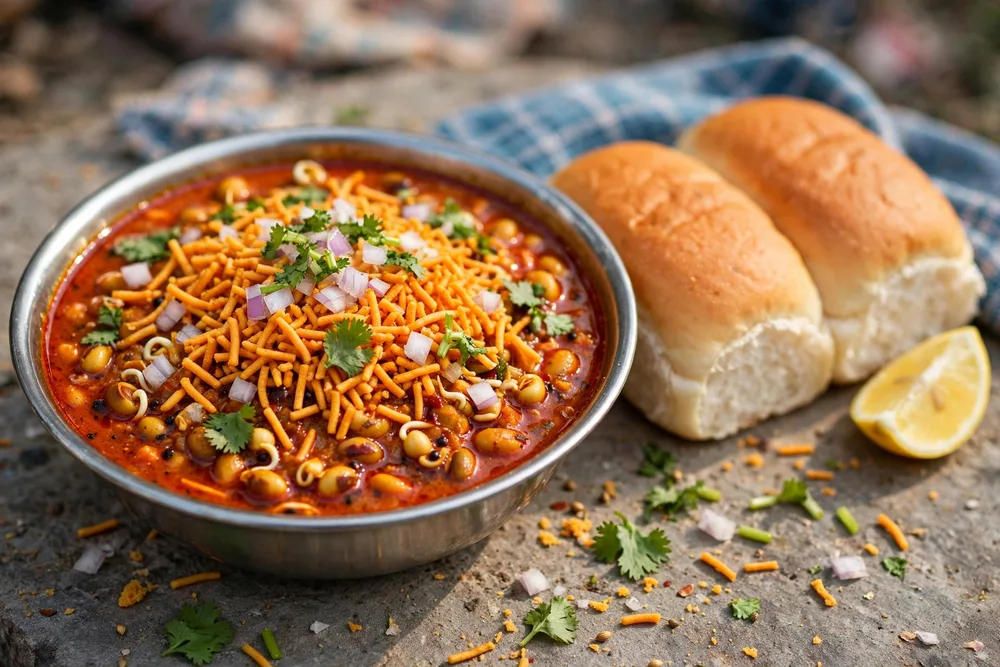
Kolhapur's fiery sprouted-bean curry, topped with farsan and onion, mopped up with soft pav — Maharashtra's loudest breakfast.
Base Batch
10 Pax
300 g (200 g misal + 2 pav)
Prep / Cook
65m
45 min
Difficulty
medium
Commercial Standard
Cost / Portion
₹25.88
Illustrative Book Rate
Section 1 · At a Glance
Ingredients & Dynamic Pax Scaling Lab
Base formulated for 10 portions. Calibrate guest count, adjust catering buffer, or search specific ingredients below.
Batch Ingredient Cost
₹259
10 portions @ ₹25.88
Raw Batch Weight
~2.48 kg
Total raw commodities
Equipment Capacity
1 × GN 1/1
Standard chafing inserts
Scaling Factor
1.0× Base
10 Pax reference base
* Scaling — linear from base 10 (×5, ×10, ×50). Above 1,000 g shown as kg; above 1,000 ml as L. Sprouts: start 200 g dry
* matki/moong per 10 portions — sprouting roughly triples the weight. For 50+ portions, cook the usal in separate 50-portion vessels so the sprouts cook evenly.
Step-by-Step Method & Critical Control Points (CCP)
Standard operating procedures with highlighted CCP warnings where execution failure compromises texture or food safety.
Sprout the beans. Soak matki or moong overnight, drain, and keep in a covered cloth for 8–12 hours until short sprouts appear. **⚠ CCP—** sprouting: rinse twice while sprouting; sour-smelling or slimy sprouts must be discarded.
Temper. Heat the oil; add mustard seeds, then cumin, then ginger-garlic paste; fry until the raw smell goes.
Build the base. Add the 300 g onions and cook until soft and golden. Add tomatoes, misal masala, chilli powder, turmeric and salt; cook until the oil separates at the edges.
Cook the usal. Add the sprouts and the 800 ml water. Bring to the boil, then simmer covered 20–25 minutes until the sprouts are soft but still hold their shape. **⚠ CCP—** texture: soft sprouts in a thin, spicy gravy (tarri); if the sprouts turn to mush, the misal is spoilt.
Check the gravy. The usal should be thinner than a dal — guests ladle the gravy (tarri) over the top at the counter. Add hot water if it has thickened.
Assemble. Ladle 200 g usal into a bowl, top with farsan, the topping onion and coriander. Serve with 2 pav and a lemon wedge. Done when: sprouts soft, gravy thin and fiery, farsan still crisp on top.
ℹ CCP = critical control point — the moment where getting it wrong spoils the dish or makes it unsafe.
Tips & Tricks + Common Mistakes to Avoid
- •Sprout at home the day before — bought sprouts vary, and stale sprouts spoil the dish.
- •Keep the gravy thin; thick misal eats like a dal and guests will ask for the tarri.
- •Top the farsan at the counter, never in the kitchen — it goes soggy in minutes.
- •Overcooking the sprouts — they turn to mush and the misal loses its bite.
- •Too little water — a thick usal with no tarri to ladle over.
- •Adding farsan too early — it soaks, softens and the topping is lost.
Section 5 · Nutrition — (300 g (200 g misal + 2 pav)
Standard food-composition estimates derived from the raw ingredient list.
Energy
392 kcal
Avg: 259 kcal
Protein
14 g
Avg: 10 g
Carbohydrate
52 g
Avg: 33 g
Fat
14 g
Avg: 10 g
Fibre
8 g
Avg: 2 g
Sodium
780 mg
Avg: 434 mg
53%
52 g
14%
14 g
32%
14 g
Energy split: carbohydrate 53% · protein 14% · fat 32%.
Check: 14×4 + 52×4 + 14×9 = 390 kcal, stated 392 kcal (rounded estimate).
Section 6 · Fun Fact & Origin
Misal means 'mixture' in Marathi — and the dish is exactly that: sprouted beans, gravy, farsan, onion and lemon, mixed by the guest at the table. Misal pav is widely documented as a Maharashtrian dish, from Kolhapur and Pune; the Kolhapuri version is the spiciest. Origin: not documented — no single inventor reliably recorded.
Section 7 · Regional Traditions
Misal pav belongs to Maharashtra, where it is a breakfast, a lunch and a late-night snack all at once. In Kolhapur it is the city's signature dish, served at dedicated misal houses with the tarri on the side; in Pune it is the working breakfast.
Three Commercial Variations
Offer two tarris — a mild one and a fiery Kolhapuri one — and top with a spoon of beaten curd.
Use moong sprouts only (cheaper than matki) and halve the farsan to 100 g, topped up with plain sev. Saves about ₹1.50 per portion (see §11).
Cut the oil to 30 ml, use moong sprouts only, and serve one pav instead of two with extra onion and lemon.
Production Intelligence & Banquet Logistics
Batch Yield
10 portions × 200 g usal = 2.0 kg usal, plus 20 pav.
Prep Schedule
Standard prep
Portion Control
one level 200 ml ladle of usal + a 20 g scoop of farsan per bowl; count two pav per portion. Weigh the first five ladles.
Holding Limits
Hot hold 65°C
- Yield: 10 portions × 200 g usal = 2.0 kg usal, plus 20 pav.
- Prep schedule (100 portions): sprout the beans a day ahead; cook the usal the morning of the event in two 50-portion vessels; set the topping station (farsan, onion, coriander, lemon) before service opens.
- Portion control: one level 200 ml ladle of usal + a 20 g scoop of farsan per bowl; count two pav per portion. Weigh the first five ladles.
- Holding and service risks: hold the usal covered and hot, replenish in small batches, and top up the tarri. Keep the farsan dry and separate; never top up a nearly empty vessel, finish the old batch first.
Food Safety, Allergens & Thermal Holding
Allergen Classification (Chapter 4 Matrix)
Contains — Wheat, Mustard. Not present — Milk, Egg, Fish, Nuts, Soy, Sesame. Diet: Veg.
Ingredient Costing, Pairings & Waste Reduction
Per Portion Cost
₹25.88
Cost per portion = (sum of ingredient quantity × rate) ÷ portions. Ingredient cost only — water, cooking fuel, transport, labour, and commercial overheads are not included. All rates are illustrative book planning benchmarks; replace with your live mandi rates.
Cost Driver Composition
Interactive Margin & Profit Simulator
Calibrate your catering client quote to verify commercial profit margins.
Quoted Revenue
₹7,800
Food Cost
₹2,588
Gross Profit
₹5,212
Profitable Menu Pairings
Kitchen Waste Reduction & Yield Strategy
The biggest waste is usal cooked ahead and thickening, and farsan gone soggy. Cook the usal in batches matched to the queue, keep the tarri thin with hot water, and top farsan only at the counter.