
Kanda Poha
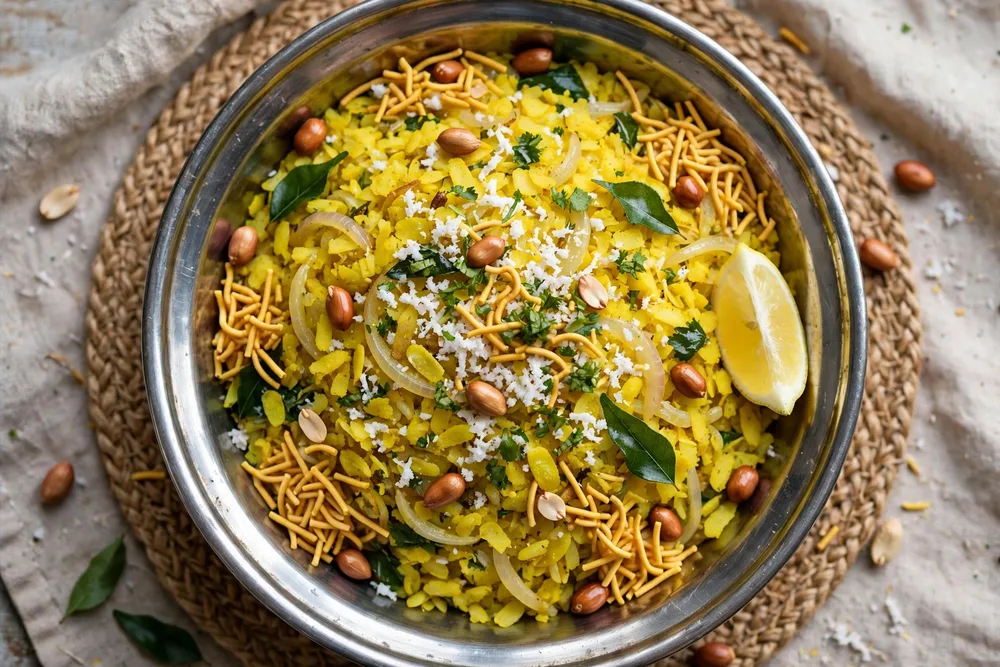
Maharashtra's everyday breakfast — flattened rice tossed with onion, peanuts and curry leaves, light, lemony and quick.
Base Batch
10 Pax
175 g
Prep / Cook
30m
15 min
Difficulty
easy–medium
Commercial Standard
Cost / Portion
₹7.68
Illustrative Book Rate
Section 1 · At a Glance
Ingredients & Dynamic Pax Scaling Lab
Base formulated for 10 portions. Calibrate guest count, adjust catering buffer, or search specific ingredients below.
Batch Ingredient Cost
₹77
10 portions @ ₹7.68
Raw Batch Weight
~1.07 kg
Total raw commodities
Equipment Capacity
1 × GN 1/1
Standard chafing inserts
Scaling Factor
1.0× Base
10 Pax reference base
* Scaling — linear from base 10 (×5, ×10, ×50). Above 1,000 g shown as kg; above 1,000 ml as L. For 50+ portions, rinse and
* rest the poha in separate 50-portion bowls — one large bowl soaks unevenly and the bottom turns to mush.
Step-by-Step Method & Critical Control Points (CCP)
Standard operating procedures with highlighted CCP warnings where execution failure compromises texture or food safety.
Rinse the poha. Put the poha in a colander, rinse once under running water, drain fully, and rest 10 minutes. **⚠ CCP—** water: rinse, do not soak. Soaked poha turns to mush; correctly rinsed poha is soft but each flake stays separate.
Fry the peanuts. Heat the oil; fry the peanuts until golden and crisp, lift out and set aside.
Temper. In the same oil add mustard seeds; when they pop, add cumin, green chillies and curry leaves. Fry about 30 seconds until fragrant.
Cook the onion. Add the onions and cook 3–4 minutes until soft and translucent — not browned.
Add the poha. Add turmeric, salt and sugar, then the poha. Toss with two spoons — do not stir hard or the flakes break. **⚠ CCP—** mixing: fold, never mash. Cover and steam on low heat 3–4 minutes.
Finish. Turn off the heat, add lemon juice, the fried peanuts, coriander and coconut. Toss once. Done when: flakes soft and separate, yellow all through, lemony, no raw-onion bite.
Serve. 175 g per portion, topped with sev. Serve hot — poha dries out fast if held.
ℹ CCP = critical control point — the moment where getting it wrong spoils the dish or makes it unsafe.
Tips & Tricks + Common Mistakes to Avoid
- •Use thick poha, never thin — thin poha dissolves on rinsing.
- •Rinse once and drain well; the flakes soften in the 10-minute rest, not in water.
- •Add the lemon off the heat so it stays bright and does not turn bitter.
- •Soaking the poha — the commonest failure; it becomes a sticky lump.
- •Stirring hard with a ladle — the flakes break and the dish turns pasty.
- •Holding too long uncovered — poha dries, hardens and is thrown away.
Section 5 · Nutrition — (175 g)
Standard food-composition estimates derived from the raw ingredient list.
Energy
235 kcal
Avg: 259 kcal
Protein
5 g
Avg: 10 g
Carbohydrate
38 g
Avg: 33 g
Fat
7 g
Avg: 10 g
Fibre
3 g
Avg: 2 g
Sodium
420 mg
Avg: 434 mg
65%
38 g
9%
5 g
27%
7 g
Energy split: carbohydrate 65% · protein 9% · fat 27%.
Check: 5×4 + 38×4 + 7×9 = 235 kcal, stated 235 kcal (rounded estimate).
Section 6 · Fun Fact & Origin
Poha is the breakfast of Maharashtra and Madhya Pradesh, and the word itself comes from the flattened rice it is made of — rice paddy pounded flat, then dried, so it cooks in minutes with just a rinse. Origin: not documented — no reliable source found for a single inventor, place or date.
Section 7 · Regional Traditions
Kanda poha — poha with onion (kanda) — is the standard Maharashtrian breakfast, served at home, in offices and at wedding breakfasts across Maharashtra. It is fast, cheap and light, and it travels well to a buffet because it needs no gravy and no reheating to order.
Three Commercial Variations
Add 100 g boiled potato and 50 g peas; finish with extra coconut and a lemon wedge.
Halve the peanuts to 40 g and leave out the sev and coconut. Keep the mustard tempering and lemon — they carry the flavour. Saves about ₹1.10 per portion (see §11).
Add 100 g mixed vegetables (peas, carrot, beans) and cut the oil to 30 ml.
Production Intelligence & Banquet Logistics
Batch Yield
10 portions × 175 g = about 1.75 kg from 500 g poha + 250 g onion + water absorbed in rinsing.
Prep Schedule
Standard prep
Portion Control
one level 175 ml ladle = one 175 g portion. Weigh the first five portions.
Holding Limits
Hot hold 65°C
- Yield: 10 portions × 175 g = about 1.75 kg from 500 g poha + 250 g onion + water absorbed in rinsing.
- Prep schedule (100 portions): chop onions and measure peanuts the evening before; rinse and cook the poha in two 50-portion kadhais in the morning, finishing each separately.
- Portion control: one level 175 ml ladle = one 175 g portion. Weigh the first five portions.
- Holding and service risks: serve fresh in small replenished batches — it dries and hardens if held. Hold covered, replenish every 20 minutes, and keep the sev in a separate bowl so it stays crisp.
Food Safety, Allergens & Thermal Holding
Allergen Classification (Chapter 4 Matrix)
Contains — Nuts, Mustard. Not present — Milk, Wheat, Egg, Fish, Soy, Sesame. Diet: Veg.
Ingredient Costing, Pairings & Waste Reduction
Per Portion Cost
₹7.68
Cost per portion = (sum of ingredient quantity × rate) ÷ portions. Ingredient cost only — water, cooking fuel, transport, labour, and commercial overheads are not included. All rates are illustrative book planning benchmarks; replace with your live mandi rates.
Cost Driver Composition
Interactive Margin & Profit Simulator
Calibrate your catering client quote to verify commercial profit margins.
Quoted Revenue
₹2,300
Food Cost
₹768
Gross Profit
₹1,532
Profitable Menu Pairings
Kitchen Waste Reduction & Yield Strategy
The biggest waste is a batch dried out from holding. Cook in small batches matched to the queue and track portions sold against portions cooked each morning — a 10-portion overcook is 1.75 kg, a 100-portion overcook is 17.5 kg.