
Dhokla
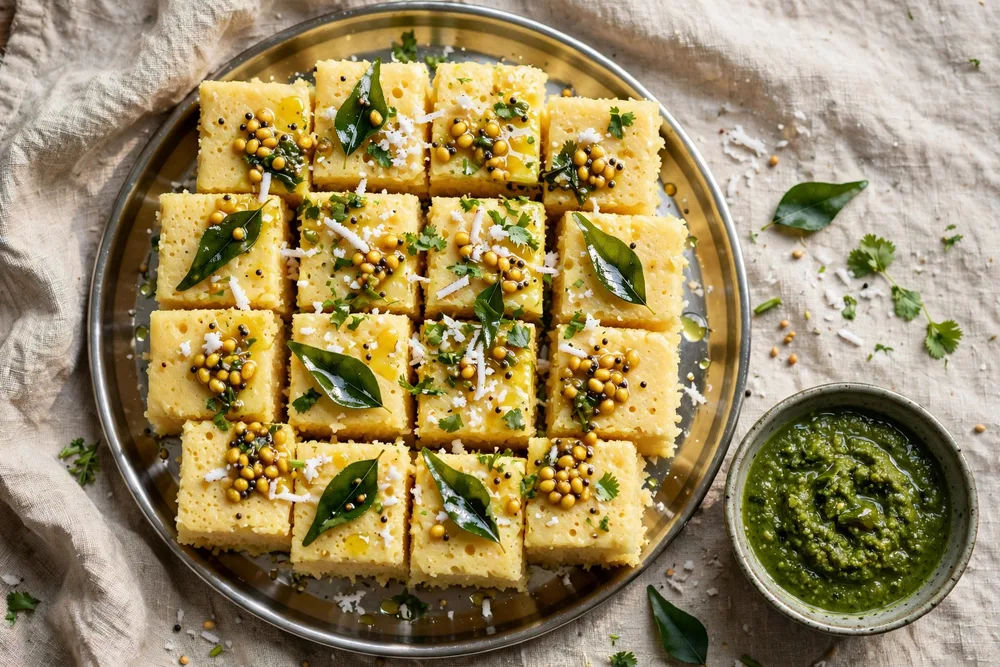
Gujarat's soft, spongy steamed savoury cake — light, lemony, and gone from the tray before the tea is poured.
Base Batch
10 Pax
150 g (3 pieces)
Prep / Cook
40m
20 min
Difficulty
medium
Commercial Standard
Cost / Portion
₹6.13
Illustrative Book Rate
Section 1 · At a Glance
Ingredients & Dynamic Pax Scaling Lab
Base formulated for 10 portions. Calibrate guest count, adjust catering buffer, or search specific ingredients below.
Batch Ingredient Cost
₹61
10 portions @ ₹6.13
Raw Batch Weight
~1.14 kg
Total raw commodities
Equipment Capacity
1 × GN 1/1
Standard chafing inserts
Scaling Factor
1.0× Base
10 Pax reference base
* Scaling — linear from base 10 (×5, ×10, ×50). Above 1,000 g shown as kg; above 1,000 ml as L. For 50+ portions, steam in
* separate 50-portion trays — one deep tray steams unevenly and the centre stays raw. Add the Eno to each tray's batter just before steaming, never to the whole bulk batch at once.
Step-by-Step Method & Critical Control Points (CCP)
Standard operating procedures with highlighted CCP warnings where execution failure compromises texture or food safety.
Make the batter. Whisk besan, curd, sugar, salt, turmeric, ginger-green chilli paste, lemon juice and the 300 ml water to a smooth, lump-free batter. Rest 30 minutes.
Prepare the steamer. Grease a tray and bring it to a full boil before the batter goes in.
Add the Eno. Stir the Eno into the batter and mix briskly for 30 seconds. **⚠ CCP—** timing: the batter must go into the steamer within a minute of adding the Eno, or the rise is lost.
Steam. Pour into the greased tray, about 2 cm deep, and steam on high heat 15–18 minutes. **⚠ CCP—** doneness: a knife or skewer comes out clean and the top springs back when pressed.
Rest, then cut. Rest 5 minutes, then cut into 30 squares (3 per portion).
Temper. Heat the oil; add mustard seeds, then sesame, green chillies and curry leaves. Add the 100 ml water and 10 g sugar, bring to a boil, and pour evenly over the cut dhokla. Garnish with coriander and coconut. Done when: soft, spongy and moist, lemony, tempering visible on top.
Serve. 3 pieces per portion with green chutney. Serve warm, never straight from the fridge.
ℹ CCP = critical control point — the moment where getting it wrong spoils the dish or makes it unsafe.
Tips & Tricks + Common Mistakes to Avoid
- •Whisk the batter lump-free before resting; lumps stay as hard spots after steaming.
- •Have the steamer at a full boil before adding the Eno — a cold start gives a dense dhokla.
- •Pour the tempering water over the cut pieces, not the whole slab, so it soaks evenly.
- •Adding Eno too early — the batter rises in the bowl and falls in the steamer.
- •Too little steaming time — the centre stays raw and sticky.
- •Skipping the tempering water — the dhokla dries out within the hour.
Section 5 · Nutrition — (150 g (3 pieces)
Standard food-composition estimates derived from the raw ingredient list.
Energy
212 kcal
Avg: 259 kcal
Protein
8 g
Avg: 10 g
Carbohydrate
30 g
Avg: 33 g
Fat
6 g
Avg: 10 g
Fibre
3 g
Avg: 2 g
Sodium
480 mg
Avg: 434 mg
58%
30 g
16%
8 g
26%
6 g
Energy split: carbohydrate 58% · protein 16% · fat 26%.
Check: 8×4 + 30×4 + 6×9 = 206 kcal, stated 212 kcal (rounded estimate).
Section 6 · Fun Fact & Origin
Khaman dhokla is made from besan, not from fermented rice and dal like its cousin idli — the rise comes from the Eno fruit salt added at the last minute, which is why the batter has to go into the steamer within a minute. Origin: not documented — no reliable source found for a single inventor, place or date.
Section 7 · Regional Traditions
Dhokla belongs to Gujarat, where it is the tea-time snack and the corporate-snack tray — light enough for a morning meeting, substantial enough for a wedding breakfast. It is steamed, not fried, which is why it suits large vegetarian buffets and health-conscious guests.
Three Commercial Variations
Steam in small individual moulds, top each piece with a spoon of green chutney and a pomegranate seed.
Leave out the coconut garnish and halve the sesame to 4 g. Keep the Eno and the tempering water — they make the dhokla. Saves about ₹0.30 per portion (see §11).
Cut the sugar in the batter to 10 g and the tempering sugar to 5 g.
Production Intelligence & Banquet Logistics
Batch Yield
30 pieces × about 50 g = about 1.5 kg from 400 g besan + 150 g curd + water.
Prep Schedule
Standard prep
Portion Control
cut each tray into 30 equal squares and count 3 per portion.
Holding Limits
Hot hold 65°C
- Yield: 30 pieces × about 50 g = about 1.5 kg from 400 g besan + 150 g curd + water.
- Prep schedule (100 portions): whisk the batter the morning of the event; steam in two 50-portion trays back to back, tempering each tray as it comes out.
- Portion control: cut each tray into 30 equal squares and count 3 per portion.
- Holding and service risks: serve fresh in small replenished batches — it dries out if held uncovered. Hold covered, replenish every 30 minutes, and keep the green chutney topped up.
Food Safety, Allergens & Thermal Holding
Allergen Classification (Chapter 4 Matrix)
Contains — Milk, Nuts, Mustard, Sesame. Not present — Wheat, Egg, Fish, Soy. Diet: Veg.
Ingredient Costing, Pairings & Waste Reduction
Per Portion Cost
₹6.13
Cost per portion = (sum of ingredient quantity × rate) ÷ portions. Ingredient cost only — water, cooking fuel, transport, labour, and commercial overheads are not included. All rates are illustrative book planning benchmarks; replace with your live mandi rates.
Cost Driver Composition
Interactive Margin & Profit Simulator
Calibrate your catering client quote to verify commercial profit margins.
Quoted Revenue
₹1,800
Food Cost
₹613
Gross Profit
₹1,187
Profitable Menu Pairings
Kitchen Waste Reduction & Yield Strategy
The biggest waste is a tray dried out from holding, or a batch that fell because the Eno went in too early. Steam to the queue in 50-portion trays and temper each tray as it comes out.