
Butter Chicken
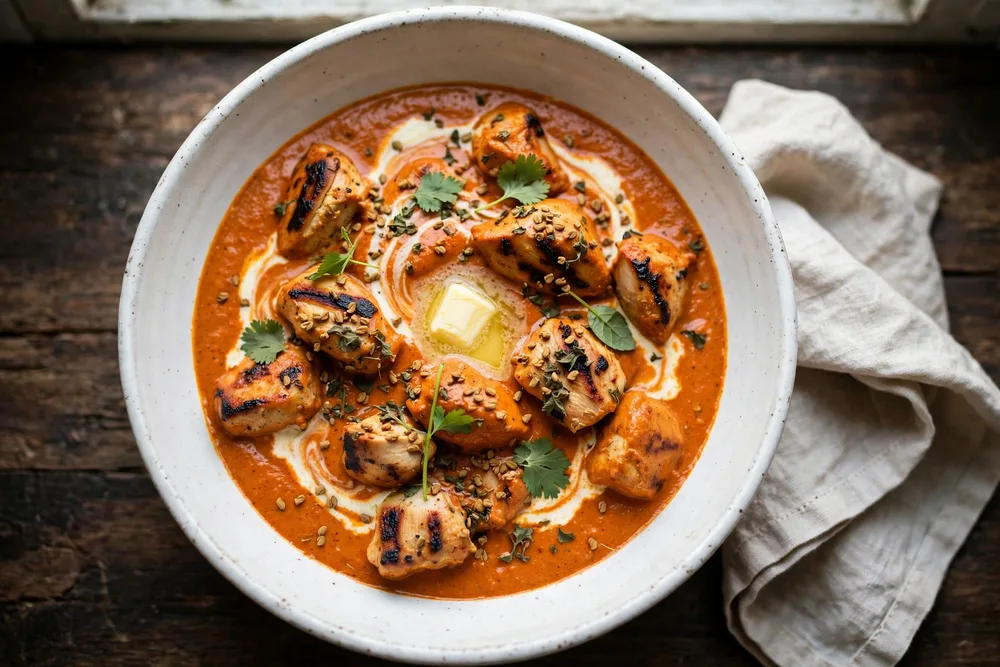
Charred tandoori chicken simmered in a silky tomato, butter and cream gravy. The Delhi restaurant classic and the premium non-vegetarian main on North Indian wedding menus.
Base Batch
10 Pax
250 g (chicken + gravy)
Prep / Cook
330m
1 hour
Difficulty
medium–high
Commercial Standard
Cost / Portion
₹81.27
Illustrative Book Rate
Section 1 · At a Glance
Ingredients & Dynamic Pax Scaling Lab
Base formulated for 10 portions. Calibrate guest count, adjust catering buffer, or search specific ingredients below.
Batch Ingredient Cost
₹813
10 portions @ ₹81.27
Raw Batch Weight
~3.92 kg
Total raw commodities
Equipment Capacity
1 × GN 1/1
Standard chafing inserts
Scaling Factor
1.0× Base
10 Pax reference base
* Scaling is linear from the base 10-portion quantities (×5, ×10, ×50). Quantities of 1,000 g or more are shown as kg; 1,000 ml or more as L.
* Salt, spice, chilli and water do not scale perfectly — always taste and adjust; never scale salt blindly.
* Kashmiri red chilli powder: 12 g in the marinade, 13 g in the gravy. Salt: 7 g in the marinade, 8 g in the gravy. Butter: 100 g in the gravy, 20 g to finish.
Step-by-Step Method & Critical Control Points (CCP)
Standard operating procedures with highlighted CCP warnings where execution failure compromises texture or food safety.
Marinate. Mix curd, ginger-garlic paste, lemon juice, mustard oil, half the chilli powder, turmeric, garam masala and half the salt. Coat the chicken, cover and refrigerate at least 4 hours, ideally overnight. **⚠ CCP—** marination: keep it chilled and covered; never leave it out at room temperature.
Cook the chicken. Grill in a hot tandoor or oven, or sear in a heavy pan, until the edges char. **⚠ CCP—** cooked through: cut the thickest piece — no pink flesh, juices run clear. In large batches, check pieces from the middle of the tray.
Build the tomato base. Heat the cooking oil; add bay leaves, cardamoms and cinnamon, then onions; cook until soft and golden. Add tomatoes, cashew nuts, remaining chilli powder and coriander and cumin powders; cook until the tomatoes break down and the mixture turns deep red.
Wait for the oil to separate. Keep cooking until oil glistens at the edges and the raw tomato smell is gone — about 20–25 minutes. **⚠ CCP:** do not rush this stage; a pale base makes a pale, sour gravy.
Blend. Remove the whole spices, cool slightly, then blend the base with the water to a smooth purée. Pass through a sieve for a silky restaurant finish.
Make the gravy and combine. Return the purée to the pan with 100 g of the butter. Simmer 10 minutes, then add the remaining salt and the sugar. Add the chicken and simmer gently 5–8 minutes so it absorbs the gravy. **⚠ CCP:** do not boil hard after this point; hard boiling toughens the chicken and can split the gravy.
Finish. Take the pan off the heat. Stir in the cream and the remaining 20 g butter, then crush the kasuri methi between your palms and sprinkle it in with the green chillies. **⚠ CCP—** cream and butter go in off the heat: boiling cream splits the gravy. Rest 5 minutes; garnish with coriander leaves. Done when: glossy, deep orange-red gravy, balanced and buttery.
ℹ CCP = critical control point — the moment where getting it wrong spoils the dish or makes it unsafe.
Tips & Tricks + Common Mistakes to Avoid
- •Use thigh meat, or a thigh–breast mix — thigh stays juicy.
- •Char the chicken well: the smoky edges carry the flavour.
- •Sieve the blended base for a smooth restaurant gravy; crush kasuri methi between your palms just before adding.
- •Adding cream to a boiling gravy — it splits; always finish off the heat.
- •Skipping the oil-separation stage — the gravy stays raw and pale.
- •Holding at a simmer for hours — the chicken toughens and butter separates.
Section 5 · Nutrition — (250 g (chicken + gravy)
Standard food-composition estimates derived from the raw ingredient list.
Energy
430 kcal
Avg: 259 kcal
Protein
32 g
Avg: 10 g
Carbohydrate
12 g
Avg: 33 g
Fat
27 g
Avg: 10 g
Fibre
2 g
Avg: 2 g
Sodium
720 mg
Avg: 434 mg
11%
12 g
31%
32 g
58%
27 g
Energy split: carbohydrate 11% · protein 31% · fat 58%.
Check: 4 × 32 g protein + 4 × 12 g carbohydrate + 9 × 27 g fat = 419 kcal, close to the stated 430 kcal (rounded estimate).
Section 6 · Fun Fact & Origin
Created at Moti Mahal, Delhi, in the 1950s, when leftover tandoori chicken was simmered in a tomato, butter and cream gravy so it would not go to waste. From that one restaurant it reached wedding buffets across India — and the world.
Section 7 · Regional Traditions
North Indian, Punjabi–Delhi tandoor cooking. Moti Mahal's founders came from Peshawar to Delhi after Partition, bringing the tandoor with them. A Delhi restaurant classic and premium-wedding staple, served with naan or jeera rice.
Three Commercial Variations
the recipe as written — tandoor-charred chicken, sieved silky gravy, full butter and cream, kasuri methi finish.
bone-in chicken, or a higher gravy-to-chicken ratio. Replace half the cashew with melon seeds; use half the cream, topped up with milk.
skinless breast, half the butter, and half the cream replaced with hung curd. Skip the sugar. Lighter, still recognisably butter chicken.
Production Intelligence & Banquet Logistics
Batch Yield
10 portions × 250 g = 2.5 kg finished.
Prep Schedule
Marinate the day before; cook the tomato base a day ahead and chill. Cook the chicken on the day; combine and finish within 30 minutes of service.
Portion Control
Use a 250 g ladle; weigh the first 5 portions of every batch.
Holding Limits
Hot hold 65°C
- Yield: 10 portions × 250 g = 2.5 kg finished.
- Prep schedule: Marinate the day before; cook the tomato base a day ahead and chill. Cook the chicken on the day; combine and finish within 30 minutes of service.
- Portion control: Use a 250 g ladle; weigh the first 5 portions of every batch.
- Holding and service risks: Hold covered; stir gently every 20 minutes; replenish in small batches. Never top up a nearly empty vessel. Check the thickest piece in each tray; keep veg and non-veg strictly separate.
Food Safety, Allergens & Thermal Holding
Allergen Classification (Chapter 4 Matrix)
Contains — Milk, Nuts, Mustard. Not present — Wheat, Egg, Fish, Soy, Sesame. Diet: Non-veg.
Ingredient Costing, Pairings & Waste Reduction
Per Portion Cost
₹81.27
Cost per portion = (sum of ingredient quantity × rate) ÷ portions. Ingredient cost only — water, cooking fuel, transport, labour, and commercial overheads are not included. All rates are illustrative book planning benchmarks; replace with your live mandi rates.
Cost Driver Composition
Interactive Margin & Profit Simulator
Calibrate your catering client quote to verify commercial profit margins.
Quoted Revenue
₹24,400
Food Cost
₹8,127
Gross Profit
₹16,273
Profitable Menu Pairings
Kitchen Waste Reduction & Yield Strategy
Use leftover tandoori chicken or unsold tikka in the gravy, not the bin. Freeze the tomato base in 10-portion packs.