
Kashmiri Mutton Rogan Josh
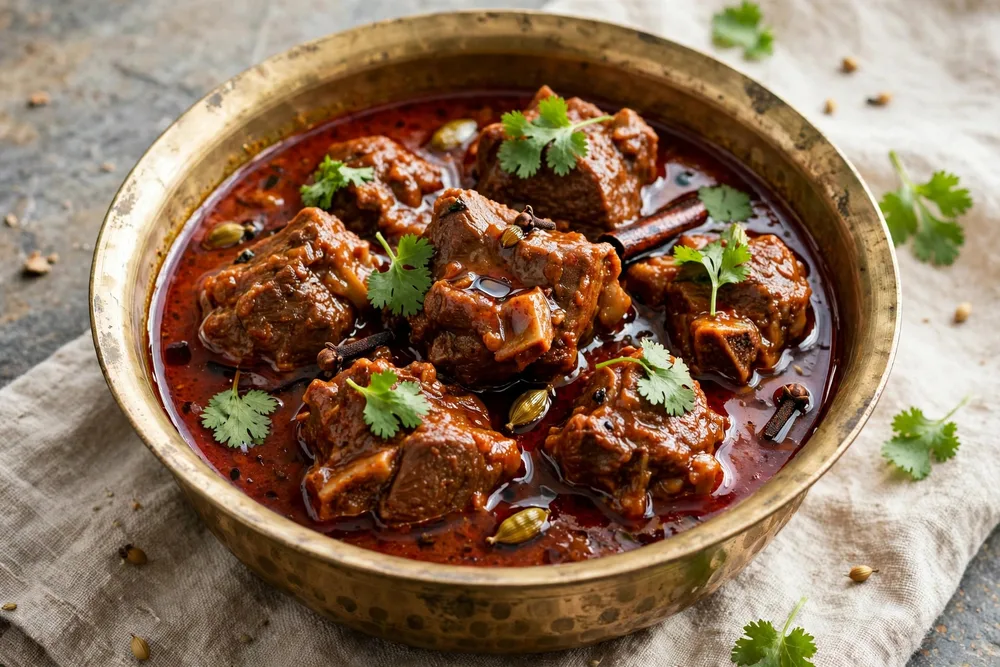
Tender mutton slow-cooked in a deep-red gravy of Kashmiri chillies, fennel and dry ginger. Aromatic rather than hot — the Kashmiri feast classic.
Base Batch
10 Pax
250 g (mutton + gravy)
Prep / Cook
100m
1 hour 15 min
Difficulty
medium–high
Commercial Standard
Cost / Portion
₹129.22
Illustrative Book Rate
Section 1 · At a Glance
Ingredients & Dynamic Pax Scaling Lab
Base formulated for 10 portions. Calibrate guest count, adjust catering buffer, or search specific ingredients below.
Batch Ingredient Cost
₹1,292
10 portions @ ₹129.22
Raw Batch Weight
~2.98 kg
Total raw commodities
Equipment Capacity
1 × GN 1/1
Standard chafing inserts
Scaling Factor
1.0× Base
10 Pax reference base
* Scaling is linear from the base 10-portion quantities (×5, ×10, ×50). Quantities of 1,000 g or more are shown as kg; 1,000 ml or more as L.
* Salt, spice, chilli and water do not scale perfectly — always taste and adjust; never scale salt blindly.
Step-by-Step Method & Critical Control Points (CCP)
Standard operating procedures with highlighted CCP warnings where execution failure compromises texture or food safety.
Marinate. Mix the mutton with curd, ginger-garlic paste and half the salt. Rest 1 hour, chilled.
Heat the ghee. Heat the ghee; add bay leaves, cardamoms and cinnamon, then the onions; cook until soft and pale golden.
Add the mutton. Add the marinated mutton and cook on high heat 5–8 minutes, stirring, until the meat changes colour.
Add the spices. Add the Kashmiri red chilli powder, fennel, dry ginger, coriander and cumin powders and asafoetida; stir well — **⚠ CCP:** the red colour comes from Kashmiri chillies, not from tomato or food colour; add no tomato.
Simmer. Add the water and the remaining salt; cover and simmer on low heat 60–75 minutes until the mutton is tender — **⚠ CCP:** check the thickest piece; the meat must be tender and show no pink flesh. Add hot water if the gravy thickens too much.
Finish. Add the garam masala; simmer 5 minutes more. The gravy should be deep red and glossy.
Serve. Garnish with coriander leaves; serve hot, 250 g per portion. Done when: mutton tender, gravy deep red, aromatic with fennel and dry ginger.
ℹ CCP = critical control point — the moment where getting it wrong spoils the dish or makes it unsafe.
Tips & Tricks + Common Mistakes to Avoid
- •Use Kashmiri red chilli powder for the colour — ordinary chilli powder makes the dish hot without the colour.
- •Simmer low and slow; mutton rushed on high heat turns tough.
- •No tomato in this dish — the gravy is built on curd and chillies.
- •Tough mutton — simmered too fast, or not long enough.
- •Pale gravy — Kashmiri chilli powder skipped or replaced with tomato.
- •Bland aroma — fennel and dry ginger are the signature; do not leave them out.
Section 5 · Nutrition — (250 g (mutton + gravy)
Standard food-composition estimates derived from the raw ingredient list.
Energy
420 kcal
Avg: 259 kcal
Protein
32 g
Avg: 10 g
Carbohydrate
8 g
Avg: 33 g
Fat
28 g
Avg: 10 g
Fibre
2 g
Avg: 2 g
Sodium
700 mg
Avg: 434 mg
8%
8 g
31%
32 g
61%
28 g
Energy split: carbohydrate 8% · protein 31% · fat 61%.
Check: 4 × 32 g protein + 4 × 8 g carbohydrate + 9 × 28 g fat = 412 kcal, close to the stated 420 kcal (rounded estimate).
Section 6 · Fun Fact & Origin
Origin: not documented — no reliable source found for a single place, person or date of first creation. Rogan josh is widely associated with Kashmiri cuisine; no inventor is recorded.
Section 7 · Regional Traditions
Rogan josh is the best-known dish of Kashmiri cuisine, served at feasts and weddings. Its deep red colour comes from Kashmiri chillies, and its aroma from fennel and dry ginger — it is aromatic rather than hot, which is what sets it apart from other mutton curries.
Three Commercial Variations
finish with a little extra ghee and serve with saffron rice.
the recipe as written uses bone-in mutton; do not reduce the meat — reduce the ghee instead.
use less ghee and serve with steamed rice and salad.
Production Intelligence & Banquet Logistics
Batch Yield
10 portions × 250 g = 2.5 kg finished.
Prep Schedule
Morning: marinate the mutton. On the day: cook slowly; hold hot through service.
Portion Control
250 g per portion by ladle; count the mutton pieces per portion (about 3).
Holding Limits
Hot hold 65°C
- Yield: 10 portions × 250 g = 2.5 kg finished.
- Prep schedule: Morning: marinate the mutton. On the day: cook slowly; hold hot through service.
- Portion control: 250 g per portion by ladle; count the mutton pieces per portion (about 3).
- Holding and service risks: Holds well hot for a full service; the flavour improves with a little holding. Stir often and loosen with hot water if needed.
Food Safety, Allergens & Thermal Holding
Allergen Classification (Chapter 4 Matrix)
Contains — Milk. Not present — Wheat, Egg, Fish, Nuts, Soy, Mustard, Sesame. Diet: Non-veg.
Ingredient Costing, Pairings & Waste Reduction
Per Portion Cost
₹129.22
Cost per portion = (sum of ingredient quantity × rate) ÷ portions. Ingredient cost only — water, cooking fuel, transport, labour, and commercial overheads are not included. All rates are illustrative book planning benchmarks; replace with your live mandi rates.
Cost Driver Composition
Interactive Margin & Profit Simulator
Calibrate your catering client quote to verify commercial profit margins.
Quoted Revenue
₹38,800
Food Cost
₹12,922
Gross Profit
₹25,878
Profitable Menu Pairings
Kitchen Waste Reduction & Yield Strategy
Leftover rogan josh becomes a filling for wraps the same day; the gravy freezes in 10-portion packs.