
Green Chutney
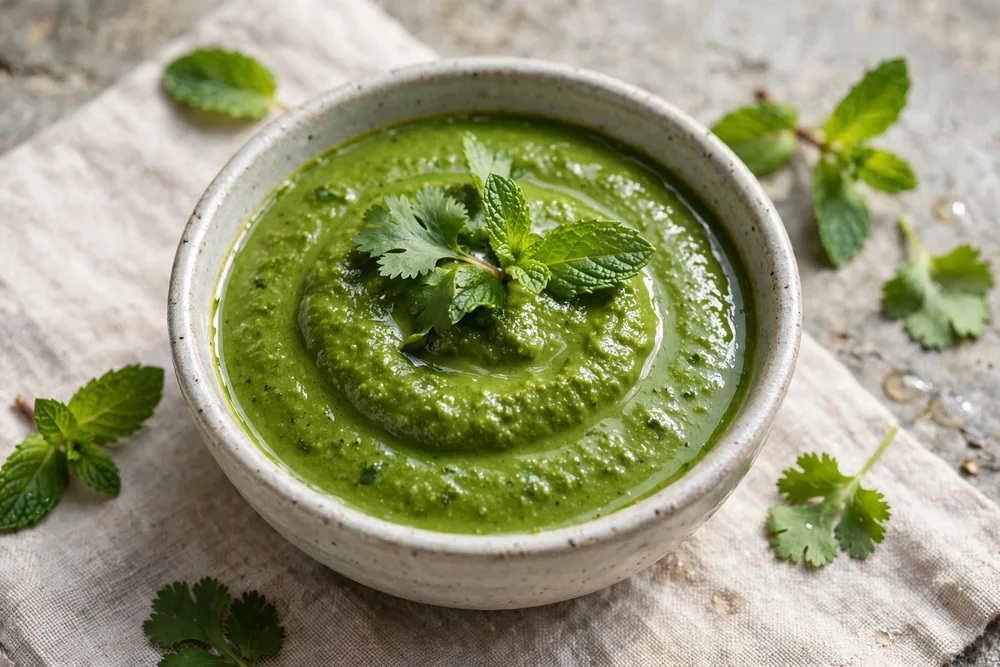
Fresh, bright-green mint-coriander chutney. The chutney every North Indian starter, chaat and tandoor counter depends on — made fresh daily, never stored for days.
Base Batch
10 Pax
30 g per portion
Prep / Cook
10m
No cooking
Difficulty
easy
Commercial Standard
Cost / Portion
₹4.94
Illustrative Book Rate
Section 1 · At a Glance
Ingredients & Dynamic Pax Scaling Lab
Base formulated for 10 portions. Calibrate guest count, adjust catering buffer, or search specific ingredients below.
Batch Ingredient Cost
₹49
10 portions @ ₹4.94
Raw Batch Weight
~0.35 kg
Total raw commodities
Equipment Capacity
1 × GN 1/1
Standard chafing inserts
Scaling Factor
1.0× Base
10 Pax reference base
* Scaling is linear from the base 10-portion quantities (×5, ×10, ×50). Quantities of 1,000 g or more are shown as kg; 1,000 ml or more as L.
* Salt, spice, chilli and water do not scale perfectly — always taste and adjust; never scale salt blindly.
Step-by-Step Method & Critical Control Points (CCP)
Standard operating procedures with highlighted CCP warnings where execution failure compromises texture or food safety.
Wash the leaves. Wash the mint and coriander leaves well; pick out any tough stems.
Grind. Grind the mint, coriander, green chillies, ginger, garlic and roasted gram with the lemon juice, sugar, salt and water to a smooth chutney — **⚠ CCP:** grind with as little water as possible; a thin chutney runs off the plate.
Taste. Taste and adjust salt, lemon and chilli — the chutney should be fresh, tangy and mildly hot.
Rest. Rest 10 minutes so the flavours settle.
Serve. Serve 30 g per portion in a small bowl. Done when: bright green, smooth, fresh and tangy.
ℹ CCP = critical control point — the moment where getting it wrong spoils the dish or makes it unsafe.
Tips & Tricks + Common Mistakes to Avoid
- •Grind with minimal water — a thick chutney holds its shape on the plate.
- •Make it fresh daily; the green dulls and the flavour fades within a day.
- •A little roasted gram gives the chutney body without changing the taste.
- •Brown chutney — ground with too much water, or stored for days.
- •Thin, runny chutney — too much water added while grinding.
- •Bitter chutney — mint stems left in, or too much raw garlic.
Section 5 · Nutrition — (30 g per portion)
Standard food-composition estimates derived from the raw ingredient list.
Energy
25 kcal
Avg: 259 kcal
Protein
1 g
Avg: 10 g
Carbohydrate
3 g
Avg: 33 g
Fat
1 g
Avg: 10 g
Fibre
1 g
Avg: 2 g
Sodium
280 mg
Avg: 434 mg
48%
3 g
16%
1 g
36%
1 g
Energy split: carbohydrate 48% · protein 16% · fat 36%.
Check: 4 × 1 g protein + 4 × 3 g carbohydrate + 9 × 1 g fat = 25 kcal, close to the stated 25 kcal (rounded estimate).
Section 6 · Fun Fact & Origin
Origin: not documented — no reliable source found for a single place, person or date of first creation. Mint-coriander chutney is an everyday North Indian accompaniment.
Section 7 · Regional Traditions
Green chutney is the everyday chutney of North India — the accompaniment to tandoori starters, samosas, pakoras and chaats at every wedding. It is made fresh every morning in a catering kitchen and never carried over.
Three Commercial Variations
add a little curd for a creamier chutney, served with tandoori starters.
the recipe as written is already low-cost.
the recipe as written is already light; skip the sugar if the guests prefer it sharper.
Production Intelligence & Banquet Logistics
Batch Yield
10 portions × 30 g = 300 g finished.
Prep Schedule
Morning: wash the leaves and grind the chutney fresh; make a second small batch for the evening service.
Portion Control
30 g per portion by a small ladle or spoon.
Holding Limits
Hot hold 65°C
- Yield: 10 portions × 30 g = 300 g finished.
- Prep schedule: Morning: wash the leaves and grind the chutney fresh; make a second small batch for the evening service.
- Portion control: 30 g per portion by a small ladle or spoon.
- Holding and service risks: Use the same day. The green dulls within hours; make fresh batches rather than holding.
Food Safety, Allergens & Thermal Holding
Allergen Classification (Chapter 4 Matrix)
Contains — none of the eight tracked allergens. Not present — Milk, Wheat, Egg, Fish, Nuts, Soy, Mustard, Sesame. Diet: Veg.
Ingredient Costing, Pairings & Waste Reduction
Per Portion Cost
₹4.94
Cost per portion = (sum of ingredient quantity × rate) ÷ portions. Ingredient cost only — water, cooking fuel, transport, labour, and commercial overheads are not included. All rates are illustrative book planning benchmarks; replace with your live mandi rates.
Cost Driver Composition
Interactive Margin & Profit Simulator
Calibrate your catering client quote to verify commercial profit margins.
Quoted Revenue
₹1,500
Food Cost
₹494
Gross Profit
₹1,006
Profitable Menu Pairings
Kitchen Waste Reduction & Yield Strategy
Leftover chutney is used the same day as a sandwich spread or a chaat topping; herb stems go into the stock pot.