
Undhiyu
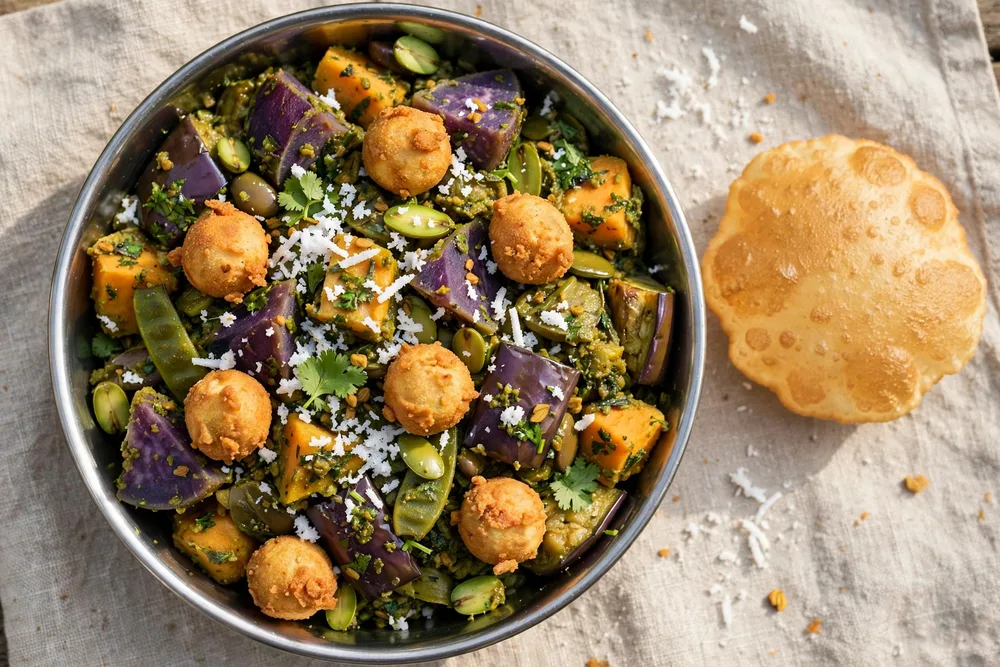
Gujarat's winter mixed-vegetable celebration — slow-cooked seasonal vegetables with fenugreek dumplings, the dish of Uttarayan.
Base Batch
10 Pax
200 g
Prep / Cook
90m
50 min
Difficulty
medium–high
Commercial Standard
Cost / Portion
₹15.41
Illustrative Book Rate
Section 1 · At a Glance
Ingredients & Dynamic Pax Scaling Lab
Base formulated for 10 portions. Calibrate guest count, adjust catering buffer, or search specific ingredients below.
Batch Ingredient Cost
₹154
10 portions @ ₹15.41
Raw Batch Weight
~2.43 kg
Total raw commodities
Equipment Capacity
1 × GN 1/1
Standard chafing inserts
Scaling Factor
1.0× Base
10 Pax reference base
* Scaling — linear from base 10 (×5, ×10, ×50). Above 1,000 g shown as kg; above 1,000 ml as L. For 50+ portions, cook in
* separate 50-portion vessels — one very large pot crushes the vegetables at the bottom. Fry the muthiya in batches; do not crowd the kadhai.
Step-by-Step Method & Critical Control Points (CCP)
Standard operating procedures with highlighted CCP warnings where execution failure compromises texture or food safety.
Make the muthiya. Mix besan, methi, the 15 g ginger-green chilli paste, 10 g sugar and 5 g salt; knead with a little water to a stiff dough. Shape into small oval dumplings.
Fry the muthiya. Fry in the 100 ml hot oil until golden and crisp outside. Drain and set aside. **⚠ CCP—** oil: hot enough that a dumpling sizzles; cool oil makes them drink oil and turn greasy.
Temper. Heat the 60 ml oil; add mustard seeds, then cumin and asafoetida. Add the 30 g ginger-green chilli paste and fry until fragrant.
Add the hard vegetables first. Add yam, sweet potato and potato with the 300 ml water; cover and cook 10 minutes. **⚠ CCP—** order: hard roots first, soft vegetables later, or everything turns to mush.
Add the soft vegetables. Add brinjal, papdi and raw banana with the dry spices, salt and 15 g sugar. Cover and cook on low heat 20–25 minutes until the vegetables are tender but hold their shape.
Finish. Add the fried muthiya, coconut, coriander and lemon juice. Mix — one or two folds only — and rest covered 5 minutes. Done when: vegetables tender and whole, lightly coated in masala, muthiya soft inside and crisp outside, no watery gravy.
Serve. 200 g per portion. Serve hot with puri or roti.
ℹ CCP = critical control point — the moment where getting it wrong spoils the dish or makes it unsafe.
Tips & Tricks + Common Mistakes to Avoid
- •Cut all the vegetables to a similar size so they cook in the same time.
- •Cook on low heat with the lid on — undhiyu is slow-cooked, not boiled.
- •Fold, never stir hard, once the muthiya go in — they break easily.
- •Adding all the vegetables at once — the soft ones dissolve while the roots stay hard.
- •Too much water — undhiyu is a dry-ish mixed vegetable, not a curry.
- •Stirring after adding muthiya — they crumble and the dish turns pasty.
Section 5 · Nutrition — (200 g)
Standard food-composition estimates derived from the raw ingredient list.
Energy
238 kcal
Avg: 259 kcal
Protein
6 g
Avg: 10 g
Carbohydrate
30 g
Avg: 33 g
Fat
10 g
Avg: 10 g
Fibre
6 g
Avg: 2 g
Sodium
610 mg
Avg: 434 mg
51%
30 g
10%
6 g
38%
10 g
Energy split: carbohydrate 51% · protein 10% · fat 38%.
Check: 6×4 + 30×4 + 10×9 = 234 kcal, stated 238 kcal (rounded estimate).
Section 6 · Fun Fact & Origin
Undhiyu is the dish of Uttarayan, Gujarat's kite festival in January — it is made only in winter, when surti papdi, purple yam and raw banana are all in season together. Origin: not documented — no reliable source found for a single inventor, place or date.
Section 7 · Regional Traditions
Undhiyu belongs to South Gujarat, especially Surat, and it is a winter dish by definition — the vegetables in it are seasonal, and outside winter the dish is made with what is available and is not the same.
Three Commercial Variations
Fry the muthiya in ghee instead of oil and finish with extra coconut and a spoon of green chutney on the side.
Halve the muthiya to 75 g besan and 40 g methi. Saves about ₹0.80 per portion (see §11).
Bake the muthiya instead of frying, cut the oil to 30 ml, and skip the sugar. The muthiya are softer.
Production Intelligence & Banquet Logistics
Batch Yield
10 portions × 200 g = 2.0 kg from 1.5 kg vegetables + 150 g besan muthiya.
Prep Schedule
Standard prep
Portion Control
one level 200 ml ladle = one 200 g portion, making sure each ladle has vegetables and at least one muthiya. Weigh the first five portions.
Holding Limits
Hot hold 65°C
- Yield: 10 portions × 200 g = 2.0 kg from 1.5 kg vegetables + 150 g besan muthiya.
- Prep schedule (100 portions): cut all vegetables and shape the muthiya the evening before, stored separately and covered; fry muthiya and cook in two 50-portion vessels on the day (~50 min per vessel).
- Portion control: one level 200 ml ladle = one 200 g portion, making sure each ladle has vegetables and at least one muthiya. Weigh the first five portions.
- Holding and service risks: hold covered in service vessels; replenish in small batches so the first servings do not dry out. keep the vessel covered and do not stir between servings.
Food Safety, Allergens & Thermal Holding
Allergen Classification (Chapter 4 Matrix)
Contains — Nuts, Mustard. Not present — Milk, Wheat, Egg, Fish, Soy, Sesame. Diet: Veg.
Ingredient Costing, Pairings & Waste Reduction
Per Portion Cost
₹15.41
Cost per portion = (sum of ingredient quantity × rate) ÷ portions. Ingredient cost only — water, cooking fuel, transport, labour, and commercial overheads are not included. All rates are illustrative book planning benchmarks; replace with your live mandi rates.
Cost Driver Composition
Interactive Margin & Profit Simulator
Calibrate your catering client quote to verify commercial profit margins.
Quoted Revenue
₹4,600
Food Cost
₹1,541
Gross Profit
₹3,059
Profitable Menu Pairings
Kitchen Waste Reduction & Yield Strategy
The biggest waste is vegetables overcooked to mush on long holding, and muthiya broken by stirring. Cook in 50-portion vessels, hold covered without stirring, and add the muthiya at the end.