
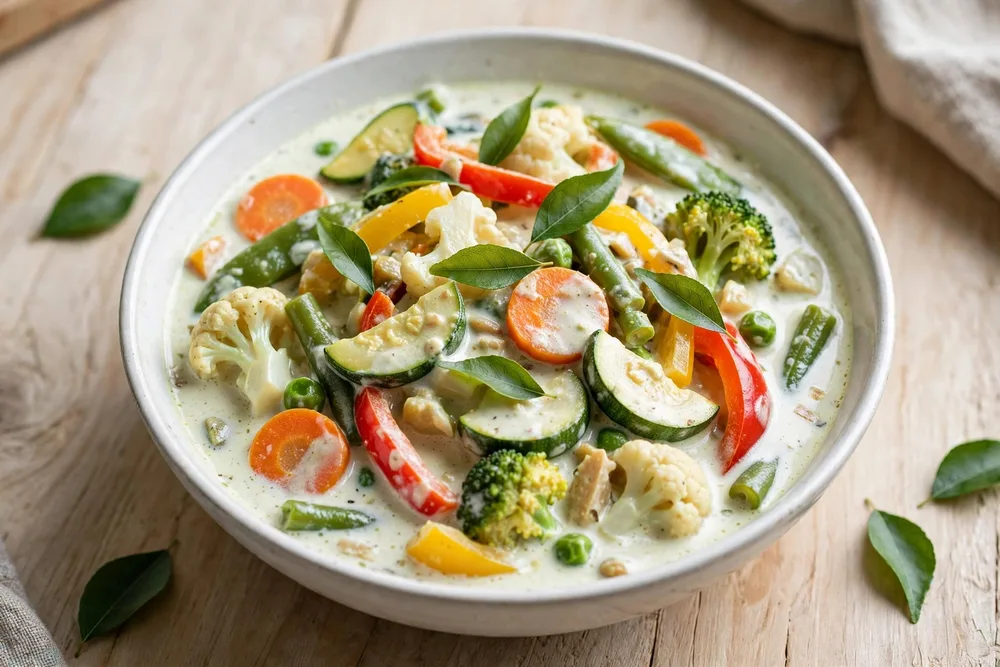
Vegan Coconut Vegetable Curry
Mixed vegetables in a creamy coconut-milk curry — no dairy, no egg, no honey
Base Batch
10 Pax
200 g
Prep / Cook
45m
25 min
Difficulty
easy
Commercial Standard
Cost / Portion
₹22.00
Illustrative Book Rate
Section 1 · At a Glance
Ingredients & Dynamic Pax Scaling Lab
Base formulated for 10 portions. Calibrate guest count, adjust catering buffer, or search specific ingredients below.
Batch Ingredient Cost
₹220
10 portions @ ₹22.00
Raw Batch Weight
~1.76 kg
Total raw commodities
Equipment Capacity
1 × GN 1/1
Standard chafing inserts
Scaling Factor
1.0× Base
10 Pax reference base
* Vegan rule honoured throughout: no dairy, egg or honey in this dish, its method or its variations. Coconut milk replaces cream entirely.
* Scaling — linear from base 10 (×5, ×10, ×50). Above 1,000 g shown as kg; above
* 1,000 ml as L. Salt, spice, chilli and water: taste and adjust — never scale blindly.
Step-by-Step Method & Critical Control Points (CCP)
Standard operating procedures with highlighted CCP warnings where execution failure compromises texture or food safety.
Temper. Heat coconut oil; add mustard seeds and wait until they pop, then cumin seeds, curry leaves, ginger and green chillies. Fry 30 seconds.
Add the hard vegetables. Add carrot, beans, cauliflower and potato with turmeric, coriander powder and salt. Stir 2 minutes.
Add coconut milk — **⚠ CCP.** Pour in the coconut milk and bring to a gentle simmer. **⚠ CCP:** never boil hard — hard boiling splits coconut milk and turns it grainy.
Simmer gently. Cover and simmer 15–18 minutes until the vegetables are tender. Add peas and capsicum for the last 5 minutes so they stay bright.
Check and rest. Taste for salt; the curry should be creamy, mild and fragrant. Rest covered 5 minutes.
Serve. Garnish with coriander leaves; serve 200 g per portion with rice or bread. Done when: vegetables tender, sauce creamy and smooth, not split.
ℹ CCP = critical control point — the moment where getting it wrong spoils the dish or makes it unsafe.
Tips & Tricks + Common Mistakes to Avoid
- •Add the soft vegetables late so they keep colour
- •Shake the coconut milk tin well before opening.
- •Hard boiling (split, grainy sauce)
- •Overcooking the vegetables (they collapse into the sauce)
- •Salting before the milk goes in (it can curdle thin coconut milk).
Section 5 · Nutrition — 200 g
Standard food-composition estimates derived from the raw ingredient list.
Energy
265 kcal
Avg: 259 kcal
Protein
6 g
Avg: 10 g
Carbohydrate
22 g
Avg: 33 g
Fat
17 g
Avg: 10 g
Fibre
5 g
Avg: 2 g
Sodium
480 mg
Avg: 434 mg
33%
22 g
9%
6 g
58%
17 g
Energy split: carbohydrate 33% · protein 9% · fat 58%.
Section 6 · Fun Fact & Origin
Origin: not documented — no reliable source found.
Section 7 · Regional Traditions
A South Indian–inspired coconut curry, served Pan-India as the vegan main at weddings and corporate lunches. Coconut-milk curries are a Kerala and coastal tradition; this version is written for a mixed buffet, where it sits beside rice and bread for vegan and non-vegan guests alike.
Three Commercial Variations
finish with a tempering of coconut oil, mustard seeds and curry leaves poured over each portion at the counter.
replace half the coconut milk with water and 50 g grated coconut; keep the tempering.
coconut oil to 20 ml, coconut milk to 600 ml with 200 ml water, and double the beans and peas.
Production Intelligence & Banquet Logistics
Batch Yield
10 portions × 200 g = 2.0 kg.
Prep Schedule
Standard prep
Portion Control
one 200 g ladle, with vegetables in every ladle — stir before each serving.
Holding Limits
hold hot and covered; stir gently every 20 minutes; do not hold over a fierce flame.
- Yield: 10 portions × 200 g = 2.0 kg.
- Prep: wash and cut all vegetables the morning of the event.
- Portion control: one 200 g ladle, with vegetables in every ladle — stir before each serving.
- Holding: hold hot and covered; stir gently every 20 minutes; do not hold over a fierce flame.
- Risk: the sauce splitting on holding — keep the heat low and replenish in small batches.
Food Safety, Allergens & Thermal Holding
Allergen Classification (Chapter 4 Matrix)
Contains — Nuts, Mustard. Not present — Milk, Wheat, Egg, Fish, Soy, Sesame. Diet: Vegan.
Ingredient Costing, Pairings & Waste Reduction
Per Portion Cost
₹22.00
Cost per portion = (sum of ingredient quantity × rate) ÷ portions. Ingredient cost only — water, cooking fuel, transport, labour, and commercial overheads are not included. All rates are illustrative book planning benchmarks; replace with your live mandi rates.
Cost Driver Composition
Interactive Margin & Profit Simulator
Calibrate your catering client quote to verify commercial profit margins.
Quoted Revenue
₹6,600
Food Cost
₹2,200
Gross Profit
₹4,400
Profitable Menu Pairings
Kitchen Waste Reduction & Yield Strategy
Leftover curry thickens overnight — thin it with a little coconut milk the same day and serve it as a soup course, or use it as the base for the next day's vegetable pulao only if it was cooled quickly and refrigerated the same day.