
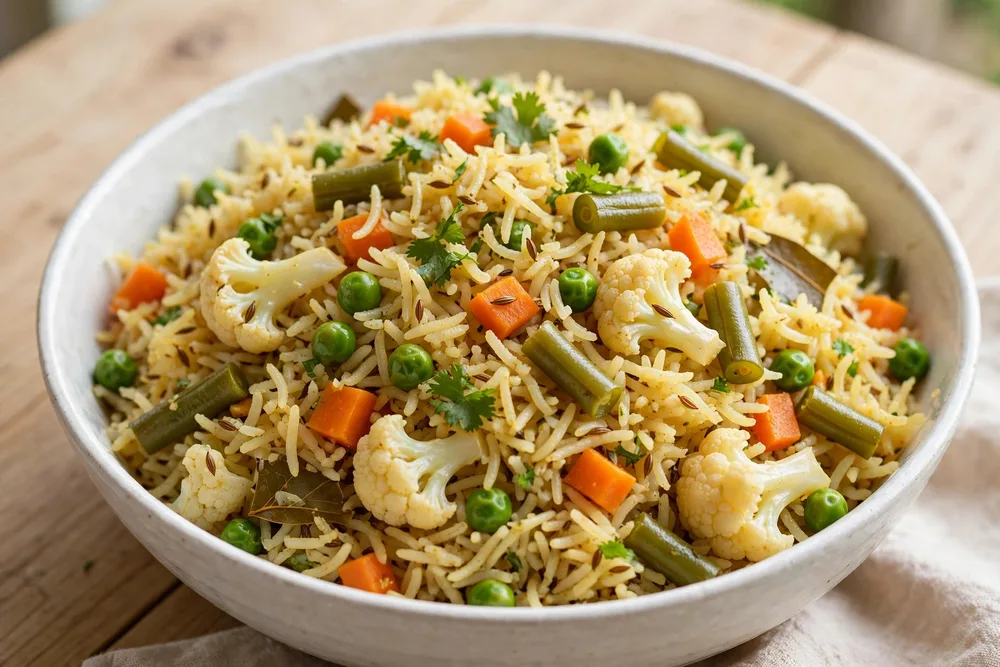
Jain Vegetable Pulao (No Onion, No Garlic)
Fragrant basmati rice with vegetables — no onion, no garlic
Base Batch
10 Pax
250 g
Prep / Cook
45m
25 min
Difficulty
easy
Commercial Standard
Cost / Portion
₹19.00
Illustrative Book Rate
Section 1 · At a Glance
Ingredients & Dynamic Pax Scaling Lab
Base formulated for 10 portions. Calibrate guest count, adjust catering buffer, or search specific ingredients below.
Batch Ingredient Cost
₹190
10 portions @ ₹19.00
Raw Batch Weight
~3.35 kg
Total raw commodities
Equipment Capacity
1 × GN 1/1
Standard chafing inserts
Scaling Factor
1.0× Base
10 Pax reference base
* Jain rule honoured throughout: no onion and no garlic in this dish, its method or its variations. Potato is included here as the library's
* Jain pulao is a cooked-rice dish for Jain guests as specified; if a guest's Jain practice excludes potato, serve the pulao without it and say
* so on the counter. Salt: taste and adjust — do not scale blindly.
* Scaling — linear from base 10 (×5, ×10, ×50). Above 1,000 g shown as kg; above
* 1,000 ml as L. Salt, spice, chilli and water: taste and adjust — never scale blindly.
Step-by-Step Method & Critical Control Points (CCP)
Standard operating procedures with highlighted CCP warnings where execution failure compromises texture or food safety.
Soak the rice. Rinse basmati until the water runs clear; soak 30 minutes and drain. **⚠ CCP:** no onion or garlic at any stage — use dedicated Jain vessels and ladles.
Temper. Heat ghee; add cumin, bay leaves, cardamoms and cinnamon, then ginger and green chillies. Fry 30 seconds until fragrant.
Add vegetables. Add carrot, peas, beans, cauliflower and potato with turmeric and salt. Stir 2 minutes so the vegetables are coated in ghee.
Add rice and water. Add the drained rice and the water. Stir once, gently. **⚠ CCP:** stir only once — repeated stirring breaks the grains.
Cook — **⚠ CCP.** Bring to the boil, cover, and cook on low heat 18–20 minutes until the water is absorbed and the rice is tender. Do not lift the lid. Rest covered 10 minutes.
Finish and serve. Fluff gently with a fork, sprinkle garam masala, lemon juice and coriander leaves, and mix once. Serve 250 g per portion. Done when: long, separate grains; vegetables tender, not mushy.
ℹ CCP = critical control point — the moment where getting it wrong spoils the dish or makes it unsafe.
Tips & Tricks + Common Mistakes to Avoid
- •Soak the rice every time — it is what keeps the grains long and separate
- •Rest the cooked pulao 10 minutes before fluffing.
- •Lifting the lid during cooking (steam escapes, rice stays hard)
- •Stirring after the water goes in (broken, sticky rice)
- •Too much water (the pulao turns to khichdi).
Section 5 · Nutrition — 250 g
Standard food-composition estimates derived from the raw ingredient list.
Energy
310 kcal
Avg: 259 kcal
Protein
7 g
Avg: 10 g
Carbohydrate
52 g
Avg: 33 g
Fat
8 g
Avg: 10 g
Fibre
4 g
Avg: 2 g
Sodium
540 mg
Avg: 434 mg
68%
52 g
9%
7 g
23%
8 g
Energy split: carbohydrate 68% · protein 9% · fat 23%.
Section 6 · Fun Fact & Origin
Origin: not documented — no reliable source found.
Section 7 · Regional Traditions
A Jain rice dish for weddings and community meals across India, served on the separate Jain counter. Pulao is the Jain main that pairs with a Jain curry and dal, so Jain guests eat a complete meal without touching the main buffet.
Three Commercial Variations
layer the rice and vegetables in a handi, seal with dough and serve dum-style at the counter.
replace half the basmati with good long-grain rice and halve the ghee.
ghee to 30 g, brown basmati instead of white, and double the beans and peas.
Production Intelligence & Banquet Logistics
Batch Yield
10 portions × 250 g = 2.5 kg, from 800 g raw rice.
Prep Schedule
Standard prep
Portion Control
one 250 g ladle; weigh the first five portions of each batch.
Holding Limits
hold covered and hot; fluff gently before each refill — never press it down.
- Yield: 10 portions × 250 g = 2.5 kg, from 800 g raw rice.
- Prep: wash and cut vegetables the morning of the event; soak rice 30 minutes before cooking.
- Portion control: one 250 g ladle; weigh the first five portions of each batch.
- Holding: hold covered and hot; fluff gently before each refill — never press it down.
- Risk: cooking 100+ portions in one vessel — cook in 50-portion vessels, or the bottom burns and the top stays raw.
Food Safety, Allergens & Thermal Holding
Allergen Classification (Chapter 4 Matrix)
Contains — Milk. Not present — Wheat, Egg, Fish, Nuts, Soy, Mustard, Sesame. Diet: Jain.
Ingredient Costing, Pairings & Waste Reduction
Per Portion Cost
₹19.00
Cost per portion = (sum of ingredient quantity × rate) ÷ portions. Ingredient cost only — water, cooking fuel, transport, labour, and commercial overheads are not included. All rates are illustrative book planning benchmarks; replace with your live mandi rates.
Cost Driver Composition
Interactive Margin & Profit Simulator
Calibrate your catering client quote to verify commercial profit margins.
Quoted Revenue
₹5,700
Food Cost
₹1,900
Gross Profit
₹3,800
Profitable Menu Pairings
Kitchen Waste Reduction & Yield Strategy
Leftover pulao is the next day's fried rice only if it was cooled quickly and refrigerated the same day — otherwise it is staff meals the same day, never the next day's service. Cook in 50-portion vessels matched to the queue.