
Gulab Jamun
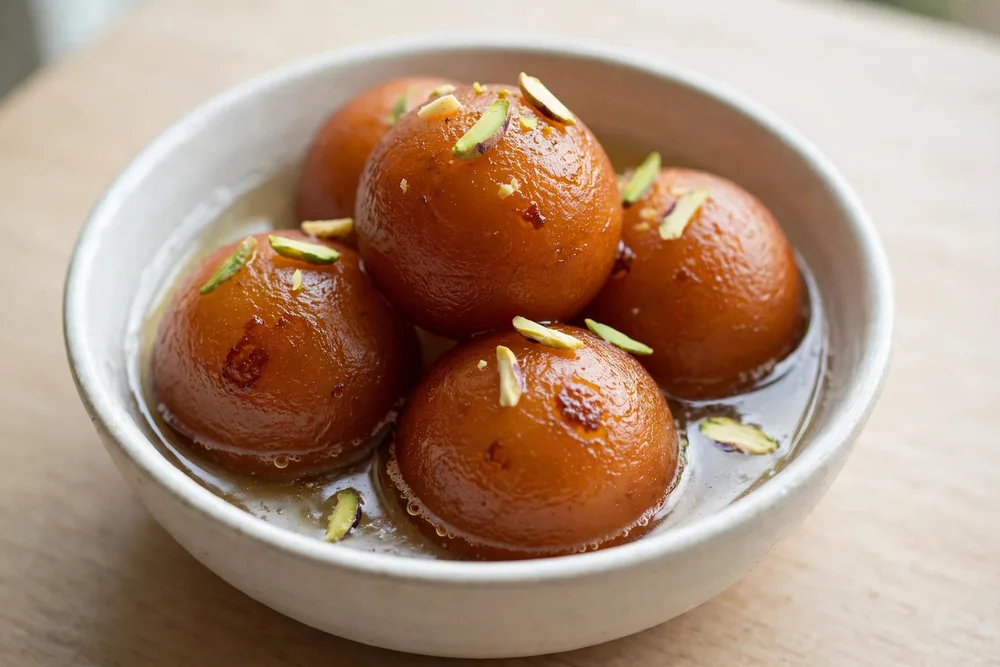
Soft, rose-scented milk dumplings soaked in warm saffron syrup. The wedding dessert guests ask for first — made ahead, held in syrup, and served warm.
Base Batch
10 Pax
2 pieces (about 70 g) + about 30 ml syrup
Prep / Cook
60m
35 min (syrup + frying)
Difficulty
medium
Commercial Standard
Cost / Portion
₹37.99
Illustrative Book Rate
Section 1 · At a Glance
Ingredients & Dynamic Pax Scaling Lab
Base formulated for 10 portions. Calibrate guest count, adjust catering buffer, or search specific ingredients below.
Batch Ingredient Cost
₹380
10 portions @ ₹37.99
Raw Batch Weight
~2.17 kg
Total raw commodities
Equipment Capacity
1 × GN 1/1
Standard chafing inserts
Scaling Factor
1.0× Base
10 Pax reference base
* Scaling is linear from the base 10-portion quantities (×5, ×10, ×50). Quantities of 1,000 g or more are shown as kg; 1,000 ml or more as L.
* Salt, spice, chilli and water do not scale perfectly — always taste and adjust; never scale salt blindly.
* Frying medium: the 500 ml is the kadai quantity for 10 portions, not the amount eaten. It is strained and reused across batches; only the
* absorbed share is costed (see §11). Soaking: at least 2 hours; overnight is best.
Step-by-Step Method & Critical Control Points (CCP)
Standard operating procedures with highlighted CCP warnings where execution failure compromises texture or food safety.
Make the syrup. Sugar, water and crushed cardamom in a wide pan; stir until dissolved, simmer 5 minutes. Control point — syrup consistency: thin and sticky, coating the back of a spoon — not one-thread stage. Stir in saffron, rose water and lemon juice. Keep warm.
Make the dough. Grate the khoya fine into a bowl; mix in the maida and baking soda evenly.
Knead soft. Add warm milk a little at a time and knead to a soft, smooth dough. Control point — dough softness: soft like chapati dough, holding together without cracking; if stiff, add milk a teaspoon at a time. Cover and rest 10 minutes.
Shape. Divide into 20 equal balls of about 30 g each. Roll between greased palms until smooth and crack-free — any surface crack will split open while frying.
Heat the ghee or oil on low-medium heat. Control point — frying temperature by sight: a tiny piece of dough should sink, then rise slowly with gentle bubbles. If it shoots up and browns at once the oil is too hot; if it sits on the bottom it is too cool.
Fry in batches, a few at a time. Stir very gently so they colour evenly, until an even golden brown all over, about 6–8 minutes a batch.
Soak at once. Drain for a few seconds, then drop the hot jamuns straight into the warm syrup — hot jamun into warm syrup is what lets the syrup soak in.
Soak. Control point — soaking time: at least 2 hours; overnight gives the softest result. Turn once halfway through if the syrup does not cover them.
How to know it is done: plump and glossy, soft and springy when pressed gently, and sweet right through to the centre, not just on the outside.
Serve 2 pieces per portion with about 30 ml of warm syrup, scattered with pistachio and almond slivers. Serve warm.
ℹ CCP = critical control point — the moment where getting it wrong spoils the dish or makes it unsafe.
Tips & Tricks + Common Mistakes to Avoid
- •Use fresh, soft khoya — dry or stale khoya is the usual reason for hard jamuns.
- •Keep the syrup warm while the jamuns fry, so each batch goes in hot.
- •Do not crowd the kadai; crowded jamuns cook unevenly.
- •Roll each ball twice — to shape, then again just before frying — to close surface cracks.
- •Hard jamun: too much maida, dough too stiff, or syrup gone cold.
- •Breaking in oil: too little maida, cracks left on the ball, or oil too hot.
- •Syrup too thin: jamuns turn soggy; simmer a little longer.
- •Syrup too thick: it never soaks to the centre.
Section 5 · Nutrition — (2 pieces (about 70 g)
Standard food-composition estimates derived from the raw ingredient list.
Energy
320 kcal
Avg: 259 kcal
Protein
6 g
Avg: 10 g
Carbohydrate
44 g
Avg: 33 g
Fat
13 g
Avg: 10 g
Fibre
1 g
Avg: 2 g
Sodium
120 mg
Avg: 434 mg
56%
44 g
8%
6 g
37%
13 g
Energy split: carbohydrate 56% · protein 8% · fat 37%.
Check: 4 × 6 g protein + 4 × 44 g carbohydrate + 9 × 13 g fat = 317 kcal, close to the stated 320 kcal (rounded estimate).
Section 6 · Fun Fact & Origin
The name says it plainly: gulab is Persian for rose (the rose water in the syrup) and jamun is the dark Indian fruit the round sweet resembles. It is widely described as having reached India with Persian influence in the medieval period; some accounts link it to the Persian fried sweet luqmat al-qadi. Origin: debated. No single inventor, place or date is reliably documented — this book records the debate rather than inventing a story. What is documented is its place today: the sweet that closes the North Indian wedding meal.
Section 7 · Regional Traditions
A North Indian sweet, now served across India: the standard closing dessert of the wedding lunch or dinner buffet, served warm in small bowls, and equally at home at Diwali, Eid and family celebrations. In the North it is commonly paired with kulfi or vanilla ice cream — hot jamun against cold kulfi is the pairing guests remember. Made ahead and held in syrup, it suits large wedding service better than any dessert finished to order.
Three Commercial Variations
khoya-rich dough, a little extra saffron in the syrup, and serve hot with a scoop of Kulfi ([#105](#dish-105)) or Vanilla Ice Cream ([#108](#dish-108)).
replace half the khoya with milk powder and a little extra milk — cheaper, still soft, and practical for large wedding counts.
use a lighter syrup (less sugar, more water, same flavourings) and skim-milk khoya; the jamun is less rich and less sweet, and the classic soft texture changes, so test it before promising the regular result.
Production Intelligence & Banquet Logistics
Batch Yield
10 portions = 20 pieces (about 70 g each with syrup).
Prep Schedule
Made ahead: fry the day before or the morning of the event and hold in syrup; flavour and softness improve with soaking. Portion 2 pieces with syrup into bowls before service opens, so the dessert counter never queues.
Portion Control
2 pieces per portion with about 30 ml syrup, portioned into bowls before service.
Holding Limits
Hot hold 65°C
- Yield: 10 portions = 20 pieces (about 70 g each with syrup).
- Prep schedule: Made ahead: fry the day before or the morning of the event and hold in syrup; flavour and softness improve with soaking. Portion 2 pieces with syrup into bowls before service opens, so the dessert counter never queues.
- Portion control: 2 pieces per portion with about 30 ml syrup, portioned into bowls before service.
- Holding and service risks: Hold covered at service temperature; do not leave the pan open or the surface dries. Sweets setting too firm or too soft, and running out of the most popular sweet first — hold back a reserve batch and release it only when the first batch is nearly gone.
Food Safety, Allergens & Thermal Holding
Allergen Classification (Chapter 4 Matrix)
Contains — Milk, Wheat, Nuts. Not present — Egg, Fish, Soy, Mustard, Sesame. Diet: Veg.
Ingredient Costing, Pairings & Waste Reduction
Per Portion Cost
₹37.99
Cost per portion = (sum of ingredient quantity × rate) ÷ portions. Ingredient cost only — water, cooking fuel, transport, labour, and commercial overheads are not included. All rates are illustrative book planning benchmarks; replace with your live mandi rates.
Cost Driver Composition
Interactive Margin & Profit Simulator
Calibrate your catering client quote to verify commercial profit margins.
Quoted Revenue
₹11,400
Food Cost
₹3,799
Gross Profit
₹7,601
Profitable Menu Pairings
Kitchen Waste Reduction & Yield Strategy
Leftover syrup sweetens kheer or halwa, or goes over ice cream at the dessert counter. Broken jamuns can be crumbled as a dessert topping instead of being discarded.