
Jowar Bhakri
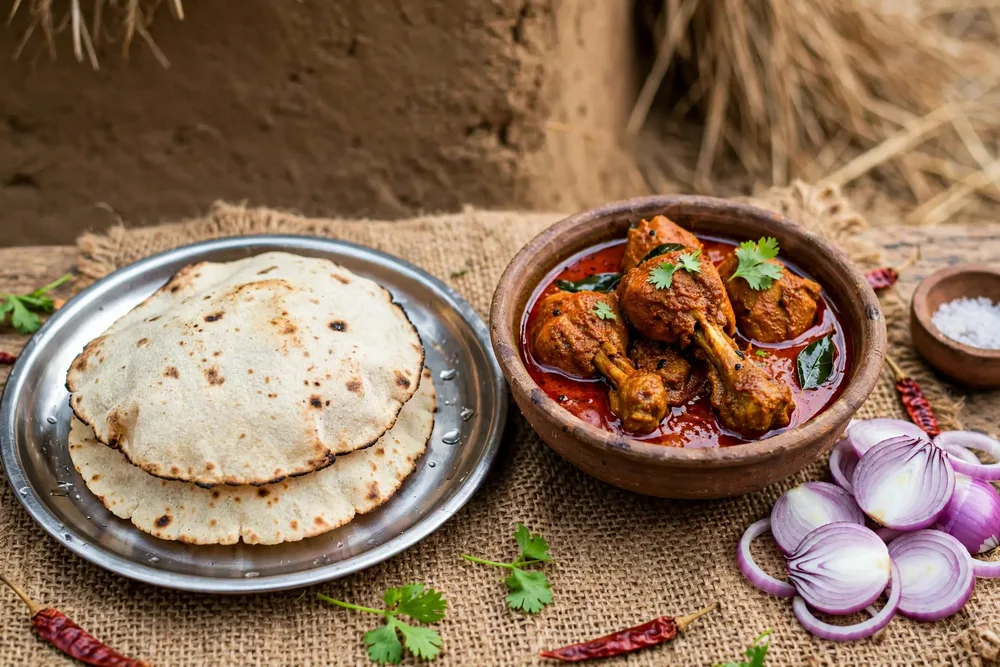
Maharashtra's rustic sorghum flatbread — thick, earthy, hand-patted, and the only bread that stands up to Kolhapuri heat.
Base Batch
10 Pax
2 bhakris (about 100 g)
Prep / Cook
35m
20 min
Difficulty
medium–high
Commercial Standard
Cost / Portion
₹5.17
Illustrative Book Rate
Section 1 · At a Glance
Ingredients & Dynamic Pax Scaling Lab
Base formulated for 10 portions. Calibrate guest count, adjust catering buffer, or search specific ingredients below.
Batch Ingredient Cost
₹52
10 portions @ ₹5.17
Raw Batch Weight
~1.24 kg
Total raw commodities
Equipment Capacity
1 × GN 1/1
Standard chafing inserts
Scaling Factor
1.0× Base
10 Pax reference base
* Scaling — linear from base 10 (×5, ×10, ×50). Above 1,000 g shown as kg; above 1,000 ml as L. Jowar has no gluten, so the
* dough cannot be rolled — it is patted by hand. For 50+ portions, knead in separate 50-portion dough batches and put one cook
* on patting and one on the tawa; a single cook cannot keep pace with service.
Step-by-Step Method & Critical Control Points (CCP)
Standard operating procedures with highlighted CCP warnings where execution failure compromises texture or food safety.
Boil the water. Bring the 450 ml water to a rolling boil with the salt.
Make the dough. Put the jowar flour in a wide bowl; pour in the hot water, mixing with a spoon, then knead with wet hands to a soft, smooth dough. **⚠ CCP—** water: hot water is essential; cold water makes a dough that cracks and will not hold together.
Rest briefly. Cover and rest 5 minutes. The dough must be used while warm — cold jowar dough cracks.
Pat the bhakri. Take a ball (about 50 g), dust with flour, and pat it out by hand on a board or on the palm, turning and pressing until it is a round about 15 cm across and evenly thick. **⚠ CCP—** thickness: even, about 3 mm; a thick centre stays raw while the edges burn.
Cook the first side. Lay it on a hot tawa; when the surface dries and small bubbles appear, flip it.
Puff the second side. Sprinkle a little water on top, flip again, and press until it puffs — or hold it over an open flame with tongs for a few seconds. **⚠ CCP—** puffing: a bhakri that does not puff is undercooked inside.
Finish. Brush lightly with ghee if the menu offers it. Stack and cover. Done when: soft, pliable, lightly spotted, puffed, no raw-flour taste.
Serve. 2 bhakris per portion. Serve hot — bhakri stiffens fast as it cools.
ℹ CCP = critical control point — the moment where getting it wrong spoils the dish or makes it unsafe.
Tips & Tricks + Common Mistakes to Avoid
- •Use boiling water for the dough — it is the whole technique; cold water will not work.
- •Keep your hands wet while kneading and patting, or the dough sticks and cracks.
- •Cook on a hot tawa and puff at once — a slow tawa dries the bhakri before it cooks.
- •Cold water in the dough — it cracks and cannot be patted out.
- •Rolling with a rolling pin — jowar has no gluten and the dough tears; pat it by hand.
- •Leaving the stack uncovered — bhakri stiffens within minutes.
Section 5 · Nutrition — (2 bhakris (about 100 g)
Standard food-composition estimates derived from the raw ingredient list.
Energy
190 kcal
Avg: 259 kcal
Protein
6 g
Avg: 10 g
Carbohydrate
38 g
Avg: 33 g
Fat
2 g
Avg: 10 g
Fibre
3 g
Avg: 2 g
Sodium
270 mg
Avg: 434 mg
78%
38 g
12%
6 g
9%
2 g
Energy split: carbohydrate 78% · protein 12% · fat 9%.
Check: 6×4 + 38×4 + 2×9 = 194 kcal, stated 190 kcal (rounded estimate).
Section 6 · Fun Fact & Origin
Bhakri is the bread of the Deccan plateau, where jowar (sorghum) grows in dry soil that wheat cannot. Origin: not documented — no reliable source found for a single inventor, place or date.
Section 7 · Regional Traditions
Jowar bhakri belongs to Maharashtra and North Karnataka, where jowar is the staple grain of the dry plateau. It is the bread of the farmer's lunch and the Kolhapuri thali — served with Kolhapuri chicken, fish curry or a shaak, and eaten by tearing and scooping.
Three Commercial Variations
Brush each bhakri with ghee as it comes off the tawa and serve it in a cloth-lined basket, two per guest.
Leave out the ghee finish. Saves about ₹1.30 per portion (see §11).
The recipe as written is already the healthier version — whole-grain jowar.
Production Intelligence & Banquet Logistics
Batch Yield
20 bhakris × about 50 g = about 1.0 kg from 600 g jowar flour + water.
Prep Schedule
Standard prep
Portion Control
weigh the first five dough balls (about 50 g each) and count two bhakris per portion.
Holding Limits
Hot hold 65°C
- Yield: 20 bhakris × about 50 g = about 1.0 kg from 600 g jowar flour + water.
- Prep schedule (100 portions): knead the dough in 50-portion batches on the day — jowar dough does not keep well overnight. One cook pats, one cooks; a pair makes about 40 bhakris an hour.
- Portion control: weigh the first five dough balls (about 50 g each) and count two bhakris per portion.
- Holding and service risks: serve fresh where possible; replenish in small batches rather than stacking large quantities. stack covered, and never hold bhakri more than 20 minutes.
Food Safety, Allergens & Thermal Holding
Allergen Classification (Chapter 4 Matrix)
Contains — Milk. Not present — Wheat, Egg, Fish, Nuts, Soy, Mustard, Sesame. Diet: Veg.
Ingredient Costing, Pairings & Waste Reduction
Per Portion Cost
₹5.17
Cost per portion = (sum of ingredient quantity × rate) ÷ portions. Ingredient cost only — water, cooking fuel, transport, labour, and commercial overheads are not included. All rates are illustrative book planning benchmarks; replace with your live mandi rates.
Cost Driver Composition
Interactive Margin & Profit Simulator
Calibrate your catering client quote to verify commercial profit margins.
Quoted Revenue
₹1,600
Food Cost
₹517
Gross Profit
₹1,083
Profitable Menu Pairings
Kitchen Waste Reduction & Yield Strategy
The biggest waste is bhakris gone stiff from holding. Pat and cook to the queue, never ahead of it, and count portions sold against bhakris cooked each service.