
Jalebi
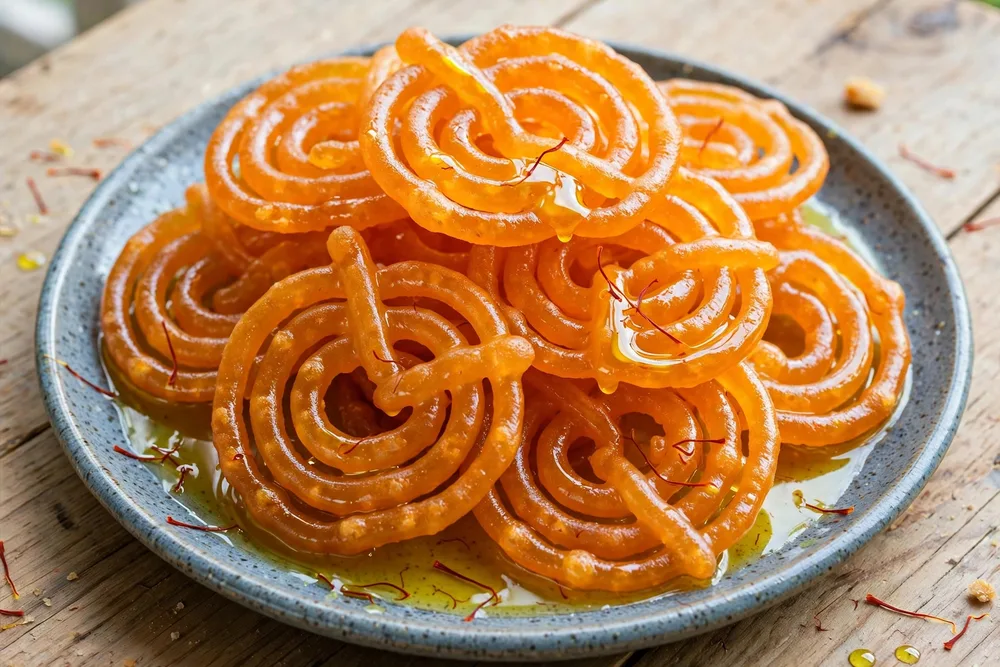
Crisp, spiral-shaped sweets soaked in saffron syrup — orange, glossy and best eaten hot from the kadai. The live-fry dessert of North Indian weddings.
Base Batch
10 Pax
4 jalebis (100 g) + syrup
Prep / Cook
770m
30 min
Difficulty
medium
Commercial Standard
Cost / Portion
₹18.38
Illustrative Book Rate
Section 1 · At a Glance
Ingredients & Dynamic Pax Scaling Lab
Base formulated for 10 portions. Calibrate guest count, adjust catering buffer, or search specific ingredients below.
Batch Ingredient Cost
₹184
10 portions @ ₹18.38
Raw Batch Weight
~2.32 kg
Total raw commodities
Equipment Capacity
1 × GN 1/1
Standard chafing inserts
Scaling Factor
1.0× Base
10 Pax reference base
* Scaling is linear from the base 10-portion quantities (×5, ×10, ×50). Quantities of 1,000 g or more are shown as kg; 1,000 ml or more as L.
* Salt, spice, chilli and water do not scale perfectly — always taste and adjust; never scale salt blindly.
* Saffron is for colour and flavour; a pinch of food colour is not used in this book. * Only the absorbed share of frying oil is costed (see §11).
Step-by-Step Method & Critical Control Points (CCP)
Standard operating procedures with highlighted CCP warnings where execution failure compromises texture or food safety.
Ferment the batter. Mix the maida, besan, curd, baking soda, saffron and water to a smooth, flowing batter. Cover and rest 12 hours (overnight) so it ferments lightly — **⚠ CCP:** the batter should be thick enough to hold a spiral; a thin batter spreads flat in the oil.
Make the syrup. Boil the sugar, water, lemon juice and cardamom until the syrup is thin and sticky, coating the back of a spoon. Stir in the rose water. Keep warm, not boiling.
Heat the oil. Heat the ghee or oil to medium — a drop of batter should rise at once with bubbles.
Pipe the spirals. Pour the batter into a piping bag or a cloth with a small hole; pipe spirals into the hot oil, starting from the centre and moving outwards. Fry until crisp and golden — about 2 minutes per side. **⚠ CCP:** pipe steadily; a shaky hand makes broken spirals.
Soak. Lift the jalebis, drain a few seconds, and drop them into the warm syrup for 30 seconds — no longer, or they go soggy.
Serve. Serve hot, 4 jalebis per portion, garnished with pistachio slivers. Done when: crisp, glossy, orange, sweet through to the centre.
ℹ CCP = critical control point — the moment where getting it wrong spoils the dish or makes it unsafe.
Tips & Tricks + Common Mistakes to Avoid
- •Ferment the batter overnight — the light sourness is the flavour of a good jalebi.
- •Keep the syrup warm and thin; a thick syrup never soaks in.
- •Pipe the spirals steadily and do not crowd the kadai.
- •Flat, shapeless jalebi — batter too thin, or not fermented.
- •Soggy jalebi — soaked in syrup too long, or the syrup too thin.
- •Pale jalebi — oil too cool, or the syrup not warm.
Section 5 · Nutrition — (4 jalebis (100 g)
Standard food-composition estimates derived from the raw ingredient list.
Energy
310 kcal
Avg: 259 kcal
Protein
4 g
Avg: 10 g
Carbohydrate
58 g
Avg: 33 g
Fat
10 g
Avg: 10 g
Fibre
1 g
Avg: 2 g
Sodium
90 mg
Avg: 434 mg
69%
58 g
5%
4 g
27%
10 g
Energy split: carbohydrate 69% · protein 5% · fat 27%.
Check: 4 × 4 g protein + 4 × 58 g carbohydrate + 9 × 10 g fat = 338 kcal, close to the stated 310 kcal (rounded estimate).
Section 6 · Fun Fact & Origin
Origin: not documented — no reliable source found for a single place, person or date of first creation. Jalebi is widely described as having reached India with Persian influence; no inventor is recorded.
Section 7 · Regional Traditions
Jalebi is the North Indian festive sweet — the spiral sweet fried at live counters at weddings, Diwali and Eid, and eaten hot from the kadai. It is a live-fry dessert: guests watch the spirals being piped and are served them seconds later.
Three Commercial Variations
serve hot with a scoop of rabri or vanilla ice cream.
the recipe as written is already low-cost; fry in a smaller kadai to use less oil.
use a lighter syrup (less sugar, more water, same flavourings); the jalebi is less sweet and less crisp, so test before promising the regular result.
Production Intelligence & Banquet Logistics
Batch Yield
10 portions = 40 jalebis, about 1.0 kg finished.
Prep Schedule
Day before: ferment the batter overnight. On the day: make the syrup, pipe and fry in small batches through service.
Portion Control
4 jalebis per portion, counted.
Holding Limits
Hot hold 65°C
- Yield: 10 portions = 40 jalebis, about 1.0 kg finished.
- Prep schedule: Day before: ferment the batter overnight. On the day: make the syrup, pipe and fry in small batches through service.
- Portion control: 4 jalebis per portion, counted.
- Holding and service risks: Fry to order in small batches. Jalebis go soft within 20 minutes; fry fresh batches rather than holding.
Food Safety, Allergens & Thermal Holding
Allergen Classification (Chapter 4 Matrix)
Contains — Milk, Wheat, Nuts. Not present — Egg, Fish, Soy, Mustard, Sesame. Diet: Veg.
Ingredient Costing, Pairings & Waste Reduction
Per Portion Cost
₹18.38
Cost per portion = (sum of ingredient quantity × rate) ÷ portions. Ingredient cost only — water, cooking fuel, transport, labour, and commercial overheads are not included. All rates are illustrative book planning benchmarks; replace with your live mandi rates.
Cost Driver Composition
Interactive Margin & Profit Simulator
Calibrate your catering client quote to verify commercial profit margins.
Quoted Revenue
₹5,500
Food Cost
₹1,838
Gross Profit
₹3,662
Profitable Menu Pairings
Kitchen Waste Reduction & Yield Strategy
Leftover syrup sweetens kheer or halwa; broken jalebis are crumbled as a dessert topping.