
Shrikhand
Gujarat's saffron hung-curd dessert — thick, creamy, and set overnight. The sweet that needs a day, not an hour.
Base Batch
10 Pax
100 g
Prep / Cook
30m
10 min
Difficulty
medium
Commercial Standard
Cost / Portion
₹21.55
Illustrative Book Rate
Section 1 · At a Glance
Ingredients & Dynamic Pax Scaling Lab
Base formulated for 10 portions. Calibrate guest count, adjust catering buffer, or search specific ingredients below.
Batch Ingredient Cost
₹216
10 portions @ ₹21.55
Raw Batch Weight
~1.77 kg
Total raw commodities
Equipment Capacity
1 × GN 1/1
Standard chafing inserts
Scaling Factor
1.0× Base
10 Pax reference base
* Scaling — linear from base 10 (×5, ×10, ×50). Above 1,000 g shown as kg; above 1,000 ml as L. Hung curd: 1.5 kg curd gives
* about 800 g hung curd — the whey drains away, so do not scale the curd down. For 50+ portions, hang the curd in separate
* cloth bundles; one very large bundle drains unevenly and the centre stays watery.
Step-by-Step Method & Critical Control Points (CCP)
Standard operating procedures with highlighted CCP warnings where execution failure compromises texture or food safety.
Hang the curd. Tie the curd in a clean muslin cloth and hang it overnight (8–12 hours) over a bowl, in the fridge, until the whey has drained and the curd is thick. **⚠ CCP—** thickness: it must hold its shape on a spoon; watery curd makes a runny shrikhand.
Whisk smooth. Turn the hung curd into a bowl and whisk until completely smooth and creamy, with no lumps.
Add the flavourings. Add the powdered sugar, saffron milk, cardamom and nutmeg. Whisk again until the sugar has dissolved and the colour is even. **⚠ CCP—** sugar: powdered sugar only; grain sugar stays gritty and will not dissolve in cold curd.
Chill. Cover and chill at least 2 hours, overnight if possible. The flavour deepens as it chills.
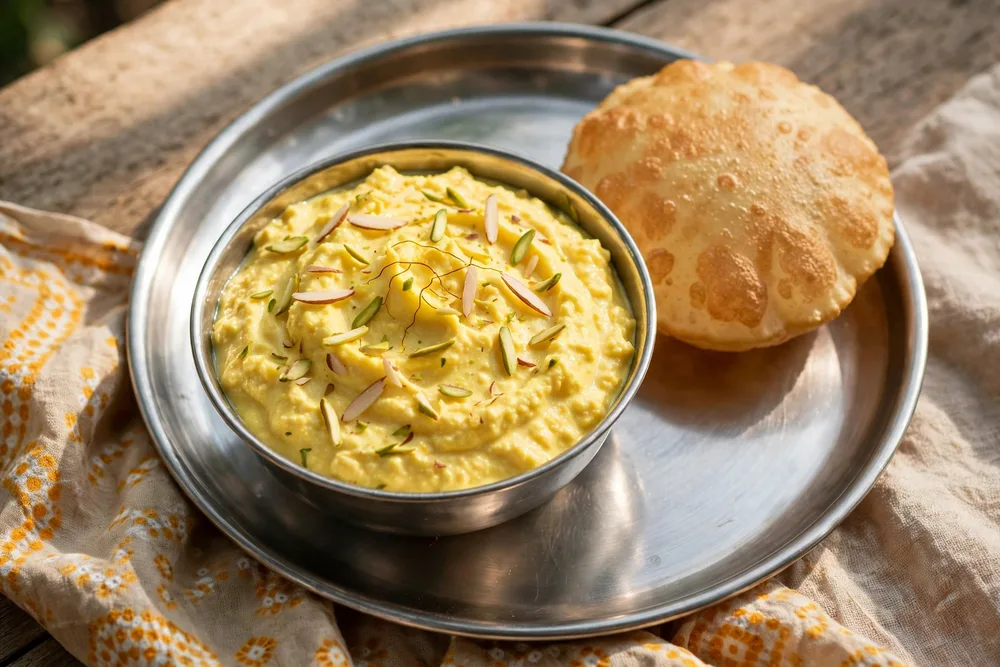
Serve. 100 g per portion in a small bowl, scattered with pistachio, almond and a few saffron strands. Done when: thick, creamy, holding its shape, saffron-yellow, sweet with cardamom — not runny and not gritty.
ℹ CCP = critical control point — the moment where getting it wrong spoils the dish or makes it unsafe.
Tips & Tricks + Common Mistakes to Avoid
- •Use full-fat curd — low-fat curd gives a thin, sour shrikhand.
- •Hang the curd in the fridge, not on the counter — warm hanging sours it.
- •Whisk until completely smooth before adding the sugar; lumps never come out afterwards.
- •Watery curd — the shrikhand runs off the spoon; hang it longer next time, there is no fix now.
- •Grain sugar — it stays gritty in cold curd; always use powdered sugar.
- •Serving warm — shrikhand must be chilled; warm shrikhand tastes flat and thin.
Section 5 · Nutrition — (100 g)
Standard food-composition estimates derived from the raw ingredient list.
Energy
198 kcal
Avg: 259 kcal
Protein
5 g
Avg: 10 g
Carbohydrate
26 g
Avg: 33 g
Fat
8 g
Avg: 10 g
Fibre
0 g
Avg: 2 g
Sodium
120 mg
Avg: 434 mg
53%
26 g
10%
5 g
37%
8 g
Energy split: carbohydrate 53% · protein 10% · fat 37%.
Check: 5×4 + 26×4 + 8×9 = 196 kcal, stated 198 kcal (rounded estimate).
Section 6 · Fun Fact & Origin
Shrikhand is the dessert of the Gujarati thali — hung curd, sugar and saffron, set overnight. Origin: not documented — no reliable source found for a single inventor, place or date.
Section 7 · Regional Traditions
Shrikhand belongs to Gujarat and Maharashtra, where it is the sweet of the thali and the wedding — served in a small bowl with puri, as part of the meal rather than after it. At a wedding lunch the shrikhand is portioned ahead into bowls before service opens, so the dessert counter never queues.
Three Commercial Variations
Use extra saffron and serve in a small earthen bowl with a pistachio praline crumble on top.
Halve the saffron milk to 15 ml and leave out the pistachio and almond garnish. Keep the cardamom — it carries the flavour. Saves about ₹5.80 per portion (see §11).
Use low-fat curd and cut the sugar to 120 g; hang it 2 hours longer so it thickens. The shrikhand is tangier.
Production Intelligence & Banquet Logistics
Batch Yield
10 portions × 100 g = 1.0 kg from 1.5 kg curd (about 800 g hung curd) + 200 g sugar.
Prep Schedule
Standard prep
Portion Control
portion 100 g into bowls before service opens with a weighed scoop.
Holding Limits
Hot hold 65°C
- Yield: 10 portions × 100 g = 1.0 kg from 1.5 kg curd (about 800 g hung curd) + 200 g sugar.
- Prep schedule (100 portions): hang the curd the day before; whisk and flavour the morning of the event; portion into bowls before service opens so the dessert counter never queues.
- Portion control: portion 100 g into bowls before service opens with a weighed scoop.
- Holding and service risks: hold covered and chilled; portion ahead where possible to avoid a queue. hold back a reserve batch and release it only when the first batch is nearly gone.
Food Safety, Allergens & Thermal Holding
Allergen Classification (Chapter 4 Matrix)
Contains — Milk, Nuts. Not present — Wheat, Egg, Fish, Soy, Mustard, Sesame. Diet: Veg.
Ingredient Costing, Pairings & Waste Reduction
Per Portion Cost
₹21.55
Cost per portion = (sum of ingredient quantity × rate) ÷ portions. Ingredient cost only — water, cooking fuel, transport, labour, and commercial overheads are not included. All rates are illustrative book planning benchmarks; replace with your live mandi rates.
Cost Driver Composition
Interactive Margin & Profit Simulator
Calibrate your catering client quote to verify commercial profit margins.
Quoted Revenue
₹6,500
Food Cost
₹2,155
Gross Profit
₹4,345
Profitable Menu Pairings
Kitchen Waste Reduction & Yield Strategy
The biggest waste is a batch that ran out first while other sweets remained, and shrikhand left standing warm. Portion into bowls before service, hold back a reserve batch, and keep it chilled and covered.