
Ven Pongal
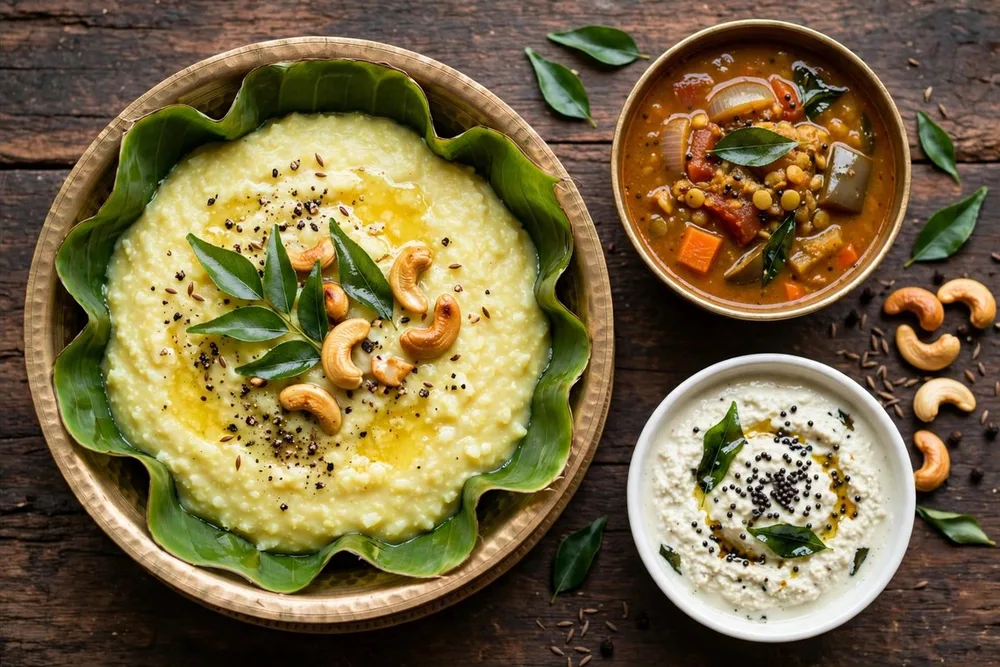
Creamy rice and moong dal porridge with a pepper–cumin ghee tempering. A temple and wedding-breakfast classic — soft, mild, served hot in small fresh batches.
Base Batch
10 Pax
250 g (2.5 kg total)
Prep / Cook
45m
30 min
Difficulty
medium
Commercial Standard
Cost / Portion
₹14.20
Illustrative Book Rate
Section 1 · At a Glance
Ingredients & Dynamic Pax Scaling Lab
Base formulated for 10 portions. Calibrate guest count, adjust catering buffer, or search specific ingredients below.
Batch Ingredient Cost
₹142
10 portions @ ₹14.20
Raw Batch Weight
~3.41 kg
Total raw commodities
Equipment Capacity
1 × GN 1/1
Standard chafing inserts
Scaling Factor
1.0× Base
10 Pax reference base
* Salt, spice, chilli and water do not scale perfectly — taste and adjust at every scale; never scale salt blindly.
* Scaling — linear from base 10 (×5, ×10, ×50). Above 1,000 g shown as kg; above 1,000 ml as L.
Step-by-Step Method & Critical Control Points (CCP)
Standard operating procedures with highlighted CCP warnings where execution failure compromises texture or food safety.
Dry-roast the dal. Roast the moong dal in a dry heavy pan, 2–3 min, until pale gold and fragrant. Do not brown it — browned dal turns bitter. Rinse rice and dal together twice; drain.
Start cooking. Put rice and dal in a pressure cooker or heavy pot with the 2.5 L water, the turmeric and 9 g of the salt (half). Bring to the boil.
Cook until soft — **⚠ CCP:** salt. Pressure-cook 4–5 whistles, or simmer covered 25–30 min, until rice and dal have broken down. Add the remaining 9 g salt only now — salt in full at the start can keep the dal firm. Taste and adjust.
Check consistency — **⚠ CCP.** Mash lightly. Done when no separate grains remain and the pongal flows slowly off the ladle, like thick porridge — it should spread slowly, not stand in a mound and not run like soup. Too thick? Loosen with a little hot water. Never cold water: it makes the pongal clump.
Make the tempering. Heat 40 g ghee; fry the cashews golden and lift out. In the same ghee add cumin, then crushed peppercorns, ginger, green chillies, curry leaves and asafoetida. Fry about 30 seconds until fragrant — do not let pepper or cumin burn, or the dish turns bitter.
Combine and rest. Pour the hot tempering and cashews over the pongal, mix well, cover and rest 5 minutes.
Finish and serve. Drizzle over the remaining 20 g ghee, mix once, serve hot at once — 250 g per portion (one level 250 ml ladle). Done when: fully soft, creamy, spreading slowly off the ladle, tempering fragrant with no burnt note.
ℹ CCP = critical control point — the moment where getting it wrong spoils the dish or makes it unsafe.
Tips & Tricks + Common Mistakes to Avoid
- •Roast the dal every time — it gives the nutty flavour and stops the dal tasting raw.
- •Keep rice : dal at 2 : 1. More dal makes it heavy; less makes it bland.
- •Crush peppercorns coarse, just before tempering.
- •Undercooked dal — hard yellow bits. Cook until the dal has broken down.
- •Too little water — it sets into a solid block as it cools.
- •Burnt tempering — blackened pepper or cumin makes the whole batch bitter; start again.
Section 5 · Nutrition — (250 g (2.5 kg total)
Standard food-composition estimates derived from the raw ingredient list.
Energy
330 kcal
Avg: 259 kcal
Protein
10 g
Avg: 10 g
Carbohydrate
55 g
Avg: 33 g
Fat
8 g
Avg: 10 g
Fibre
4 g
Avg: 2 g
Sodium
700 mg
Avg: 434 mg
66%
55 g
12%
10 g
22%
8 g
Energy split: carbohydrate 66% · protein 12% · fat 22%.
Check: 10×4 + 55×4 + 8×9 = 332 kcal, shown as 330 kcal (rounded). Sodium 700 mg comes from 1.8 g salt per portion.
Section 6 · Fun Fact & Origin
Fun fact: “Ven” means “white” in Tamil — Ven Pongal is the white, savoury pongal, named to set it apart from its sweet sister, Sakkarai Pongal, made with jaggery. Ven Pongal is widely associated with temple prasadam tradition in Tamil Nadu. Origin: not documented — no reliable source found for a single place, person or date of first creation.
Section 7 · Regional Traditions
Ven Pongal belongs to Tamil Nadu, where rice and moong dal are everyday staples. It is the breakfast of the harvest festival Thai Pongal (January), when the new rice is cooked in a fresh pot and offered before it is eaten. At weddings and house-warmings it is served on a banana leaf with sambar, coconut chutney and medu vada.
Three Commercial Variations
Full 60 g ghee per 10 portions plus an extra 20 g cashews. Temper a second small batch of ghee, pepper and curry leaves at the counter and pour it over each portion as served.
Halve the ghee to 30 g and leave out the cashews. Keep the pepper–cumin tempering — it carries the flavour.
Ghee to 20 g, moong dal up to 300 g, rice down to 450 g, and stir in 100 g grated carrot. Portion stays 250 g.
Production Intelligence & Banquet Logistics
Batch Yield
10 portions × 250 g = 2.5 kg cooked, from 500 g rice + 250 g dal + 2.5 L water.
Prep Schedule
Standard prep
Portion Control
one level 250 ml ladle = one 250 g portion. Weigh the first five portions of each batch.
Holding Limits
Hot hold 65°C
- Yield: 10 portions × 250 g = 2.5 kg cooked, from 500 g rice + 250 g dal + 2.5 L water.
- Prep schedule (100 portions): roast and rinse the evening before; cook in two 50-portion vessels in the morning, tempering each separately.
- Portion control: one level 250 ml ladle = one 250 g portion. Weigh the first five portions of each batch.
- Holding and service risks: serve fresh in small replenished batches — it thickens and turns soggy if held too long. Hold covered, replenish every 20–30 min, loosen with hot water only. Cook a fresh batch rather than holding one through a whole service.
Food Safety, Allergens & Thermal Holding
Allergen Classification (Chapter 4 Matrix)
Contains — Milk, Nuts. Not present — Wheat, Egg, Fish, Soy, Mustard, Sesame. Diet: Veg.
Ingredient Costing, Pairings & Waste Reduction
Per Portion Cost
₹14.20
Cost per portion = (sum of ingredient quantity × rate) ÷ portions. Ingredient cost only — water, cooking fuel, transport, labour, and commercial overheads are not included. All rates are illustrative book planning benchmarks; replace with your live mandi rates.
Cost Driver Composition
Interactive Margin & Profit Simulator
Calibrate your catering client quote to verify commercial profit margins.
Quoted Revenue
₹4,300
Food Cost
₹1,420
Gross Profit
₹2,880
Profitable Menu Pairings
Kitchen Waste Reduction & Yield Strategy
The biggest waste is a whole batch thickening and being thrown away. Cook in small batches matched to the queue. Leftover pongal must not be sold the next day; use it for staff meals the same day.