
Vegetable Hakka Noodles
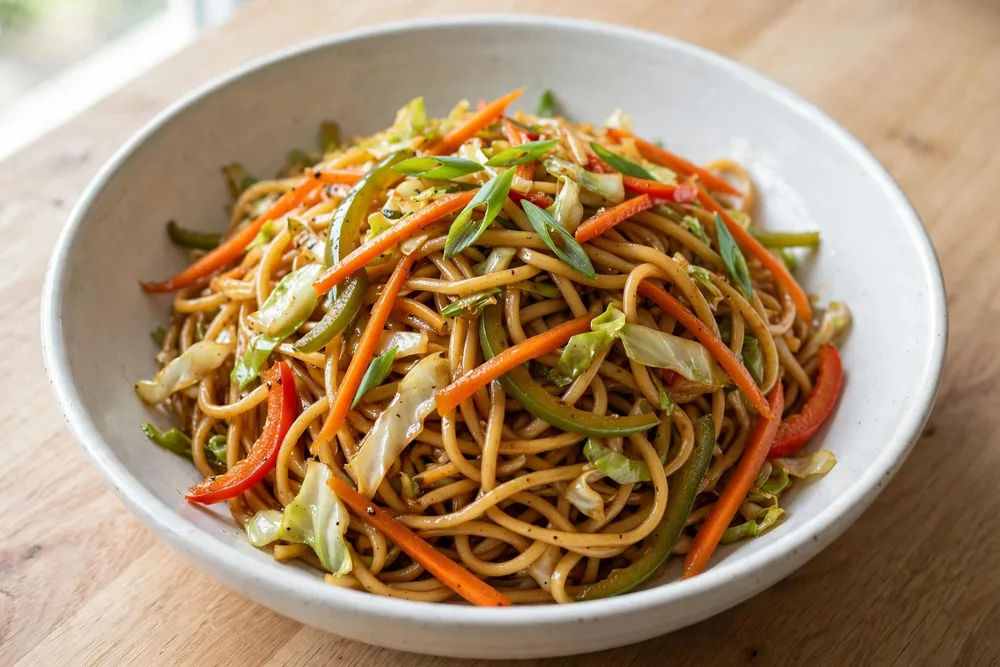
Wok-tossed noodles with julienned vegetables — the Indo-Chinese counter main
Base Batch
10 Pax
250 g
Prep / Cook
30m
15 min
Difficulty
easy
Commercial Standard
Cost / Portion
₹15.80
Illustrative Book Rate
Section 1 · At a Glance
Ingredients & Dynamic Pax Scaling Lab
Base formulated for 10 portions. Calibrate guest count, adjust catering buffer, or search specific ingredients below.
Batch Ingredient Cost
₹158
10 portions @ ₹15.80
Raw Batch Weight
~4.58 kg
Total raw commodities
Equipment Capacity
1 × GN 1/1
Standard chafing inserts
Scaling Factor
1.0× Base
10 Pax reference base
* Noodles: boil, drain and toss with a little oil so they do not stick while waiting for the wok.
* Scaling — linear from base 10 (×5, ×10, ×50). Above 1,000 g shown as kg; above
* 1,000 ml as L. Salt, spice, chilli and water: taste and adjust — never scale blindly.
Step-by-Step Method & Critical Control Points (CCP)
Standard operating procedures with highlighted CCP warnings where execution failure compromises texture or food safety.
Boil the noodles. Boil the water with half the salt; add noodles and cook until just tender, 4–5 minutes. Drain, rinse briefly, toss with a little of the oil, and keep aside. **⚠ CCP:** do not overcook — soft noodles break in the wok.
Heat the wok. Heat the remaining oil in a wide wok on high heat until it shimmers.
Fry the aromatics. Add ginger and garlic; fry 30 seconds until fragrant, not brown.
Fry the vegetables. Add cabbage, carrot, capsicum and beans; toss on high heat 2–3 minutes until just tender and still crisp.
Add the noodles — **⚠ CCP.** Add the noodles and toss hard for 2–3 minutes until hot through. **⚠ CCP:** keep the heat high and the batches small (10 portions at a time) — a big, cool batch steams and clumps.
Season and serve. Sprinkle soy sauce, chilli sauce, vinegar, remaining salt and pepper around the edges, toss once more, fold in the spring onion, and serve 250 g per portion at once. Done when: noodles glossy and separate, vegetables bright and crisp, smoky and savoury.
ℹ CCP = critical control point — the moment where getting it wrong spoils the dish or makes it unsafe.
Tips & Tricks + Common Mistakes to Avoid
- •Toss the boiled noodles in a little oil so they stay separate
- •Keep the wok screaming hot — that heat is the flavour.
- •Overcooked noodles (they snap and clump)
- •Overloading the wok (steamed, soggy noodles)
- •Too much sauce (dark, salty noodles that stain the plate).
Section 5 · Nutrition — 250 g
Standard food-composition estimates derived from the raw ingredient list.
Energy
345 kcal
Avg: 259 kcal
Protein
9 g
Avg: 10 g
Carbohydrate
55 g
Avg: 33 g
Fat
10 g
Avg: 10 g
Fibre
4 g
Avg: 2 g
Sodium
720 mg
Avg: 434 mg
64%
55 g
10%
9 g
26%
10 g
Energy split: carbohydrate 64% · protein 10% · fat 26%.
Section 6 · Fun Fact & Origin
Hakka noodles are documented as an Indo-Chinese dish: Hakka Chinese migrants brought noodle cooking to Kolkata, and Indian kitchens adapted it with local vegetables, soy sauce and chilli sauce. No single inventor is reliably documented.
Section 7 · Regional Traditions
An Indo-Chinese dish, now Pan-India: the noodle main at weddings, birthdays and corporate lunches across India, served at live counters beside Vegetable Fried Rice ([#174](#dish-174)), and the standard late-night item at any mixed buffet.
Three Commercial Variations
finish with a drizzle of sesame oil and a sprinkle of toasted sesame seeds at the counter.
use plain wheat noodles instead of branded hakka noodles and halve the chilli sauce.
whole-wheat noodles, oil to 30 ml, soy sauce to 30 ml, and double the cabbage and beans.
Production Intelligence & Banquet Logistics
Batch Yield
10 portions × 250 g = 2.5 kg, from 800 g dry noodles.
Prep Schedule
Standard prep
Portion Control
one 250 g ladle; weigh the first five portions of each batch.
Holding Limits
do not hold — toss to order in 10-portion batches; a held batch clumps within 20 minutes.
- Yield: 10 portions × 250 g = 2.5 kg, from 800 g dry noodles.
- Prep: boil noodles in the last hour before service; chop all vegetables the morning of the event.
- Portion control: one 250 g ladle; weigh the first five portions of each batch.
- Holding: do not hold — toss to order in 10-portion batches; a held batch clumps within 20 minutes.
- Risk: the wok cooling between batches — reheat it fully before each batch, or the noodles steam.
Food Safety, Allergens & Thermal Holding
Allergen Classification (Chapter 4 Matrix)
Contains — Wheat, Soy. Not present — Milk, Egg, Fish, Nuts, Mustard, Sesame. Diet: Veg.
Ingredient Costing, Pairings & Waste Reduction
Per Portion Cost
₹15.80
Cost per portion = (sum of ingredient quantity × rate) ÷ portions. Ingredient cost only — water, cooking fuel, transport, labour, and commercial overheads are not included. All rates are illustrative book planning benchmarks; replace with your live mandi rates.
Cost Driver Composition
Interactive Margin & Profit Simulator
Calibrate your catering client quote to verify commercial profit margins.
Quoted Revenue
₹4,700
Food Cost
₹1,580
Gross Profit
₹3,120
Profitable Menu Pairings
Kitchen Waste Reduction & Yield Strategy
Boiled noodles left over go into the next batch of fried noodles only if cooled quickly and refrigerated the same day — otherwise they are staff meals the same day. Vegetable trimmings go into stock; never toss a whole batch because the wok was too cool.