
Vada Pav
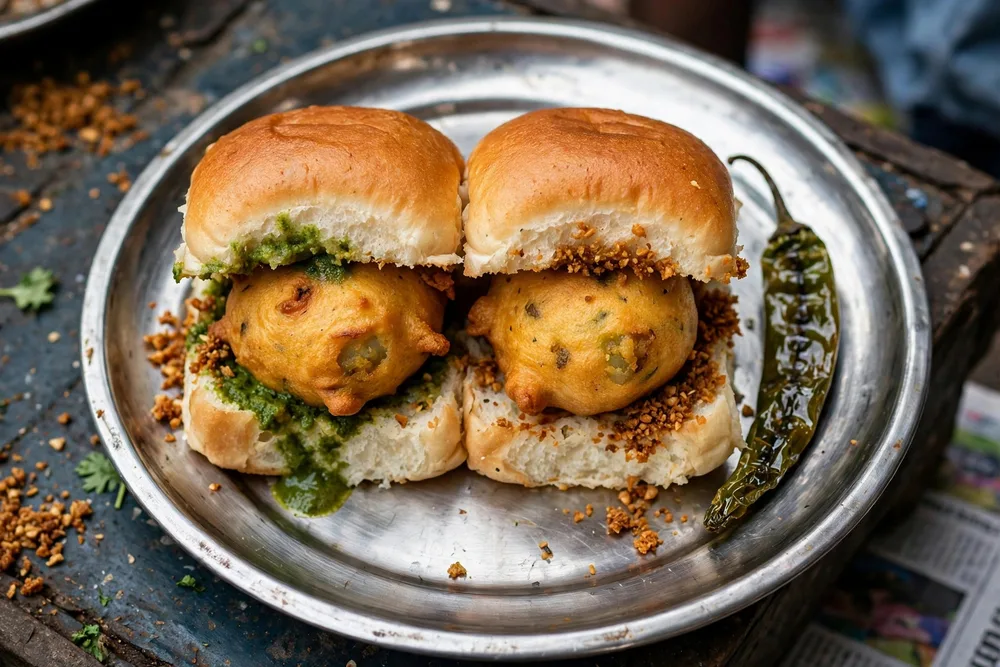
Mumbai's burger — a spiced potato vada in a soft pav with chutneys and a fried green chilli. The city's fastest snack.
Base Batch
10 Pax
2 vada pav (about 190 g)
Prep / Cook
45m
20 min
Difficulty
medium
Commercial Standard
Cost / Portion
₹19.55
Illustrative Book Rate
Section 1 · At a Glance
Ingredients & Dynamic Pax Scaling Lab
Base formulated for 10 portions. Calibrate guest count, adjust catering buffer, or search specific ingredients below.
Batch Ingredient Cost
₹196
10 portions @ ₹19.55
Raw Batch Weight
~1.69 kg
Total raw commodities
Equipment Capacity
1 × GN 1/1
Standard chafing inserts
Scaling Factor
1.0× Base
10 Pax reference base
* Scaling — linear from base 10 (×5, ×10, ×50). Above 1,000 g shown as kg; above 1,000 ml as L. Frying oil: the 500 ml is the
* kadhai quantity for 10 portions, not the amount eaten — it is strained and reused across batches; only the absorbed share is
* costed (see §11). For 50+ portions, fry in small batches so the oil temperature does not drop.
Step-by-Step Method & Critical Control Points (CCP)
Standard operating procedures with highlighted CCP warnings where execution failure compromises texture or food safety.
Make the filling. Temper mustard, cumin, asafoetida and curry leaves in oil; add ginger-green chilli paste and turmeric, fry 30 seconds. Add mashed potatoes, salt, coriander and lemon; mix and cool. **⚠ CCP—** it must hold its shape.
Shape the vadas. Divide into 20 equal balls (about 35 g each) and roll smooth.
Make the batter. Whisk besan, rice flour, the 3 g turmeric, 5 g salt, baking soda and the 150 ml water to a smooth batter — thick enough to coat, thin enough to drip. Rest 10 minutes.
Heat the oil. Heat the 500 ml oil on medium-high heat. **⚠ CCP—** temperature by sight: a drop of batter should sizzle and rise; if it sinks, the oil is too cool, and if it browns, it is too hot.
Fry. Dip each ball in batter, let the excess drip, and lower into the oil. Fry 3–4 minutes until golden and crisp. Drain on a rack, not on paper — paper makes the coating soggy.
Fry the chillies. Fry the green chillies for a few seconds until they blister; sprinkle with a little salt.
Assemble. Slit a pav, spread green chutney on one side and dry garlic chutney on the other, place a hot vada inside, and serve with a fried chilli. Done when: vada crisp outside and soft inside, pav soft, chutneys bright, chilli blistered.
Serve. 2 vada pav per portion. Serve hot — a vada pav held for 10 minutes is a different, worse dish.
ℹ CCP = critical control point — the moment where getting it wrong spoils the dish or makes it unsafe.
Tips & Tricks + Common Mistakes to Avoid
- •Cool the filling fully before shaping — warm filling makes the batter slide off.
- •Add rice flour to the batter; it is what keeps the coating crisp.
- •Drain on a rack, not on paper — paper traps steam and softens the crust.
- •Oil too cool — the vadas drink oil and turn greasy.
- •Oil too hot — the batter browns while the inside stays cold.
- •Assembling ahead of service — the pav goes soggy and the vada loses its crunch.
Section 5 · Nutrition — (2 vada pav (about 190 g)
Standard food-composition estimates derived from the raw ingredient list.
Energy
348 kcal
Avg: 259 kcal
Protein
7 g
Avg: 10 g
Carbohydrate
46 g
Avg: 33 g
Fat
15 g
Avg: 10 g
Fibre
3 g
Avg: 2 g
Sodium
550 mg
Avg: 434 mg
53%
46 g
8%
7 g
39%
15 g
Energy split: carbohydrate 53% · protein 8% · fat 39%.
Check: 7×4 + 46×4 + 15×9 = 347 kcal, stated 348 kcal (rounded estimate).
Section 6 · Fun Fact & Origin
Vada pav is Mumbai's answer to the burger — invented, by the most widely told account, in the 1960s and 1970s by street vendors near Dadar station, who put a batata vada inside a pav so mill workers could eat it with one hand on the way to work. Vada pav is widely described as a Mumbai street food of the 1960s–1970s, made for mill workers near Dadar station; several vendors are named. Origin: debated — no single inventor reliably documented.
Section 7 · Regional Traditions
Vada pav belongs to Mumbai, where it is the city's snack — sold from handcarts and stalls on every corner, eaten standing up, with a fried green chilli on the side. It is the snack of the commute, the college canteen and the corporate break.
Three Commercial Variations
Use a cheese slice inside the pav and a spoon of schezwan chutney alongside.
Skip the dry garlic chutney. Saves about ₹1.00 per portion (see §11).
Bake the battered vadas in a hot oven instead of deep-frying; serve one vada pav with a salad.
Production Intelligence & Banquet Logistics
Batch Yield
20 vada pav (20 vadas × about 50 g + 20 pav × about 43 g) = about 1.9 kg.
Prep Schedule
Standard prep
Portion Control
weigh the first five filling balls (about 35 g each) and count two vada pav per portion.
Holding Limits
Hot hold 65°C
- Yield: 20 vada pav (20 vadas × about 50 g + 20 pav × about 43 g) = about 1.9 kg.
- Prep schedule (100 portions): boil and mash the potatoes and make the filling the morning of the event; shape the vadas and fry in small batches at the counter, assembling to order (~20 min per 50-portion batch).
- Portion control: weigh the first five filling balls (about 35 g each) and count two vada pav per portion.
- Holding and service risks: serve fresh in small batches — fried starters lose crispness fast if held. fry to the queue, keep the oil hot between batches, and assemble only to order.
Food Safety, Allergens & Thermal Holding
Allergen Classification (Chapter 4 Matrix)
Contains — Wheat, Mustard. Not present — Milk, Egg, Fish, Nuts, Soy, Sesame. Diet: Veg.
Ingredient Costing, Pairings & Waste Reduction
Per Portion Cost
₹19.55
Cost per portion = (sum of ingredient quantity × rate) ÷ portions. Ingredient cost only — water, cooking fuel, transport, labour, and commercial overheads are not included. All rates are illustrative book planning benchmarks; replace with your live mandi rates.
Cost Driver Composition
Interactive Margin & Profit Simulator
Calibrate your catering client quote to verify commercial profit margins.
Quoted Revenue
₹5,900
Food Cost
₹1,955
Gross Profit
₹3,945
Profitable Menu Pairings
Kitchen Waste Reduction & Yield Strategy
The biggest waste is vadas fried ahead and gone soggy, and oil dropped cold by frying too many at once. Fry in small batches to the queue, drain on a rack, and assemble only to order.