
South Indian Wedding Poori
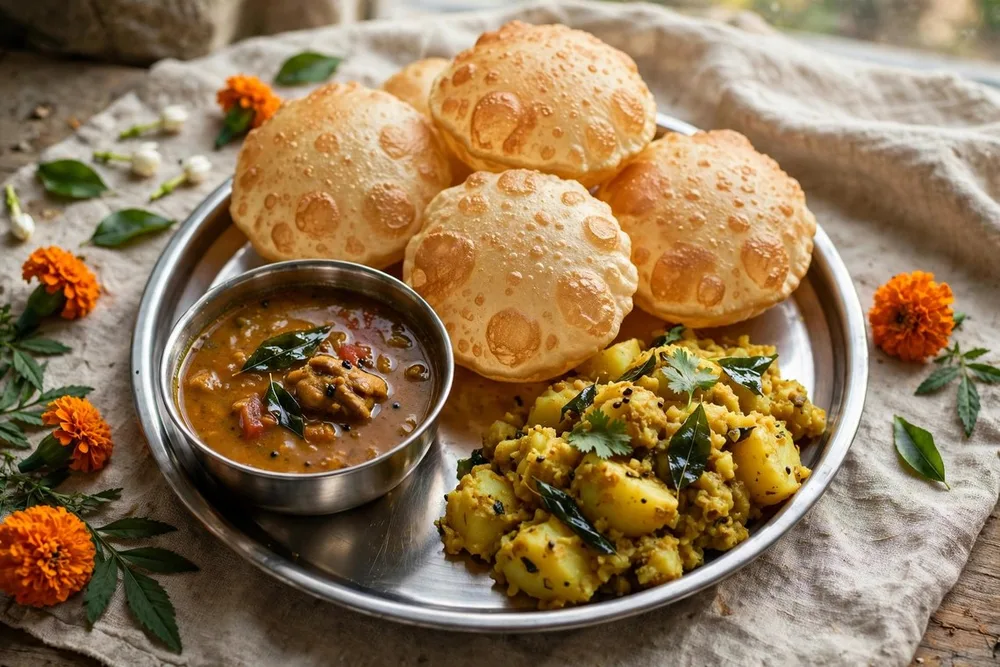
Puffed wheat flatbread, fried golden — the wedding poori, served hot with potato masala and sambar.
Base Batch
10 Pax
2 pooris (120 g)
Prep / Cook
35m
15 min
Difficulty
medium
Commercial Standard
Cost / Portion
₹4.91
Illustrative Book Rate
Section 1 · At a Glance
Ingredients & Dynamic Pax Scaling Lab
Base formulated for 10 portions. Calibrate guest count, adjust catering buffer, or search specific ingredients below.
Batch Ingredient Cost
₹49
10 portions @ ₹4.91
Raw Batch Weight
~0.92 kg
Total raw commodities
Equipment Capacity
1 × GN 1/1
Standard chafing inserts
Scaling Factor
1.0× Base
10 Pax reference base
* Salt, spice, chilli and water do not scale perfectly — taste and adjust at every scale; never scale salt blindly.
* Scaling — linear from base 10 (×5, ×10, ×50). Above 1,000 g shown as kg; above 1,000 ml as L.
Step-by-Step Method & Critical Control Points (CCP)
Standard operating procedures with highlighted CCP warnings where execution failure compromises texture or food safety.
Mix the atta, rava, salt and oil, then add water a little at a time and knead into a firm, smooth dough — **⚠ CCP:** the dough must be firm, not soft; soft dough drinks oil and will not puff.
Rest the dough covered for 30 minutes. Divide into small balls and roll each into a thin round, about 10 cm across.
Heat the oil to medium-hot. Slide a poori in and press it gently with a slotted spoon so it puffs up.
Flip once and fry until golden on both sides. Drain on a rack and serve hot at once with potato masala and sambar.
Fry in small batches so the oil stays hot — **⚠ CCP:** oil that cools makes flat, oily pooris.
ℹ CCP = critical control point — the moment where getting it wrong spoils the dish or makes it unsafe.
Tips & Tricks + Common Mistakes to Avoid
- •Firm dough is the secret — soft dough never puffs.
- •Roll the rounds evenly; a thin spot bursts and the poori will not puff.
- •Press gently with the spoon the moment the poori hits the oil.
- •Soft dough — flat, oily pooris.
- •Cool oil — pooris that drink oil and stay flat.
- •Rolling too thick — heavy pooris that do not puff.
Section 5 · Nutrition — (2 pooris (120 g)
Standard food-composition estimates derived from the raw ingredient list.
Energy
275 kcal
Avg: 259 kcal
Protein
9 g
Avg: 10 g
Carbohydrate
46 g
Avg: 33 g
Fat
6 g
Avg: 10 g
Fibre
2 g
Avg: 2 g
Sodium
310 mg
Avg: 434 mg
67%
46 g
13%
9 g
20%
6 g
Energy split: carbohydrate 67% · protein 13% · fat 20%.
Check: 9×4 + 46×4 + 6×9 = 274 kcal, shown as 275 kcal (rounded). Sodium 310 mg comes from 0.8 g salt per portion.
Section 6 · Fun Fact & Origin
Fun fact: Poori is the wedding bread — it puffs in seconds in hot oil, so it is fried live at the counter and served the moment it leaves the kadai. Origin: not documented — no reliable source found.
Section 7 · Regional Traditions
Wedding poori is served at South Indian weddings and festivals with potato masala, sambar and chutney, fried live at a counter so guests get it puffed and hot. It is breakfast and lunch food, and the poori–masala pair is a standard wedding plate.
Three Commercial Variations
Serve with potato masala, sambar and a spoon of chutney on the same plate, fried to order.
Fry smaller pooris and serve 2 per portion; the masala carries the plate.
Use whole-wheat flour, fry at the right temperature so the poori absorbs less oil, and serve with vegetable sambar.
Production Intelligence & Banquet Logistics
Batch Yield
10 portions × 2 pooris = 20 pooris, about 1.2 kg, from 500 g atta.
Prep Schedule
knead and rest the dough in the morning; roll and fry to order in the last hour before service.
Portion Control
one weighed dough ball per poori; serve 2 per portion.
Holding Limits
fry to order. Pooris deflate and soften within minutes of frying.
- Yield: 10 portions × 2 pooris = 20 pooris, about 1.2 kg, from 500 g atta.
- Prep schedule: knead and rest the dough in the morning; roll and fry to order in the last hour before service.
- Portion control: one weighed dough ball per poori; serve 2 per portion.
- Holding: fry to order. Pooris deflate and soften within minutes of frying.
Food Safety, Allergens & Thermal Holding
Allergen Classification (Chapter 4 Matrix)
Contains — Wheat. Not present — Milk, Egg, Fish, Nuts, Soy, Mustard, Sesame. Diet: Veg.
Ingredient Costing, Pairings & Waste Reduction
Per Portion Cost
₹4.91
Cost per portion = (sum of ingredient quantity × rate) ÷ portions. Ingredient cost only — water, cooking fuel, transport, labour, and commercial overheads are not included. All rates are illustrative book planning benchmarks; replace with your live mandi rates.
Cost Driver Composition
Interactive Margin & Profit Simulator
Calibrate your catering client quote to verify commercial profit margins.
Quoted Revenue
₹1,500
Food Cost
₹491
Gross Profit
₹1,009
Profitable Menu Pairings
Kitchen Waste Reduction & Yield Strategy
Only the oil actually absorbed is costed — the oil in the kadai is strained and reused. Pooris that do not puff are served as poori chips with chutney, not thrown away.