
Rava Dosa
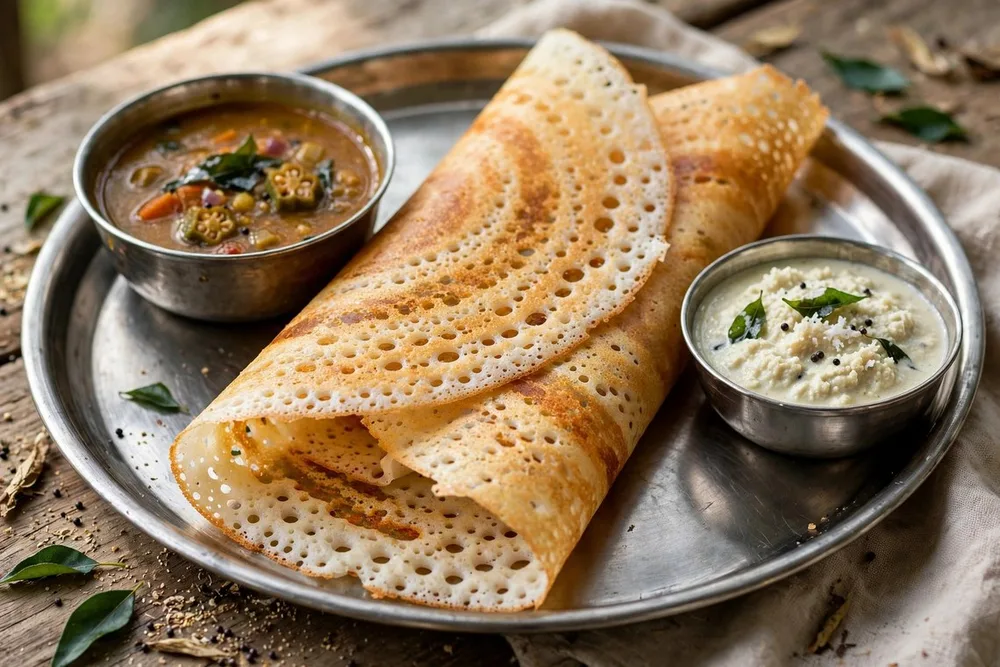
Lacy, crisp semolina crepe with holes all over — no fermentation, mixed and poured straight onto a hot griddle.
Base Batch
10 Pax
1 dosa (180 g)
Prep / Cook
30m
15 min
Difficulty
medium
Commercial Standard
Cost / Portion
₹4.91
Illustrative Book Rate
Section 1 · At a Glance
Ingredients & Dynamic Pax Scaling Lab
Base formulated for 10 portions. Calibrate guest count, adjust catering buffer, or search specific ingredients below.
Batch Ingredient Cost
₹49
10 portions @ ₹4.91
Raw Batch Weight
~1.54 kg
Total raw commodities
Equipment Capacity
1 × GN 1/1
Standard chafing inserts
Scaling Factor
1.0× Base
10 Pax reference base
* Salt, spice, chilli and water do not scale perfectly — taste and adjust at every scale; never scale salt blindly.
* Scaling — linear from base 10 (×5, ×10, ×50). Above 1,000 g shown as kg; above 1,000 ml as L.
Step-by-Step Method & Critical Control Points (CCP)
Standard operating procedures with highlighted CCP warnings where execution failure compromises texture or food safety.
Mix the rava, rice flour and maida with the water, salt, chillies, ginger, cumin, crushed peppercorns, curry leaves and coriander leaves into a thin, watery batter. Rest 30 minutes — the rava absorbs water and thickens slightly.
Stir the batter well before every dosa; the rava settles fast. Add a splash of water if it thickens too much — the batter must pour like thin buttermilk.
Heat the griddle on high. Sprinkle water to test — it must sizzle hard. Pour the batter from a height in a rough circle, filling the holes with a few more dribbles — **⚠ CCP:** the griddle must be very hot, or the batter will not set into a lacy net.
Drizzle oil or ghee around the edge and into the holes. Cook without flipping until the dosa is golden, crisp and dry.
Lift it off and serve at once with sambar and chutney. Do not stack dosas — they steam each other soft.
ℹ CCP = critical control point — the moment where getting it wrong spoils the dish or makes it unsafe.
Tips & Tricks + Common Mistakes to Avoid
- •Pour from a height and do not spread with a ladle — the holes are the point of the dish.
- •Stir between every dosa; settled rava gives a thick first dosa and a thin last one.
- •A hotter griddle gives a lacier dosa; if it browns too fast, lower the heat a little.
- •Thick batter — a flat pancake with no holes.
- •A cool griddle — the batter pools instead of setting into a net.
- •Stacking finished dosas — they turn limp and leathery.
Section 5 · Nutrition — (1 dosa (180 g)
Standard food-composition estimates derived from the raw ingredient list.
Energy
270 kcal
Avg: 259 kcal
Protein
7 g
Avg: 10 g
Carbohydrate
52 g
Avg: 33 g
Fat
4 g
Avg: 10 g
Fibre
2 g
Avg: 2 g
Sodium
390 mg
Avg: 434 mg
76%
52 g
10%
7 g
13%
4 g
Energy split: carbohydrate 76% · protein 10% · fat 13%.
Check: 7×4 + 52×4 + 4×9 = 272 kcal, shown as 270 kcal (rounded). Sodium 390 mg comes from 1.0 g salt per portion.
Section 6 · Fun Fact & Origin
Fun fact: Rava dosa is the instant dosa: unlike fermented dosa batter, it needs no overnight wait, which is why it is the standby when a kitchen runs out of batter. Origin: not documented — no reliable source found.
Section 7 · Regional Traditions
Rava dosa is a Karnataka tiffin-room favourite, served at breakfast and dinner across South India. It is a live-counter dish at weddings — guests watch the batter poured from a height — and it is always served with sambar and coconut chutney.
Three Commercial Variations
Add finely chopped onion and a few cashew pieces to the batter and roast with ghee for a richer, golden finish.
Leave out the cashews and roast with oil; the lacy texture is the selling point, not the garnish.
Use whole-wheat rava and roast with the minimum oil on a non-stick griddle.
Production Intelligence & Banquet Logistics
Batch Yield
10 portions × 180 g = 1.8 kg (10 dosas).
Prep Schedule
mix the batter 30 minutes before service; chop the aromatics in the morning.
Portion Control
one small jug of batter per dosa; measure the first three pours.
Holding Limits
cook to order only. A rava dosa loses its crispness within minutes of leaving the griddle.
- Yield: 10 portions × 180 g = 1.8 kg (10 dosas).
- Prep schedule: mix the batter 30 minutes before service; chop the aromatics in the morning.
- Portion control: one small jug of batter per dosa; measure the first three pours.
- Holding: cook to order only. A rava dosa loses its crispness within minutes of leaving the griddle.
Food Safety, Allergens & Thermal Holding
Allergen Classification (Chapter 4 Matrix)
Contains — Milk, Wheat. Not present — Egg, Fish, Nuts, Soy, Mustard, Sesame. Diet: Veg.
Ingredient Costing, Pairings & Waste Reduction
Per Portion Cost
₹4.91
Cost per portion = (sum of ingredient quantity × rate) ÷ portions. Ingredient cost only — water, cooking fuel, transport, labour, and commercial overheads are not included. All rates are illustrative book planning benchmarks; replace with your live mandi rates.
Cost Driver Composition
Interactive Margin & Profit Simulator
Calibrate your catering client quote to verify commercial profit margins.
Quoted Revenue
₹1,500
Food Cost
₹491
Gross Profit
₹1,009
Profitable Menu Pairings
Kitchen Waste Reduction & Yield Strategy
Batter that thickens on standing is thinned with water and used up the same service. Broken dosa pieces are served as a crisp topping over sambar rice at staff meals, not sold.