
Radhaballabhi
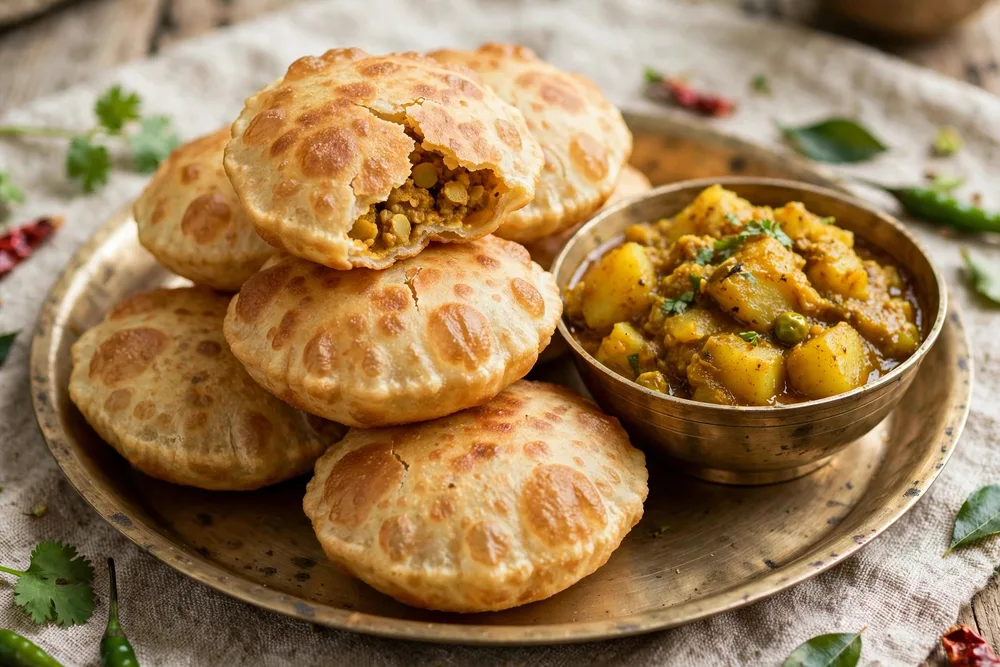
Golden puffed pooris stuffed with a spiced urad dal filling — a festive Bengali breakfast poori, richer than luchi and made for special mornings.
Base Batch
10 Pax
2 pooris (about 120 g)
Prep / Cook
70m
30 min
Difficulty
medium–high
Commercial Standard
Cost / Portion
₹8.92
Illustrative Book Rate
Section 1 · At a Glance
Ingredients & Dynamic Pax Scaling Lab
Base formulated for 10 portions. Calibrate guest count, adjust catering buffer, or search specific ingredients below.
Batch Ingredient Cost
₹89
10 portions @ ₹8.92
Raw Batch Weight
~1.46 kg
Total raw commodities
Equipment Capacity
1 × GN 1/1
Standard chafing inserts
Scaling Factor
1.0× Base
10 Pax reference base
* Salt, spice and chilli: taste and adjust to your own ingredients — they do not scale perfectly. Water: adjust to your rice, dal and vegetables.
* Scaling — linear from base 10 (×5, ×10, ×50). Above 1,000 g shown as kg; above 1,000 ml as L.
Step-by-Step Method & Critical Control Points (CCP)
Standard operating procedures with highlighted CCP warnings where execution failure compromises texture or food safety.
Soak the dal. Soak urad dal 4 hours, drain well. Grind with ginger and green chillies to a thick, coarse paste with as little water as possible. **⚠ CCP—** paste: too wet and the filling leaks while rolling.
Cook the filling. Heat the cooking oil; add fennel seeds and asafoetida, then the dal paste, cumin powder and salt. Cook on low heat, stirring, 8–10 minutes until dry and crumbly. Cool completely.
Make the dough. Mix maida, ghee and salt; add warm water and knead to a soft, smooth dough. Rest 30 minutes covered.
Stuff. Divide dough and filling each into 20 equal parts. Flatten a dough ball, place filling in the centre, seal and roll into a smooth ball. Rest 5 minutes.
Roll. Roll each stuffed ball gently on an oiled surface to a round about 12 cm across. **⚠ CCP—** rolling: too much pressure tears the poori and the filling leaks into the oil.
Fry. Heat the frying oil on medium-high. **⚠ CCP—** oil: a small piece of dough should rise at once. Slide a poori in, press gently so it puffs, flip once, lift out pale gold, about 30 seconds a side. Drain briefly.
Serve hot at once, 2 pooris per portion, with alur dom or cholar dal. Done when: puffed, golden, filling evenly spread, no leak.
ℹ CCP = critical control point — the moment where getting it wrong spoils the dish or makes it unsafe.
Tips & Tricks + Common Mistakes to Avoid
- •Grind the dal coarse, not smooth — a smooth paste turns gummy.
- •Cool the filling fully before stuffing, or the dough softens.
- •Roll with light, even pressure from the centre out.
- •Wet filling — it bursts in the oil and spoils the batch.
- •Torn poori — oil seeps in and the poori goes heavy.
- •Frying too hot — brown outside, doughy inside.
Section 5 · Nutrition — (2 pooris (about 120 g)
Standard food-composition estimates derived from the raw ingredient list.
Energy
410 kcal
Avg: 259 kcal
Protein
10 g
Avg: 10 g
Carbohydrate
62 g
Avg: 33 g
Fat
14 g
Avg: 10 g
Fibre
3 g
Avg: 2 g
Sodium
640 mg
Avg: 434 mg
60%
62 g
10%
10 g
30%
14 g
Energy split: carbohydrate 60% · protein 10% · fat 30%.
Section 6 · Fun Fact & Origin
Origin: not documented — no reliable source found.
Section 7 · Regional Traditions
Radhaballabhi is a festive Bengali poori, named for Radha and served at Janmashtami, weddings and special breakfasts in West Bengal, usually with alur dom or cholar dal.
Three Commercial Variations
Fry in ghee, add a little more fennel to the filling, serve with a richer alur dom.
Use half urad dal and half chana dal in the filling.
Shallow-fry in a little oil; serve with a light dal instead of fried potato curry.
Production Intelligence & Banquet Logistics
Batch Yield
20 stuffed pooris, about 1.2 kg.
Prep Schedule
soak dal the night before; grind and cook the filling the morning of the event; stuff and roll 30 minutes before service.
Portion Control
count 2 pooris per plate.
Holding Limits
pooris do not hold — fry to order in small batches; filling holds refrigerated for a day.
- Yield: 20 stuffed pooris, about 1.2 kg.
- Prep schedule: soak dal the night before; grind and cook the filling the morning of the event; stuff and roll 30 minutes before service.
- Portion control: count 2 pooris per plate.
- Holding: pooris do not hold — fry to order in small batches; filling holds refrigerated for a day.
- Service risk: torn pooris in the oil — keep a spare batch of dough and filling ready.
Food Safety, Allergens & Thermal Holding
Allergen Classification (Chapter 4 Matrix)
Contains — Milk, Wheat. Not present — Egg, Fish, Nuts, Soy, Mustard, Sesame. Diet: Veg.
Ingredient Costing, Pairings & Waste Reduction
Per Portion Cost
₹8.92
Cost per portion = (sum of ingredient quantity × rate) ÷ portions. Ingredient cost only — water, cooking fuel, transport, labour, and commercial overheads are not included. All rates are illustrative book planning benchmarks; replace with your live mandi rates.
Cost Driver Composition
Interactive Margin & Profit Simulator
Calibrate your catering client quote to verify commercial profit margins.
Quoted Revenue
₹2,700
Food Cost
₹892
Gross Profit
₹1,808
Profitable Menu Pairings
Kitchen Waste Reduction & Yield Strategy
Leftover filling becomes paratha stuffing or a dal pancake; torn pooris are cut and fried as namkeen.