
Ghugni
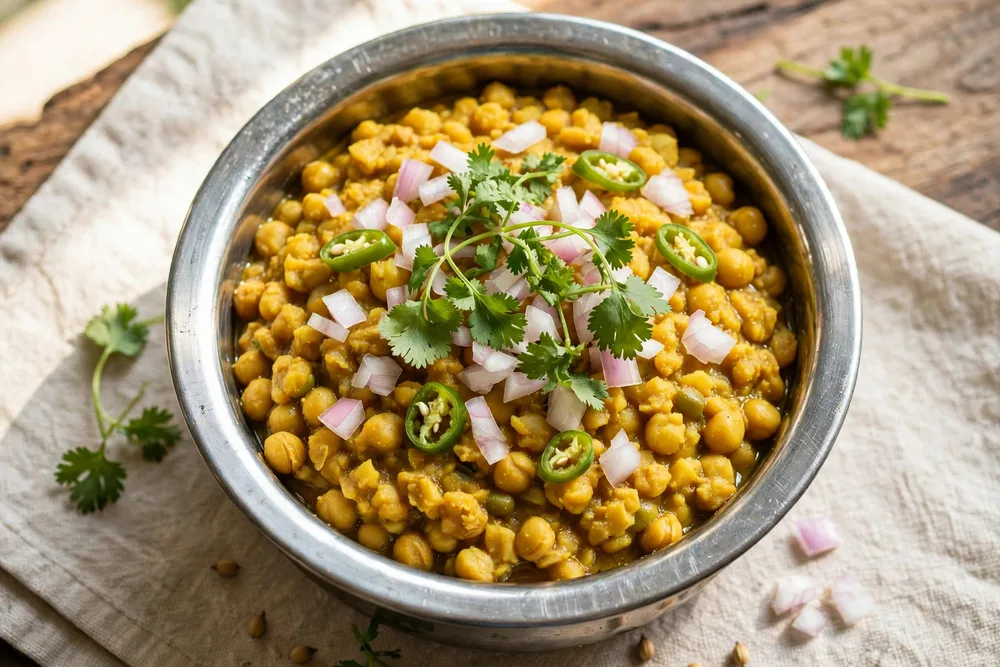
Yellow peas simmered with onion, tomato and spice, finished with raw onion, chilli and coriander — the Bengali street and breakfast bowl, ladled hot over toast or with luchi.
Base Batch
10 Pax
200 g
Prep / Cook
415m
40 min
Difficulty
easy
Commercial Standard
Cost / Portion
₹7.97
Illustrative Book Rate
Section 1 · At a Glance
Ingredients & Dynamic Pax Scaling Lab
Base formulated for 10 portions. Calibrate guest count, adjust catering buffer, or search specific ingredients below.
Batch Ingredient Cost
₹80
10 portions @ ₹7.97
Raw Batch Weight
~2.89 kg
Total raw commodities
Equipment Capacity
1 × GN 1/1
Standard chafing inserts
Scaling Factor
1.0× Base
10 Pax reference base
* Salt, spice and chilli: taste and adjust to your own ingredients — they do not scale perfectly. Water: adjust to your rice, dal and vegetables.
* Scaling — linear from base 10 (×5, ×10, ×50). Above 1,000 g shown as kg; above 1,000 ml as L.
Step-by-Step Method & Critical Control Points (CCP)
Standard operating procedures with highlighted CCP warnings where execution failure compromises texture or food safety.
Soak the peas. Soak yellow peas overnight (at least 6 hours). Drain and rinse.
Cook the peas. Pressure-cook peas with potatoes, turmeric and half the salt in 1.5 L water for 4–5 whistles, until soft but not mushy. **⚠ CCP—** peas: undercooked peas stay hard; overcooked peas turn to paste.
Make the masala. Heat the oil; add bay leaves, then onions and fry golden. Add ginger paste, tomatoes, red chilli and cumin powders; cook until the oil separates.
Combine. Add the cooked peas and potatoes with their cooking water. Simmer 10 minutes until the gravy thickens slightly. Stir in garam masala, green chillies and the remaining salt. Taste and adjust.
Serve hot, 200 g per portion, topped with raw chopped onion, coriander and a lemon wedge. Done when: peas soft and whole, gravy spoon-coating, balanced heat and tang.
ℹ CCP = critical control point — the moment where getting it wrong spoils the dish or makes it unsafe.
Tips & Tricks + Common Mistakes to Avoid
- •Soak peas fully — short soaking means long cooking and hard peas.
- •Keep some peas whole for texture; mash a spoonful to thicken the gravy.
- •Add the raw onion garnish only at service, so it stays crisp.
- •Under-soaked peas — hard centres even after cooking.
- •Too much water — a thin, soupy ghugni.
- •Adding lemon too early — it dulls the colour and flavour.
Section 5 · Nutrition — (200 g)
Standard food-composition estimates derived from the raw ingredient list.
Energy
265 kcal
Avg: 259 kcal
Protein
12 g
Avg: 10 g
Carbohydrate
42 g
Avg: 33 g
Fat
7 g
Avg: 10 g
Fibre
8 g
Avg: 2 g
Sodium
580 mg
Avg: 434 mg
60%
42 g
17%
12 g
23%
7 g
Energy split: carbohydrate 60% · protein 17% · fat 23%.
Section 6 · Fun Fact & Origin
Origin: not documented — no reliable source found.
Section 7 · Regional Traditions
Ghugni is a Bengali street-food and breakfast staple across West Bengal and Odisha, sold from carts and served at home with luchi, bread or puffed rice, and as a chaat-style evening snack.
Three Commercial Variations
Finish with tamarind chutney, sev and a drizzle of ghee.
Increase the potato share and serve with bread.
Use less oil and skip the fried garnish; serve with salad.
Production Intelligence & Banquet Logistics
Batch Yield
about 2.0 kg.
Prep Schedule
soak peas the night before; cook the base the morning of the event; reheat and garnish at service.
Portion Control
200 g ladle per portion.
Holding Limits
holds covered for 3 hours; stir and add a little hot water if it thickens.
- Yield: about 2.0 kg.
- Prep schedule: soak peas the night before; cook the base the morning of the event; reheat and garnish at service.
- Portion control: 200 g ladle per portion.
- Holding: holds covered for 3 hours; stir and add a little hot water if it thickens.
- Service risk: peas drying out on holding — keep the lid on and the heat low.
Food Safety, Allergens & Thermal Holding
Allergen Classification (Chapter 4 Matrix)
Contains — none of the eight tracked allergens. Not present — Milk, Wheat, Egg, Fish, Nuts, Soy, Mustard, Sesame. Diet: Veg.
Ingredient Costing, Pairings & Waste Reduction
Per Portion Cost
₹7.97
Cost per portion = (sum of ingredient quantity × rate) ÷ portions. Ingredient cost only — water, cooking fuel, transport, labour, and commercial overheads are not included. All rates are illustrative book planning benchmarks; replace with your live mandi rates.
Cost Driver Composition
Interactive Margin & Profit Simulator
Calibrate your catering client quote to verify commercial profit margins.
Quoted Revenue
₹2,400
Food Cost
₹797
Gross Profit
₹1,603
Profitable Menu Pairings
Kitchen Waste Reduction & Yield Strategy
Leftover ghugni becomes a chaat topping or a sandwich filling; day-old peas are mashed into cutlet mixture for [#129](#dish-129) Vegetable Chop.