
Punjabi Samosa
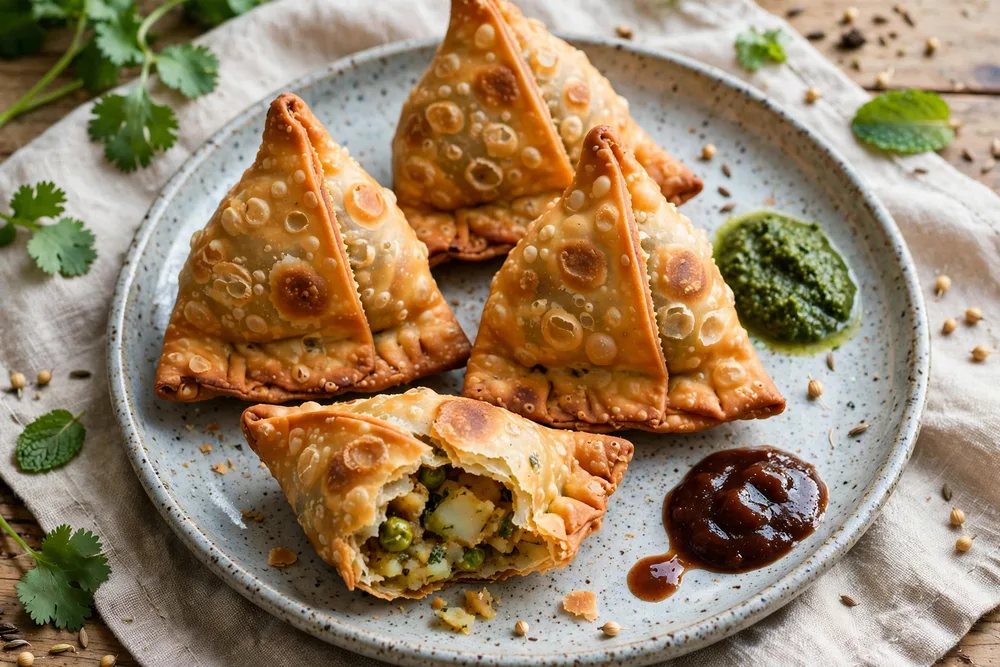
Crisp, flaky pastry triangles filled with spiced potato and peas. The Punjabi samosa — bigger, spicier and flakier than its cousins — and the most-ordered starter in North India.
Base Batch
10 Pax
2 samosas (160 g) + chutney
Prep / Cook
60m
30 min
Difficulty
medium
Commercial Standard
Cost / Portion
₹14.93
Illustrative Book Rate
Section 1 · At a Glance
Ingredients & Dynamic Pax Scaling Lab
Base formulated for 10 portions. Calibrate guest count, adjust catering buffer, or search specific ingredients below.
Batch Ingredient Cost
₹149
10 portions @ ₹14.93
Raw Batch Weight
~2.49 kg
Total raw commodities
Equipment Capacity
1 × GN 1/1
Standard chafing inserts
Scaling Factor
1.0× Base
10 Pax reference base
* Scaling is linear from the base 10-portion quantities (×5, ×10, ×50). Quantities of 1,000 g or more are shown as kg; 1,000 ml or more as L.
* Salt, spice, chilli and water do not scale perfectly — always taste and adjust; never scale salt blindly.
* Only the absorbed share of frying oil is costed (see §11). * Tamarind chutney is costed here as a bought-in item at an illustrative rate.
Step-by-Step Method & Critical Control Points (CCP)
Standard operating procedures with highlighted CCP warnings where execution failure compromises texture or food safety.
Make the filling. Heat 20 ml oil; add cumin, then onion, ginger and green chillies; cook until soft. Add the potato, peas, coriander and red chilli powders, garam masala, amchur and 10 g salt; cook 3–4 minutes. Cool fully — **⚠ CCP:** warm filling makes the pastry soggy.
Knead the dough. Rub 60 ml oil into the maida with 6 g salt until crumbly, then add water and knead to a firm dough. Rest 20 minutes — **⚠ CCP:** the oil rubbed in is what makes the samosa flaky.
Roll. Divide the dough into 10 balls; roll each into an oval, cut in half, and form a cone. Seal the cone with a little water.
Fill. Fill each cone with about 40 g filling; seal the top firmly, pressing out the air.
Fry. Heat the oil to medium-low — **⚠ CCP:** fry on low-medium heat, not high, or the outside browns while the inside stays raw. Fry in small batches until golden and crisp, about 6–8 minutes. Drain well.
Serve. Serve hot, 2 samosas per portion, with tamarind chutney. Done when: golden, blistered, crisp, filling hot and spiced.
ℹ CCP = critical control point — the moment where getting it wrong spoils the dish or makes it unsafe.
Tips & Tricks + Common Mistakes to Avoid
- •Cool the filling fully before filling — warm filling ruins the pastry.
- •Fry slow and steady; samosa is a low-heat fry.
- •Seal the cone well and press out the air, or the samosa bursts in the oil.
- •Burst samosa — seal not closed, or air left inside.
- •Raw centre — fried too fast on high heat.
- •Not flaky — too little oil rubbed into the dough.
Section 5 · Nutrition — (2 samosas (160 g)
Standard food-composition estimates derived from the raw ingredient list.
Energy
380 kcal
Avg: 259 kcal
Protein
7 g
Avg: 10 g
Carbohydrate
56 g
Avg: 33 g
Fat
13 g
Avg: 10 g
Fibre
4 g
Avg: 2 g
Sodium
620 mg
Avg: 434 mg
61%
56 g
8%
7 g
32%
13 g
Energy split: carbohydrate 61% · protein 8% · fat 32%.
Check: 4 × 7 g protein + 4 × 56 g carbohydrate + 9 × 13 g fat = 369 kcal, close to the stated 380 kcal (rounded estimate).
Section 6 · Fun Fact & Origin
Origin: not documented — no reliable source found for a single place, person or date of first creation. Samosa reached India long ago and the Punjabi version — large, potato-filled, flaky — is the best-known form; no inventor is recorded.
Section 7 · Regional Traditions
The Punjabi samosa is the best-known samosa in India — large, flaky, potato-and-pea filled, and the most-ordered starter at North Indian weddings and evening snacks. It is fried at a live counter so guests get it crisp and hot.
Three Commercial Variations
serve with both tamarind and mint chutneys, and a small salad.
the recipe as written is already low-cost; fry in a smaller kadai to use less oil.
bake the samosas instead of frying — the texture changes, so test before promising the fried result.
Production Intelligence & Banquet Logistics
Batch Yield
10 portions = 20 samosas, about 1.6 kg finished (plus chutney).
Prep Schedule
Morning: boil potatoes, make the filling and cool it. On the day: shape and fry in small batches through service.
Portion Control
2 samosas per portion, counted; chutney by a small ladle.
Holding Limits
Hot hold 65°C
- Yield: 10 portions = 20 samosas, about 1.6 kg finished (plus chutney).
- Prep schedule: Morning: boil potatoes, make the filling and cool it. On the day: shape and fry in small batches through service.
- Portion control: 2 samosas per portion, counted; chutney by a small ladle.
- Holding and service risks: Fry to order in small batches. Samosas lose their crispness within 30 minutes; cook fresh batches.
Food Safety, Allergens & Thermal Holding
Allergen Classification (Chapter 4 Matrix)
Contains — Wheat. Not present — Milk, Egg, Fish, Nuts, Soy, Mustard, Sesame. Diet: Veg.
Ingredient Costing, Pairings & Waste Reduction
Per Portion Cost
₹14.93
Cost per portion = (sum of ingredient quantity × rate) ÷ portions. Ingredient cost only — water, cooking fuel, transport, labour, and commercial overheads are not included. All rates are illustrative book planning benchmarks; replace with your live mandi rates.
Cost Driver Composition
Interactive Margin & Profit Simulator
Calibrate your catering client quote to verify commercial profit margins.
Quoted Revenue
₹4,500
Food Cost
₹1,493
Gross Profit
₹3,007
Profitable Menu Pairings
Kitchen Waste Reduction & Yield Strategy
Leftover filling becomes a samosa-chaat topping the same day; frying oil is strained and reused the same day.