
Pumpkin Kootu
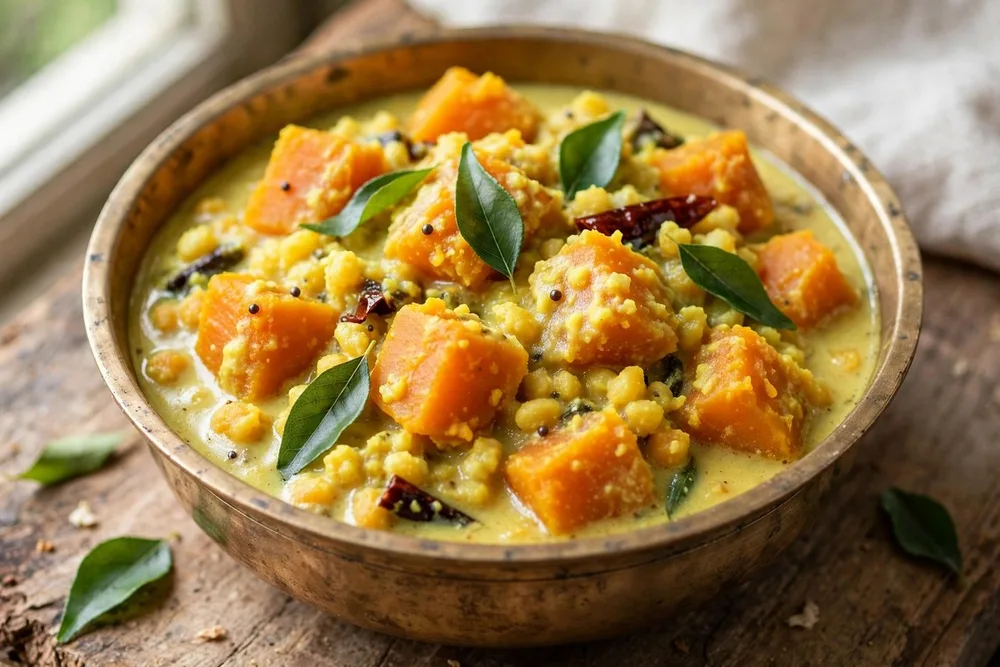
Soft pumpkin and moong dal cooked together with coconut — mild, sweet and the comfort dish of a Tamil lunch.
Base Batch
10 Pax
150 g
Prep / Cook
35m
20 min
Difficulty
easy
Commercial Standard
Cost / Portion
₹7.12
Illustrative Book Rate
Section 1 · At a Glance
Ingredients & Dynamic Pax Scaling Lab
Base formulated for 10 portions. Calibrate guest count, adjust catering buffer, or search specific ingredients below.
Batch Ingredient Cost
₹71
10 portions @ ₹7.12
Raw Batch Weight
~1.63 kg
Total raw commodities
Equipment Capacity
1 × GN 1/1
Standard chafing inserts
Scaling Factor
1.0× Base
10 Pax reference base
* Salt, spice, chilli and water do not scale perfectly — taste and adjust at every scale; never scale salt blindly.
* Scaling — linear from base 10 (×5, ×10, ×50). Above 1,000 g shown as kg; above 1,000 ml as L.
Step-by-Step Method & Critical Control Points (CCP)
Standard operating procedures with highlighted CCP warnings where execution failure compromises texture or food safety.
Pressure-cook the moong dal with the turmeric and 400 ml water until soft; mash it lightly.
Cook the pumpkin cubes in 200 ml water with salt until just soft — **⚠ CCP:** pumpkin softens fast, so check after 5 minutes; overcooked pumpkin turns to a sweet mush.
Grind the coconut, green chillies and cumin to a coarse paste.
Stir the dal and the coconut paste into the pumpkin and simmer gently for 3–4 minutes.
Heat the oil, temper the mustard seeds, urad dal and curry leaves, and pour over the kootu. Serve hot with rice.
ℹ CCP = critical control point — the moment where getting it wrong spoils the dish or makes it unsafe.
Tips & Tricks + Common Mistakes to Avoid
- •Cook the pumpkin and dal separately — together, one always overcooks.
- •Add the coconut paste at the end and simmer gently, never boil hard.
- •A little jaggery suits pumpkin kootu if the pumpkin is not sweet.
- •Overcooking the pumpkin — a sweet, formless mush.
- •Boiling the coconut paste — oily and separated.
- •Too much water — a thin, watery kootu.
Section 5 · Nutrition — (150 g)
Standard food-composition estimates derived from the raw ingredient list.
Energy
175 kcal
Avg: 259 kcal
Protein
7 g
Avg: 10 g
Carbohydrate
30 g
Avg: 33 g
Fat
3 g
Avg: 10 g
Fibre
2 g
Avg: 2 g
Sodium
390 mg
Avg: 434 mg
69%
30 g
16%
7 g
15%
3 g
Energy split: carbohydrate 69% · protein 16% · fat 15%.
Check: 7×4 + 30×4 + 3×9 = 175 kcal, shown as 175 kcal (rounded). Sodium 390 mg comes from 1.0 g salt per portion.
Section 6 · Fun Fact & Origin
Fun fact: Kootu is the Tamil comfort dish — dal and vegetable cooked together into one soft, mild pot, made for rice and a spoon of ghee. Origin: not documented — no reliable source found.
Section 7 · Regional Traditions
Pumpkin kootu is Tamil lunch food, served with rice, sambar and rasam, and it is a regular on wedding leaves because it is mild enough for every guest, including children and older people.
Three Commercial Variations
Finish with a ghee tempering and a few cashew pieces for a richer plate.
Use pumpkin alone with a little less dal; the coconut paste carries the flavour.
Use minimal oil and more pumpkin; the dish is naturally light.
Production Intelligence & Banquet Logistics
Batch Yield
10 portions × 150 g = 1.5 kg, from 700 g pumpkin + 200 g dal.
Prep Schedule
cook the dal in the morning; cube the pumpkin an hour before service; finish in the last 20 minutes.
Portion Control
one weighed 150 g scoop per portion.
Holding Limits
hold warm, covered, up to an hour. It thickens on holding — loosen with hot water.
- Yield: 10 portions × 150 g = 1.5 kg, from 700 g pumpkin + 200 g dal.
- Prep schedule: cook the dal in the morning; cube the pumpkin an hour before service; finish in the last 20 minutes.
- Portion control: one weighed 150 g scoop per portion.
- Holding: hold warm, covered, up to an hour. It thickens on holding — loosen with hot water.
Food Safety, Allergens & Thermal Holding
Allergen Classification (Chapter 4 Matrix)
Contains — Nuts, Mustard. Not present — Milk, Wheat, Egg, Fish, Soy, Sesame. Diet: Veg.
Ingredient Costing, Pairings & Waste Reduction
Per Portion Cost
₹7.12
Cost per portion = (sum of ingredient quantity × rate) ÷ portions. Ingredient cost only — water, cooking fuel, transport, labour, and commercial overheads are not included. All rates are illustrative book planning benchmarks; replace with your live mandi rates.
Cost Driver Composition
Interactive Margin & Profit Simulator
Calibrate your catering client quote to verify commercial profit margins.
Quoted Revenue
₹2,100
Food Cost
₹712
Gross Profit
₹1,388
Profitable Menu Pairings
Kitchen Waste Reduction & Yield Strategy
Pumpkin skin and seeds go into sambar stock or compost. Kootu left over is thinned into a soup for staff meals the same day.