
Moong Dal Halwa
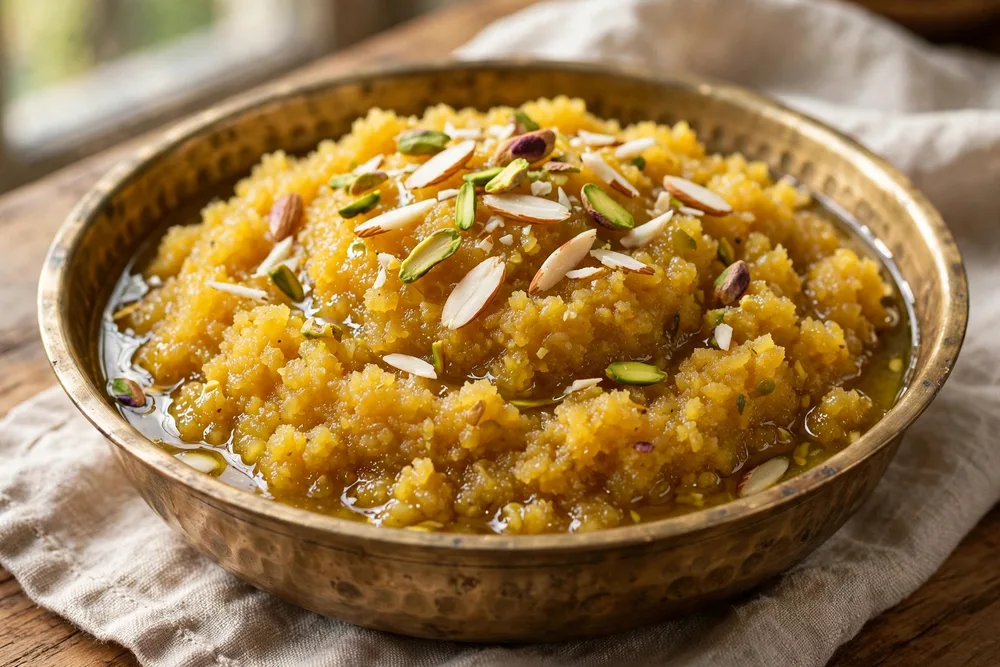
Rich, grainy halwa of roasted moong dal, ghee and sugar. The most labour-intensive sweet on the menu — and the one guests ask for by name at winter weddings.
Base Batch
10 Pax
150 g
Prep / Cook
320m
1 hour
Difficulty
medium–high
Commercial Standard
Cost / Portion
₹23.30
Illustrative Book Rate
Section 1 · At a Glance
Ingredients & Dynamic Pax Scaling Lab
Base formulated for 10 portions. Calibrate guest count, adjust catering buffer, or search specific ingredients below.
Batch Ingredient Cost
₹233
10 portions @ ₹23.30
Raw Batch Weight
~2.00 kg
Total raw commodities
Equipment Capacity
1 × GN 1/1
Standard chafing inserts
Scaling Factor
1.0× Base
10 Pax reference base
* Scaling is linear from the base 10-portion quantities (×5, ×10, ×50). Quantities of 1,000 g or more are shown as kg; 1,000 ml or more as L.
* Salt, spice, chilli and water do not scale perfectly — always taste and adjust; never scale salt blindly.
Step-by-Step Method & Critical Control Points (CCP)
Standard operating procedures with highlighted CCP warnings where execution failure compromises texture or food safety.
Soak the dal. Soak the moong dal 4 hours; drain well.
Grind. Grind the dal to a coarse paste with as little water as possible.
Roast in ghee. Heat the ghee in a heavy pan; add the dal paste and roast on low-medium heat, stirring constantly, until golden and fragrant — about 30–40 minutes. **⚠ CCP:** this is the dish; under-roasted dal tastes raw, over-roasted dal tastes burnt. Do not leave the pan.
Add the milk. Add the milk and cook, stirring, until absorbed.
Add the sugar. Add the sugar and cook until the halwa thickens and leaves the sides of the pan.
Finish. Stir in the cardamom powder, cashews, almonds and raisins; cook 5 minutes more.
Serve. Serve warm, 150 g per portion. Done when: golden, grainy, glossy with ghee, fragrant with cardamom.
ℹ CCP = critical control point — the moment where getting it wrong spoils the dish or makes it unsafe.
Tips & Tricks + Common Mistakes to Avoid
- •Roast the dal patiently — the roasting is the flavour of the dish.
- •Stir constantly; the dal catches and burns easily.
- •Grind coarse, not smooth; the halwa should be grainy.
- •Raw taste — dal not roasted long enough.
- •Burnt halwa — roasted too hot, or left unstirred.
- •Smooth, pasty halwa — dal ground too fine.
Section 5 · Nutrition — (150 g)
Standard food-composition estimates derived from the raw ingredient list.
Energy
380 kcal
Avg: 259 kcal
Protein
8 g
Avg: 10 g
Carbohydrate
48 g
Avg: 33 g
Fat
18 g
Avg: 10 g
Fibre
2 g
Avg: 2 g
Sodium
80 mg
Avg: 434 mg
50%
48 g
8%
8 g
42%
18 g
Energy split: carbohydrate 50% · protein 8% · fat 42%.
Check: 4 × 8 g protein + 4 × 48 g carbohydrate + 9 × 18 g fat = 386 kcal, close to the stated 380 kcal (rounded estimate).
Section 6 · Fun Fact & Origin
Origin: not documented — no reliable source found for a single place, person or date of first creation. Moong dal halwa is widely associated with Rajasthani and North Indian winter weddings; no inventor is recorded.
Section 7 · Regional Traditions
Moong dal halwa is the winter-wedding halwa of North India — rich, grainy and labour-intensive, and the sweet guests ask for by name. It is the dessert caterers make when they want to show the kitchen's skill, because the roasting cannot be rushed.
Three Commercial Variations
serve warm with a scoop of vanilla ice cream.
use less ghee and more milk; the halwa is lighter but still rich.
use less ghee and sugar; the halwa is lighter, so test before promising the regular result.
Production Intelligence & Banquet Logistics
Batch Yield
10 portions × 150 g = 1.5 kg finished.
Prep Schedule
Morning: soak the dal 4 hours ahead. On the day: grind, roast and finish; hold warm through service.
Portion Control
150 g per portion by a weighed ladle or scoop.
Holding Limits
Hot hold 65°C
- Yield: 10 portions × 150 g = 1.5 kg finished.
- Prep schedule: Morning: soak the dal 4 hours ahead. On the day: grind, roast and finish; hold warm through service.
- Portion control: 150 g per portion by a weighed ladle or scoop.
- Holding and service risks: Hold warm and covered; stir often. Reheats well the same day — add a little milk when reheating.
Food Safety, Allergens & Thermal Holding
Allergen Classification (Chapter 4 Matrix)
Contains — Milk, Nuts. Not present — Wheat, Egg, Fish, Soy, Mustard, Sesame. Diet: Veg.
Ingredient Costing, Pairings & Waste Reduction
Per Portion Cost
₹23.30
Cost per portion = (sum of ingredient quantity × rate) ÷ portions. Ingredient cost only — water, cooking fuel, transport, labour, and commercial overheads are not included. All rates are illustrative book planning benchmarks; replace with your live mandi rates.
Cost Driver Composition
Interactive Margin & Profit Simulator
Calibrate your catering client quote to verify commercial profit margins.
Quoted Revenue
₹7,000
Food Cost
₹2,330
Gross Profit
₹4,670
Profitable Menu Pairings
Kitchen Waste Reduction & Yield Strategy
Dal soaking water is used in the next batch of dough; leftover halwa is served the same day as a topping for ice cream.