
Kothimbir Vadi
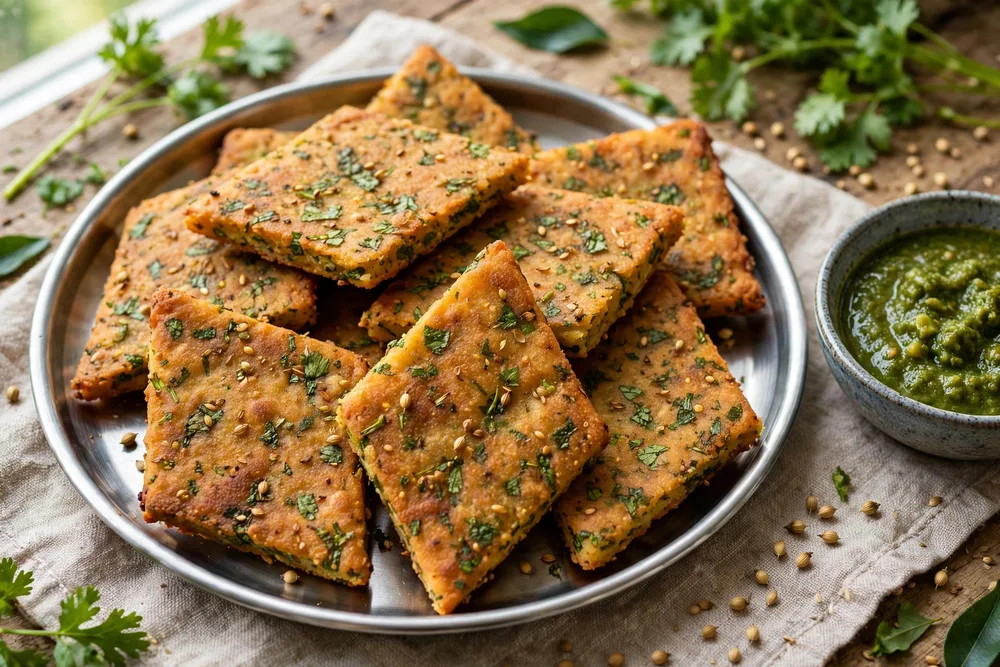
Maharashtra's coriander-and-besan steamed cake, cut into diamonds and fried crisp — the snack that uses up a bunch of coriander.
Base Batch
10 Pax
80 g (4 pieces)
Prep / Cook
45m
25 min
Difficulty
medium
Commercial Standard
Cost / Portion
₹8.82
Illustrative Book Rate
Section 1 · At a Glance
Ingredients & Dynamic Pax Scaling Lab
Base formulated for 10 portions. Calibrate guest count, adjust catering buffer, or search specific ingredients below.
Batch Ingredient Cost
₹88
10 portions @ ₹8.82
Raw Batch Weight
~1.10 kg
Total raw commodities
Equipment Capacity
1 × GN 1/1
Standard chafing inserts
Scaling Factor
1.0× Base
10 Pax reference base
* Scaling — linear from base 10 (×5, ×10, ×50). Above 1,000 g shown as kg; above 1,000 ml as L. For 50+ portions, steam in
* separate 50-portion trays — one deep tray steams unevenly and the centre stays raw. Slice and fry in small batches so the oil stays hot.
Step-by-Step Method & Critical Control Points (CCP)
Standard operating procedures with highlighted CCP warnings where execution failure compromises texture or food safety.
Make the batter. Mix the chopped coriander with besan, rice flour, all the dry spices, salt, sugar, lemon juice, sesame and baking soda. Add water to a thick, spoonable batter. **⚠ CCP—** thickness: thick enough to hold its shape; a runny batter steams soggy.
Steam. Grease a tray, spread the batter about 2 cm thick, and steam on high heat 15–18 minutes. **⚠ CCP—** doneness: a knife comes out clean and the top springs back when pressed.
Cool and cut. Cool fully — at least 20 minutes — then cut into 40 diamonds (4 per portion). **⚠ CCP—** cooling: cutting while hot crumbles the slab; it must be cool and firm.
Fry. Heat the oil on medium-high heat; shallow-fry the diamonds a few at a time until golden and crisp on both sides, about 2 minutes a side. Drain on a rack.
Serve. 4 pieces per portion with green chutney. Serve hot — the crisp edge is the point of the dish.
ℹ CCP = critical control point — the moment where getting it wrong spoils the dish or makes it unsafe.
Tips & Tricks + Common Mistakes to Avoid
- •Chop the coriander fine — coarse leaves make the slab fall apart when cut.
- •Cool the steamed slab fully before cutting; a warm slab crumbles.
- •Fry a few at a time so the oil stays hot and the pieces crisp instead of soaking.
- •Runny batter — it steams soggy and will not hold a diamond shape.
- •Cutting while hot — the slab crumbles and the pieces are lost.
- •Crowding the frying pan — the oil cools and the vadi turn greasy.
Section 5 · Nutrition — (80 g (4 pieces)
Standard food-composition estimates derived from the raw ingredient list.
Energy
120 kcal
Avg: 259 kcal
Protein
4 g
Avg: 10 g
Carbohydrate
14 g
Avg: 33 g
Fat
5 g
Avg: 10 g
Fibre
2 g
Avg: 2 g
Sodium
260 mg
Avg: 434 mg
48%
14 g
14%
4 g
38%
5 g
Energy split: carbohydrate 48% · protein 14% · fat 38%.
Check: 4×4 + 14×4 + 5×9 = 117 kcal, stated 120 kcal (rounded estimate).
Section 6 · Fun Fact & Origin
'Kothimbir' is the Marathi word for coriander leaves — this dish uses a whole bunch of them at once. Origin: not documented — no reliable source found for a single inventor, place or date.
Section 7 · Regional Traditions
Kothimbir vadi belongs to Maharashtra, where it is the tea-time snack and the dinner starter — steamed, cut into diamonds and fried crisp, served with green chutney.
Three Commercial Variations
Serve the diamonds steamed, not fried, topped with a spoon of green chutney and a pomegranate seed.
Use the same recipe — coriander and besan are already cheap. Save by serving the vadi steamed, without frying. Saves about ₹1.50 per portion (see §11).
Serve steamed, not fried, and cut the oil to a brushed film. The vadi is softer — say so on the menu.
Production Intelligence & Banquet Logistics
Batch Yield
40 pieces × about 20 g = about 800 g from 300 g coriander + 250 g besan.
Prep Schedule
Standard prep
Portion Control
cut each tray into 40 equal diamonds and count four per portion.
Holding Limits
Hot hold 65°C
- Yield: 40 pieces × about 20 g = about 800 g from 300 g coriander + 250 g besan.
- Prep schedule (100 portions): make the batter and steam the slabs the morning of the event; cool, cut and fry in small batches at the counter (~20 min per 50-portion batch).
- Portion control: cut each tray into 40 equal diamonds and count four per portion.
- Holding and service risks: serve fresh in small batches — fried starters lose crispness fast if held. fry to the queue, drain on a rack, and never hold fried vadi under a lid, which traps steam.
Food Safety, Allergens & Thermal Holding
Allergen Classification (Chapter 4 Matrix)
Contains — Sesame. Not present — Milk, Wheat, Egg, Fish, Nuts, Soy, Mustard. Diet: Veg.
Ingredient Costing, Pairings & Waste Reduction
Per Portion Cost
₹8.82
Cost per portion = (sum of ingredient quantity × rate) ÷ portions. Ingredient cost only — water, cooking fuel, transport, labour, and commercial overheads are not included. All rates are illustrative book planning benchmarks; replace with your live mandi rates.
Cost Driver Composition
Interactive Margin & Profit Simulator
Calibrate your catering client quote to verify commercial profit margins.
Quoted Revenue
₹2,600
Food Cost
₹882
Gross Profit
₹1,718
Profitable Menu Pairings
Kitchen Waste Reduction & Yield Strategy
The biggest waste is a slab cut while hot and crumbled, and pieces fried ahead and gone soft. Cool the slab fully before cutting, fry to the queue, and track portions sold against pieces fried — a 10-portion overcook is 40 pieces.