
Idiyappam
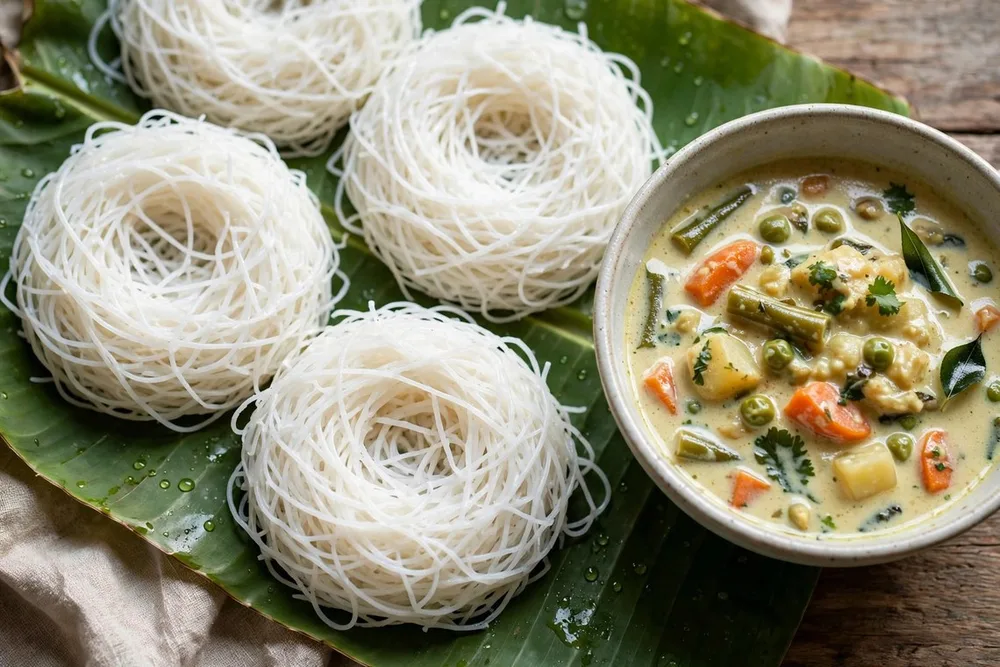
Soft nests of steamed rice-flour noodles — delicate, plain and made to soak up curry, stew or sweetened coconut milk.
Base Batch
10 Pax
2 idiyappam (150 g)
Prep / Cook
35m
15 min
Difficulty
medium
Commercial Standard
Cost / Portion
₹3.98
Illustrative Book Rate
Section 1 · At a Glance
Ingredients & Dynamic Pax Scaling Lab
Base formulated for 10 portions. Calibrate guest count, adjust catering buffer, or search specific ingredients below.
Batch Ingredient Cost
₹40
10 portions @ ₹3.98
Raw Batch Weight
~1.12 kg
Total raw commodities
Equipment Capacity
1 × GN 1/1
Standard chafing inserts
Scaling Factor
1.0× Base
10 Pax reference base
* Salt, spice, chilli and water do not scale perfectly — taste and adjust at every scale; never scale salt blindly.
* Scaling — linear from base 10 (×5, ×10, ×50). Above 1,000 g shown as kg; above 1,000 ml as L.
Step-by-Step Method & Critical Control Points (CCP)
Standard operating procedures with highlighted CCP warnings where execution failure compromises texture or food safety.
Bring the water to a rolling boil with the salt and oil. Tip the rice flour into a wide bowl.
Pour the boiling water over the flour a little at a time, mixing with a wooden spoon, until it forms a soft, smooth dough that holds together — **⚠ CCP:** the water must be boiling when it meets the flour, or the dough turns grainy and the noodles break.
Knead briefly while warm, then press the dough through an idiyappam press onto greased plates in loose, round nests. Sprinkle a little grated coconut over each nest.
Steam the nests for 8–10 minutes until soft and cooked through. Do not press the nests flat or stack them while hot.
Serve hot at once with vegetable stew, egg curry or sweetened coconut milk.
ℹ CCP = critical control point — the moment where getting it wrong spoils the dish or makes it unsafe.
Tips & Tricks + Common Mistakes to Avoid
- •Roasted rice flour is essential — raw flour gives a sticky, grey idiyappam.
- •Press the nests loosely; tight pressing makes them dense.
- •Grease the plates well or the nests tear when lifted.
- •Lukewarm water — grainy dough, broken noodles.
- •Over-steaming — the nests go soggy and collapse.
- •Pressing too firmly — dense, heavy nests instead of soft ones.
Section 5 · Nutrition — (2 idiyappam (150 g)
Standard food-composition estimates derived from the raw ingredient list.
Energy
235 kcal
Avg: 259 kcal
Protein
6 g
Avg: 10 g
Carbohydrate
50 g
Avg: 33 g
Fat
1 g
Avg: 10 g
Fibre
1 g
Avg: 2 g
Sodium
310 mg
Avg: 434 mg
86%
50 g
10%
6 g
4%
1 g
Energy split: carbohydrate 86% · protein 10% · fat 4%.
Check: 6×4 + 50×4 + 1×9 = 233 kcal, shown as 235 kcal (rounded). Sodium 310 mg comes from 0.8 g salt per portion.
Section 6 · Fun Fact & Origin
Fun fact: Idiyappam is also called string hoppers — the name describes exactly what it is: rice flour pressed into fine strings and steamed. Origin: not documented — no reliable source found.
Section 7 · Regional Traditions
Idiyappam belongs to Kerala and Tamil Nadu, served at breakfast and dinner. It is the classic partner for vegetable stew, egg curry and coconut milk, and at weddings it is served in nests on a banana leaf. With sweetened coconut milk it becomes a light dessert.
Three Commercial Variations
Serve the nests in a small basket lined with banana leaf, with a separate bowl of stew and a spoon of coconut milk on the side.
Skip the coconut topping and serve with sambar or a simple vegetable curry.
Use red-rice flour for more fibre and serve with a vegetable stew rather than sweetened milk.
Production Intelligence & Banquet Logistics
Batch Yield
10 portions × 2 nests = 20 nests, about 1.5 kg, from 500 g flour.
Prep Schedule
make the dough in the morning; press and steam in the last 30 minutes before service, in small batches.
Portion Control
one press-load = one nest; count 2 nests per portion.
Holding Limits
steam to order. Nests dry out and harden within 20 minutes of steaming.
- Yield: 10 portions × 2 nests = 20 nests, about 1.5 kg, from 500 g flour.
- Prep schedule: make the dough in the morning; press and steam in the last 30 minutes before service, in small batches.
- Portion control: one press-load = one nest; count 2 nests per portion.
- Holding: steam to order. Nests dry out and harden within 20 minutes of steaming.
Food Safety, Allergens & Thermal Holding
Allergen Classification (Chapter 4 Matrix)
Contains — Nuts. Not present — Milk, Wheat, Egg, Fish, Soy, Mustard, Sesame. Diet: Veg.
Ingredient Costing, Pairings & Waste Reduction
Per Portion Cost
₹3.98
Cost per portion = (sum of ingredient quantity × rate) ÷ portions. Ingredient cost only — water, cooking fuel, transport, labour, and commercial overheads are not included. All rates are illustrative book planning benchmarks; replace with your live mandi rates.
Cost Driver Composition
Interactive Margin & Profit Simulator
Calibrate your catering client quote to verify commercial profit margins.
Quoted Revenue
₹1,500
Food Cost
₹398
Gross Profit
₹1,102
Profitable Menu Pairings
Kitchen Waste Reduction & Yield Strategy
Dough that is too dry to press is kneaded with a splash of boiling water and used up at once. Torn nests are not wasted — they go into coconut-milk payasam for staff meals.