
Appam
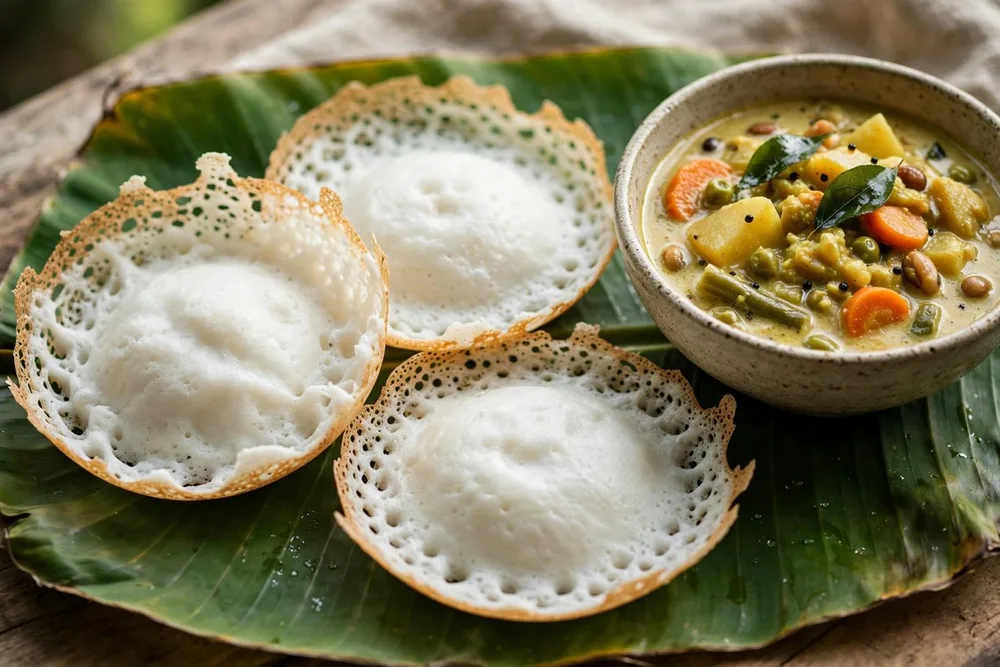
Lacy-edged rice pancake with a soft, spongy centre — cooked in a curved appam pan, made for scooping up stew.
Base Batch
10 Pax
2 appams (160 g)
Prep / Cook
515m
15 min
Difficulty
medium
Commercial Standard
Cost / Portion
₹3.42
Illustrative Book Rate
Section 1 · At a Glance
Ingredients & Dynamic Pax Scaling Lab
Base formulated for 10 portions. Calibrate guest count, adjust catering buffer, or search specific ingredients below.
Batch Ingredient Cost
₹34
10 portions @ ₹3.42
Raw Batch Weight
~0.93 kg
Total raw commodities
Equipment Capacity
1 × GN 1/1
Standard chafing inserts
Scaling Factor
1.0× Base
10 Pax reference base
* Salt, spice, chilli and water do not scale perfectly — taste and adjust at every scale; never scale salt blindly.
* Scaling — linear from base 10 (×5, ×10, ×50). Above 1,000 g shown as kg; above 1,000 ml as L.
Step-by-Step Method & Critical Control Points (CCP)
Standard operating procedures with highlighted CCP warnings where execution failure compromises texture or food safety.
Soak the rice for 4–5 hours. Grind it with the grated coconut, cooked rice and enough water to a smooth, thin batter.
Stir in the yeast and sugar, cover and ferment 8 hours or overnight — **⚠ CCP:** the batter must rise and smell mildly yeasty. Flat batter gives flat, dense appams.
Add salt and stir gently. Heat the appam pan (appachatti) on medium-high and grease it very lightly with oil.
Pour a ladle of batter into the centre and swirl the pan once so the batter coats the sides thinly and pools thick in the middle.
Cover and cook 2–3 minutes until the edges are crisp and lacy and the centre is soft and spongy. Do not flip. Lift out and serve hot.
ℹ CCP = critical control point — the moment where getting it wrong spoils the dish or makes it unsafe.
Tips & Tricks + Common Mistakes to Avoid
- •The swirl is the skill — one smooth turn, then leave the pan alone.
- •A well-seasoned pan releases the appam cleanly; a new pan needs a few practice rounds.
- •Ferment in a warm place; in cool weather the yeast works slowly.
- •Thick batter — a heavy pancake with no lacy edge.
- •No cover on the pan — the centre stays raw while the edges burn.
- •Flipping the appam — it is meant to be cooked on one side only.
Section 5 · Nutrition — (2 appams (160 g)
Standard food-composition estimates derived from the raw ingredient list.
Energy
245 kcal
Avg: 259 kcal
Protein
7 g
Avg: 10 g
Carbohydrate
48 g
Avg: 33 g
Fat
3 g
Avg: 10 g
Fibre
2 g
Avg: 2 g
Sodium
310 mg
Avg: 434 mg
78%
48 g
11%
7 g
11%
3 g
Energy split: carbohydrate 78% · protein 11% · fat 11%.
Check: 7×4 + 48×4 + 3×9 = 247 kcal, shown as 245 kcal (rounded). Sodium 310 mg comes from 0.8 g salt per portion.
Section 6 · Fun Fact & Origin
Fun fact: Appam is the Kerala breakfast that travelled the world with the Malayali diaspora — the same lacy pancake is now served in restaurants from Dubai to London. Origin: not documented — no reliable source found.
Section 7 · Regional Traditions
Appam belongs to Kerala, where it is breakfast and dinner food, served with vegetable stew, egg curry or chicken stew. At weddings and festivals it is cooked live at a counter in the appam pan, and with sweetened coconut milk it is a light dessert.
Three Commercial Variations
Serve with a small bowl of vegetable stew and a spoon of coconut milk, and cook the appams to order at the counter.
Use less coconut in the batter and serve with sambar instead of stew.
Use red rice for the batter and serve with a vegetable stew, skipping the sugar.
Production Intelligence & Banquet Logistics
Batch Yield
10 portions × 2 appams = 20 appams, about 1.6 kg.
Prep Schedule
soak and grind the evening before, ferment overnight, cook in the last hour before service.
Portion Control
one ladle of batter = one appam; serve 2 per portion.
Holding Limits
cook to order. Appams soften and lose their lacy edge within 15 minutes of cooking.
- Yield: 10 portions × 2 appams = 20 appams, about 1.6 kg.
- Prep schedule: soak and grind the evening before, ferment overnight, cook in the last hour before service.
- Portion control: one ladle of batter = one appam; serve 2 per portion.
- Holding: cook to order. Appams soften and lose their lacy edge within 15 minutes of cooking.
Food Safety, Allergens & Thermal Holding
Allergen Classification (Chapter 4 Matrix)
Contains — Nuts. Not present — Milk, Wheat, Egg, Fish, Soy, Mustard, Sesame. Diet: Veg.
Ingredient Costing, Pairings & Waste Reduction
Per Portion Cost
₹3.42
Cost per portion = (sum of ingredient quantity × rate) ÷ portions. Ingredient cost only — water, cooking fuel, transport, labour, and commercial overheads are not included. All rates are illustrative book planning benchmarks; replace with your live mandi rates.
Cost Driver Composition
Interactive Margin & Profit Simulator
Calibrate your catering client quote to verify commercial profit margins.
Quoted Revenue
₹1,500
Food Cost
₹342
Gross Profit
₹1,158
Profitable Menu Pairings
Kitchen Waste Reduction & Yield Strategy
Batter left over makes sweet appams with jaggery for staff meals. Appams that tear are served torn, with stew poured over — never thrown away while the stew is good.