
Vazhakkai Bajji
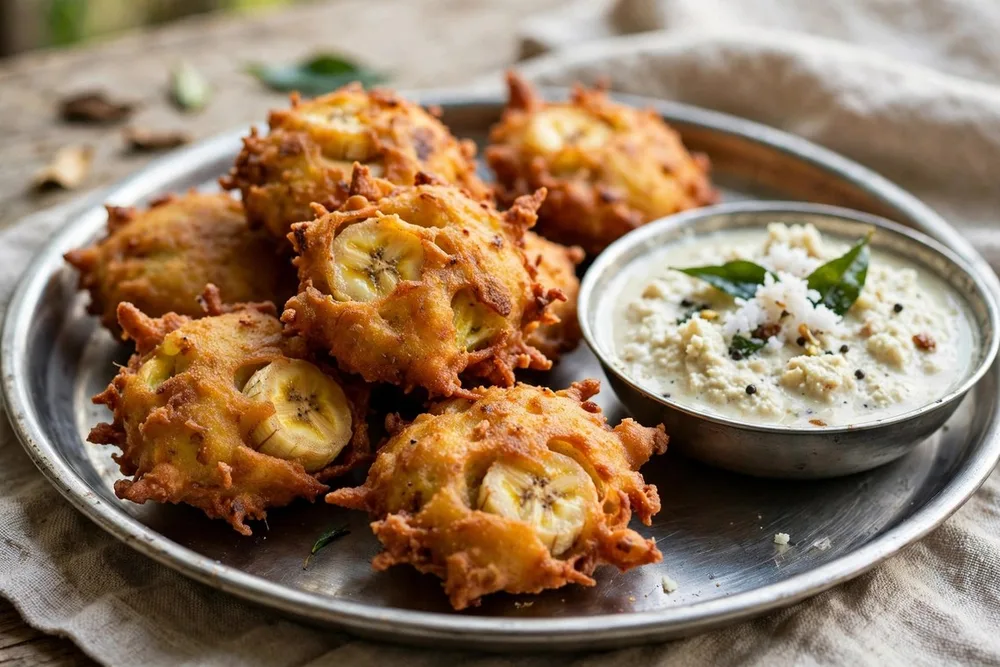
Crisp raw-banana fritters in a spiced gram-flour batter — the tea-time snack of Tamil Nadu, fried golden.
Base Batch
10 Pax
4 bajji (120 g)
Prep / Cook
22m
12 min
Difficulty
easy
Commercial Standard
Cost / Portion
₹8.09
Illustrative Book Rate
Section 1 · At a Glance
Ingredients & Dynamic Pax Scaling Lab
Base formulated for 10 portions. Calibrate guest count, adjust catering buffer, or search specific ingredients below.
Batch Ingredient Cost
₹81
10 portions @ ₹8.09
Raw Batch Weight
~1.50 kg
Total raw commodities
Equipment Capacity
1 × GN 1/1
Standard chafing inserts
Scaling Factor
1.0× Base
10 Pax reference base
* Salt, spice, chilli and water do not scale perfectly — taste and adjust at every scale; never scale salt blindly.
* Scaling — linear from base 10 (×5, ×10, ×50). Above 1,000 g shown as kg; above 1,000 ml as L.
Step-by-Step Method & Critical Control Points (CCP)
Standard operating procedures with highlighted CCP warnings where execution failure compromises texture or food safety.
Slice the raw bananas into thin rounds, about 3 mm thick, and sprinkle with salt.
Mix the besan, rice flour, chilli powder, turmeric, asafoetida and salt with water into a thick, smooth batter — **⚠ CCP:** the batter must coat the back of a spoon; thin batter slides off the banana and leaves it bare.
Heat the oil to medium-hot. Dip each banana slice in the batter, let the excess drip off, and slide it into the oil.
Fry in small batches until golden and crisp on both sides, about 2–3 minutes per batch.
Drain on a rack and serve hot with coconut chutney.
ℹ CCP = critical control point — the moment where getting it wrong spoils the dish or makes it unsafe.
Tips & Tricks + Common Mistakes to Avoid
- •Slice the banana thin and even, or the centres stay raw.
- •A thick batter coats; a thin batter slides off.
- •Fry in small batches so the oil stays hot.
- •Thin batter — bare banana, no coating.
- •Thick slices — raw centres, burnt coating.
- •Crowding the kadai — soggy, oily bajji.
Section 5 · Nutrition — (4 bajji (120 g)
Standard food-composition estimates derived from the raw ingredient list.
Energy
240 kcal
Avg: 259 kcal
Protein
9 g
Avg: 10 g
Carbohydrate
38 g
Avg: 33 g
Fat
6 g
Avg: 10 g
Fibre
2 g
Avg: 2 g
Sodium
510 mg
Avg: 434 mg
63%
38 g
15%
9 g
22%
6 g
Energy split: carbohydrate 63% · protein 15% · fat 22%.
Check: 9×4 + 38×4 + 6×9 = 242 kcal, shown as 240 kcal (rounded). Sodium 510 mg comes from 1.3 g salt per portion.
Section 6 · Fun Fact & Origin
Fun fact: Bajji is the Tamil tea-time fritter — banana, chilli or onion dipped in gram-flour batter and fried crisp, sold at every roadside stall. Origin: not documented — no reliable source found.
Section 7 · Regional Traditions
Vazhakkai bajji is Tamil snack food, served at tea time, at weddings as a starter, and at festivals with chutney. It is fried live at a counter so guests get it crisp and hot.
Three Commercial Variations
Serve with coconut chutney and a sprinkle of chaat masala on top.
Use smaller slices and keep the batter simple; the banana carries the dish.
Shallow-fry in a non-stick pan with minimal oil, and serve with chutney.
Production Intelligence & Banquet Logistics
Batch Yield
10 portions × 4 bajji = 40 bajji, about 1.2 kg.
Prep Schedule
peel and slice the bananas an hour before service; mix the batter fresh; fry to order.
Portion Control
4 bajji per portion, counted out.
Holding Limits
fry to order. Bajji softens within 15 minutes of frying.
- Yield: 10 portions × 4 bajji = 40 bajji, about 1.2 kg.
- Prep schedule: peel and slice the bananas an hour before service; mix the batter fresh; fry to order.
- Portion control: 4 bajji per portion, counted out.
- Holding: fry to order. Bajji softens within 15 minutes of frying.
Food Safety, Allergens & Thermal Holding
Allergen Classification (Chapter 4 Matrix)
Contains — none of the eight tracked allergens. Not present — Milk, Wheat, Egg, Fish, Nuts, Soy, Mustard, Sesame. Diet: Veg.
Ingredient Costing, Pairings & Waste Reduction
Per Portion Cost
₹8.09
Cost per portion = (sum of ingredient quantity × rate) ÷ portions. Ingredient cost only — water, cooking fuel, transport, labour, and commercial overheads are not included. All rates are illustrative book planning benchmarks; replace with your live mandi rates.
Cost Driver Composition
Interactive Margin & Profit Simulator
Calibrate your catering client quote to verify commercial profit margins.
Quoted Revenue
₹2,400
Food Cost
₹809
Gross Profit
₹1,591
Profitable Menu Pairings
Kitchen Waste Reduction & Yield Strategy
Only the oil actually absorbed is costed — the oil in the kadai is strained and reused. Bajji left over is chopped into a chaat with onion and chutney for staff meals.