
Payesh
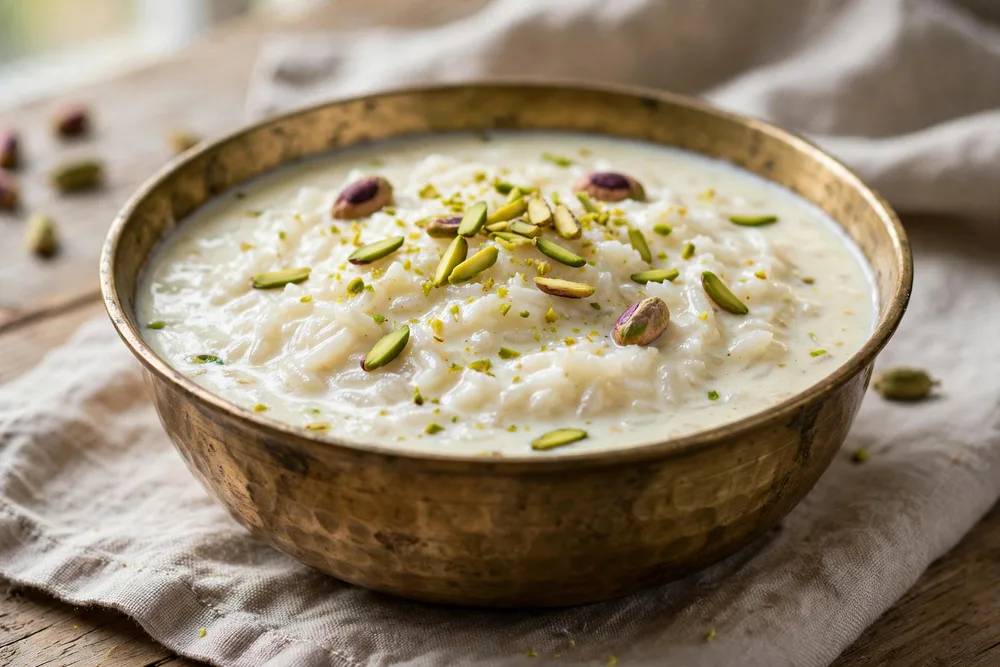
Creamy rice pudding with Gobindobhog rice, milk and bay leaf — the Bengali payesh, served at birthdays, weddings and Puja.
Base Batch
10 Pax
150 g
Prep / Cook
55m
45 min
Difficulty
easy
Commercial Standard
Cost / Portion
₹19.48
Illustrative Book Rate
Section 1 · At a Glance
Ingredients & Dynamic Pax Scaling Lab
Base formulated for 10 portions. Calibrate guest count, adjust catering buffer, or search specific ingredients below.
Batch Ingredient Cost
₹195
10 portions @ ₹19.48
Raw Batch Weight
~2.36 kg
Total raw commodities
Equipment Capacity
1 × GN 1/1
Standard chafing inserts
Scaling Factor
1.0× Base
10 Pax reference base
* Salt, spice and chilli: taste and adjust to your own ingredients — they do not scale perfectly. Water: adjust to your rice, dal and vegetables.
* Scaling — linear from base 10 (×5, ×10, ×50). Above 1,000 g shown as kg; above 1,000 ml as L.
Step-by-Step Method & Critical Control Points (CCP)
Standard operating procedures with highlighted CCP warnings where execution failure compromises texture or food safety.
Soak the rice. Wash and soak the rice 20 minutes; drain.
Reduce the milk. Boil the milk with the bay leaf in a heavy pan; simmer on low heat 15 minutes until slightly reduced, stirring so it does not catch. **⚠ CCP—** milk: stir often; scorched milk spoils the whole payesh.
Cook the rice. Add the rice and cardamoms; simmer on low heat 25–30 minutes, stirring often, until the rice is soft and the payesh is creamy. **⚠ CCP—** rice: the rice must be fully soft; undercooked rice stays hard in the pudding.
Sweeten. Stir in sugar, cashews and raisins; cook 5 minutes more. Take off the heat; stir in ghee. Cool slightly, then chill. Serve 150 g per portion, garnished with pistachio. Done when: rice soft, payesh creamy and flowing, sweet and fragrant.
ℹ CCP = critical control point — the moment where getting it wrong spoils the dish or makes it unsafe.
Tips & Tricks + Common Mistakes to Avoid
- •Stir often — milk catches easily on the bottom of the pan.
- •Cook on low heat; high heat scorches the milk.
- •Serve chilled or at room temperature, not hot.
- •Scorched milk — bitter payesh all through.
- •Undercooked rice — hard grains in a creamy pudding.
- •Too much sugar — it turns cloying.
Section 5 · Nutrition — (150 g)
Standard food-composition estimates derived from the raw ingredient list.
Energy
240 kcal
Avg: 259 kcal
Protein
6 g
Avg: 10 g
Carbohydrate
36 g
Avg: 33 g
Fat
9 g
Avg: 10 g
Fibre
0 g
Avg: 2 g
Sodium
120 mg
Avg: 434 mg
58%
36 g
10%
6 g
33%
9 g
Energy split: carbohydrate 58% · protein 10% · fat 33%.
Section 6 · Fun Fact & Origin
Origin: not documented — no reliable source found.
Section 7 · Regional Traditions
Payesh is the Bengali rice pudding of West Bengal, served at birthdays, weddings and Durga Puja; a birthday in Bengal traditionally begins with payesh.
Three Commercial Variations
Use more cashews and pistachio, and serve chilled in small bowls.
Use plain rice and fewer nuts.
Use less sugar and skimmed milk — the payesh will be thinner, so test it first.
Production Intelligence & Banquet Logistics
Batch Yield
about 1.5 kg.
Prep Schedule
make the day before — payesh tastes better chilled overnight.
Portion Control
150 g per bowl with a 150 ml ladle.
Holding Limits
holds refrigerated for 2 days.
- Yield: about 1.5 kg.
- Prep schedule: make the day before — payesh tastes better chilled overnight.
- Portion control: 150 g per bowl with a 150 ml ladle.
- Holding: holds refrigerated for 2 days.
- Service risk: payesh thickening on chilling — loosen with a little cold milk before serving.
Food Safety, Allergens & Thermal Holding
Allergen Classification (Chapter 4 Matrix)
Contains — Milk, Nuts. Not present — Wheat, Egg, Fish, Soy, Mustard, Sesame. Diet: Veg.
Ingredient Costing, Pairings & Waste Reduction
Per Portion Cost
₹19.48
Cost per portion = (sum of ingredient quantity × rate) ÷ portions. Ingredient cost only — water, cooking fuel, transport, labour, and commercial overheads are not included. All rates are illustrative book planning benchmarks; replace with your live mandi rates.
Cost Driver Composition
Interactive Margin & Profit Simulator
Calibrate your catering client quote to verify commercial profit margins.
Quoted Revenue
₹5,800
Food Cost
₹1,948
Gross Profit
₹3,852
Profitable Menu Pairings
Kitchen Waste Reduction & Yield Strategy
Leftover payesh is served over ice cream or with fruit the next day; milk skin is stirred back in, not discarded.