
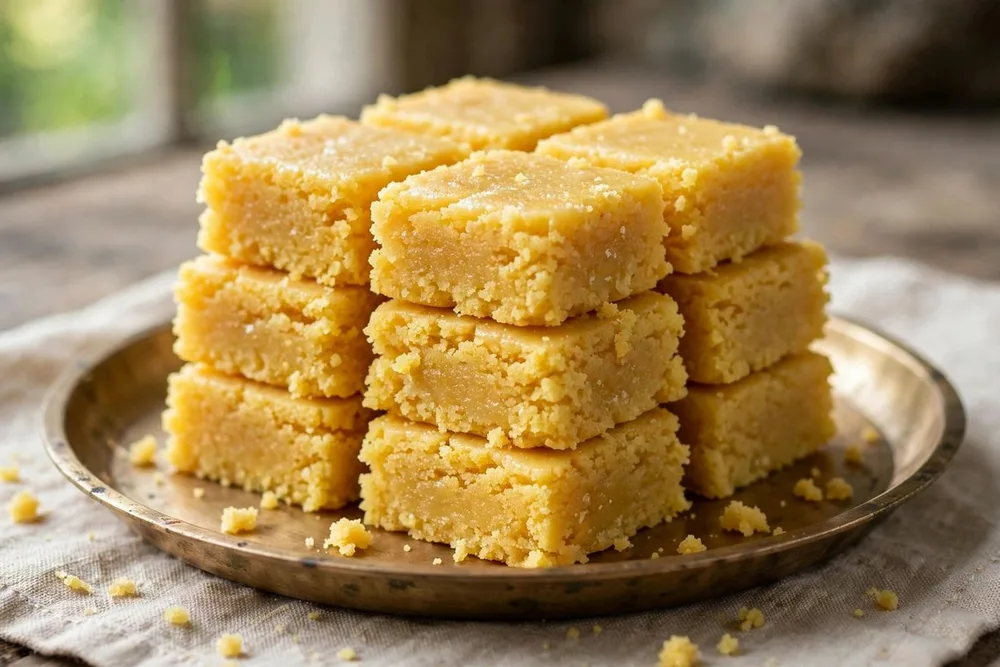
Mysore Pak
Melt-in-the-mouth gram-flour sweet, rich with ghee — the royal sweet of Mysore, made in minutes and cut into squares.
Base Batch
10 Pax
2 pieces (90 g)
Prep / Cook
35m
25 min
Difficulty
medium
Commercial Standard
Cost / Portion
₹25.60
Illustrative Book Rate
Section 1 · At a Glance
Ingredients & Dynamic Pax Scaling Lab
Base formulated for 10 portions. Calibrate guest count, adjust catering buffer, or search specific ingredients below.
Batch Ingredient Cost
₹256
10 portions @ ₹25.60
Raw Batch Weight
~1.30 kg
Total raw commodities
Equipment Capacity
1 × GN 1/1
Standard chafing inserts
Scaling Factor
1.0× Base
10 Pax reference base
* Salt, spice, chilli and water do not scale perfectly — taste and adjust at every scale; never scale salt blindly.
* Scaling — linear from base 10 (×5, ×10, ×50). Above 1,000 g shown as kg; above 1,000 ml as L.
Step-by-Step Method & Critical Control Points (CCP)
Standard operating procedures with highlighted CCP warnings where execution failure compromises texture or food safety.
Grease a plate or tray with ghee. Sieve the besan so there are no lumps.
Boil the sugar with the water to a one-string syrup — **⚠ CCP:** the syrup must reach one string, or the pak will not set; overcook it and the pak turns hard.
Turn the heat low and add the besan a spoon at a time, stirring constantly so no lumps form.
Heat the ghee and oil together until hot. Pour it into the besan mixture in a thin stream, stirring all the time, until the mixture leaves the sides of the pan and looks porous and frothy.
Pour into the greased tray, level it, and cut into squares while still warm. Cool fully before lifting out.
ℹ CCP = critical control point — the moment where getting it wrong spoils the dish or makes it unsafe.
Tips & Tricks + Common Mistakes to Avoid
- •Sieve the besan — lumps ruin the texture.
- •One-string syrup is the test; learn it before a big batch.
- •Pour the hot ghee in a thin stream, stirring all the time.
- •Thin syrup — a soft pak that never sets.
- •Overcooked syrup — a hard, dry pak.
- •Lumpy besan — a grainy, uneven sweet.
Section 5 · Nutrition — (2 pieces (90 g)
Standard food-composition estimates derived from the raw ingredient list.
Energy
485 kcal
Avg: 259 kcal
Protein
6 g
Avg: 10 g
Carbohydrate
48 g
Avg: 33 g
Fat
30 g
Avg: 10 g
Fibre
1 g
Avg: 2 g
Sodium
0 mg
Avg: 434 mg
40%
48 g
5%
6 g
56%
30 g
Energy split: carbohydrate 40% · protein 5% · fat 56%.
Check: 6×4 + 48×4 + 30×9 = 486 kcal, shown as 485 kcal (rounded). Sodium 0 mg comes from 0.0 g salt per portion.
Section 6 · Fun Fact & Origin
Fun fact: Mysore pak was created in the Mysore palace kitchens — the cook Kakasura Madappa made it for the Maharaja, who named it after his city. The Mysore-palace story, with the cook Kakasura Madappa named, is widely documented. Origin: not documented — no reliable source found for a single place, person or date of first creation beyond this palace association.
Section 7 · Regional Traditions
Mysore pak belongs to Karnataka, where it is the sweet of weddings, festivals and Deepavali, packed in boxes as a gift. It is the sweet a Mysore kitchen is judged by, and it is served at the end of a wedding meal.
Three Commercial Variations
Use pure ghee throughout and cut neat, even squares for gift boxes.
Use half oil and half ghee; the texture stays, the cost falls.
Use less ghee and sugar and cut smaller pieces; this is a rich sweet by nature.
Production Intelligence & Banquet Logistics
Batch Yield
10 portions × 2 pieces = 20 pieces, about 900 g, from 300 g besan + 400 g sugar + 300 g ghee.
Prep Schedule
make the pak the day before the event; it sets overnight and cuts cleanly the next day.
Portion Control
cut into equal weighed squares; serve 2 per portion.
Holding Limits
store in an airtight box at room temperature for up to a week. Keep away from moisture.
- Yield: 10 portions × 2 pieces = 20 pieces, about 900 g, from 300 g besan + 400 g sugar + 300 g ghee.
- Prep schedule: make the pak the day before the event; it sets overnight and cuts cleanly the next day.
- Portion control: cut into equal weighed squares; serve 2 per portion.
- Holding: store in an airtight box at room temperature for up to a week. Keep away from moisture.
Food Safety, Allergens & Thermal Holding
Allergen Classification (Chapter 4 Matrix)
Contains — Milk. Not present — Wheat, Egg, Fish, Nuts, Soy, Mustard, Sesame. Diet: Veg.
Ingredient Costing, Pairings & Waste Reduction
Per Portion Cost
₹25.60
Cost per portion = (sum of ingredient quantity × rate) ÷ portions. Ingredient cost only — water, cooking fuel, transport, labour, and commercial overheads are not included. All rates are illustrative book planning benchmarks; replace with your live mandi rates.
Cost Driver Composition
Interactive Margin & Profit Simulator
Calibrate your catering client quote to verify commercial profit margins.
Quoted Revenue
₹7,700
Food Cost
₹2,560
Gross Profit
₹5,140
Profitable Menu Pairings
Kitchen Waste Reduction & Yield Strategy
Crumbs and offcuts are rolled into ladoos, never thrown away. Ghee left over from frying is strained and reused for tempering.