
Missi Roti
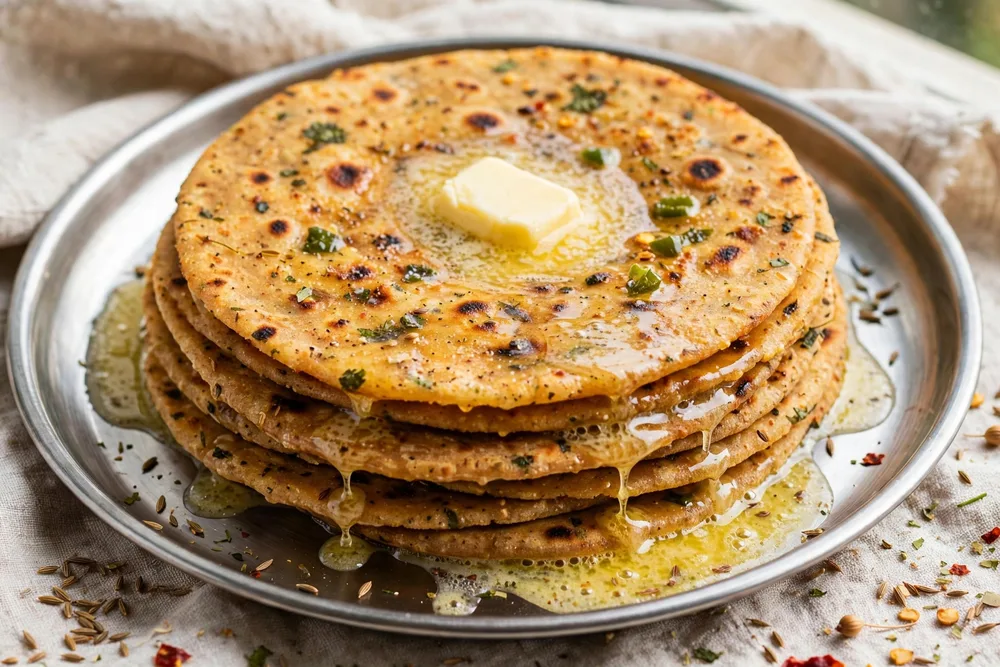
Spiced gram-flour and wheat roti, golden and slightly crisp. The Rajasthani–Punjabi bread that pairs with sarson ka saag and dal — earthy, filling and cheap.
Base Batch
10 Pax
2 rotis (140 g)
Prep / Cook
30m
15 min
Difficulty
easy
Commercial Standard
Cost / Portion
₹9.30
Illustrative Book Rate
Section 1 · At a Glance
Ingredients & Dynamic Pax Scaling Lab
Base formulated for 10 portions. Calibrate guest count, adjust catering buffer, or search specific ingredients below.
Batch Ingredient Cost
₹93
10 portions @ ₹9.30
Raw Batch Weight
~1.19 kg
Total raw commodities
Equipment Capacity
1 × GN 1/1
Standard chafing inserts
Scaling Factor
1.0× Base
10 Pax reference base
* Scaling is linear from the base 10-portion quantities (×5, ×10, ×50). Quantities of 1,000 g or more are shown as kg; 1,000 ml or more as L.
* Salt, spice, chilli and water do not scale perfectly — always taste and adjust; never scale salt blindly.
Step-by-Step Method & Critical Control Points (CCP)
Standard operating procedures with highlighted CCP warnings where execution failure compromises texture or food safety.
Mix the dough. Mix the atta, besan, onion, green chillies, coriander, cumin, coriander and red chilli powders, turmeric, salt and 15 ml oil.
Knead. Add water a little at a time and knead to a firm, smooth dough — **⚠ CCP:** besan dough is stiffer than plain atta; add water slowly or the dough turns sticky. Rest 20 minutes.
Divide. Divide the dough into 20 equal balls.
Roll. Roll each ball to about 15 cm, even thickness. Besan dough cracks at the edges more easily — roll gently.
Roast. Cook on a hot tawa until golden spots appear on both sides, drizzling ghee around the edge and pressing lightly.
Finish. Brush lightly with ghee and keep covered in a cloth-lined basket.
Serve. Serve hot, 2 rotis per portion. Done when: golden, slightly crisp at the edges, soft inside, spiced aroma.
ℹ CCP = critical control point — the moment where getting it wrong spoils the dish or makes it unsafe.
Tips & Tricks + Common Mistakes to Avoid
- •Add water slowly — besan dough goes from firm to sticky fast.
- •Roll gently; besan dough cracks if rolled hard.
- •Serve with sarson ka saag or dal — the roti is the partner, not the main.
- •Cracked roti — dough too dry, or rolled too hard.
- •Sticky dough — too much water added at once.
- •Raw centre — roti too thick, or the tawa too hot.
Section 5 · Nutrition — (2 rotis (140 g)
Standard food-composition estimates derived from the raw ingredient list.
Energy
240 kcal
Avg: 259 kcal
Protein
9 g
Avg: 10 g
Carbohydrate
40 g
Avg: 33 g
Fat
8 g
Avg: 10 g
Fibre
3 g
Avg: 2 g
Sodium
460 mg
Avg: 434 mg
60%
40 g
13%
9 g
27%
8 g
Energy split: carbohydrate 60% · protein 13% · fat 27%.
Section 6 · Fun Fact & Origin
Origin: not documented — no reliable source found for a single place, person or date of first creation. Missi roti is widely associated with Rajasthan and Punjab; no inventor is recorded.
Section 7 · Regional Traditions
Missi roti is the gram-flour bread of Rajasthan and Punjab, eaten with sarson ka saag, dal and curd. It is a rustic, filling bread — a wedding menu carries it when the menu already has a saag or a dal that needs a heartier bread than a plain roti.
Three Commercial Variations
add a little ajwain to the dough and finish with white butter.
the recipe as written is already low-cost.
roast with minimal ghee and serve with dal and salad.
Production Intelligence & Banquet Logistics
Batch Yield
10 portions = 20 rotis, about 1.4 kg finished.
Prep Schedule
Morning: knead the dough and rest. Roll and roast to order at the counter.
Portion Control
2 rotis per portion, counted.
Holding Limits
Hot hold 65°C
- Yield: 10 portions = 20 rotis, about 1.4 kg finished.
- Prep schedule: Morning: knead the dough and rest. Roll and roast to order at the counter.
- Portion control: 2 rotis per portion, counted.
- Holding and service risks: Roast to order. Missi rotis stay soft longer than plain rotis but dry out within 30 minutes; cook fresh batches.
Food Safety, Allergens & Thermal Holding
Allergen Classification (Chapter 4 Matrix)
Contains — Milk, Wheat. Not present — Egg, Fish, Nuts, Soy, Mustard, Sesame. Diet: Veg.
Ingredient Costing, Pairings & Waste Reduction
Per Portion Cost
₹9.30
Cost per portion = (sum of ingredient quantity × rate) ÷ portions. Ingredient cost only — water, cooking fuel, transport, labour, and commercial overheads are not included. All rates are illustrative book planning benchmarks; replace with your live mandi rates.
Cost Driver Composition
Interactive Margin & Profit Simulator
Calibrate your catering client quote to verify commercial profit margins.
Quoted Revenue
₹2,800
Food Cost
₹930
Gross Profit
₹1,870
Profitable Menu Pairings
Kitchen Waste Reduction & Yield Strategy
Dough offcuts are re-kneaded; day-old rotis are cut into chips for a chaat topping the same day.