
Hyderabadi Chicken Biryani
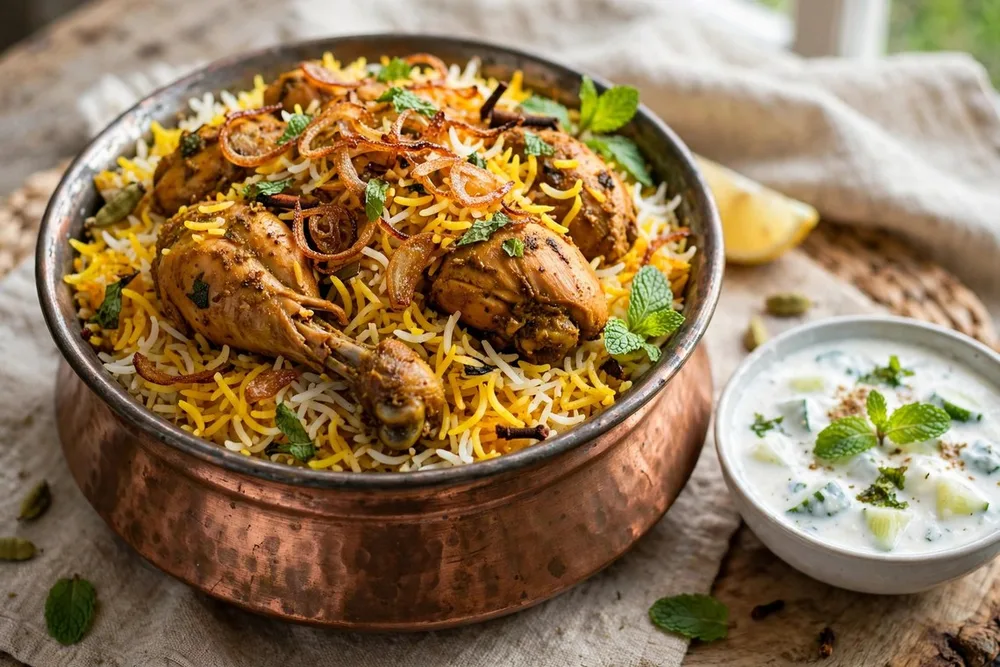
Layered basmati and marinated chicken cooked on dum — saffron, fried onions and mint.
Base Batch
10 Pax
300 g
Prep / Cook
225m
60 min
Difficulty
advanced
Commercial Standard
Cost / Portion
₹77.51
Illustrative Book Rate
Section 1 · At a Glance
Ingredients & Dynamic Pax Scaling Lab
Base formulated for 10 portions. Calibrate guest count, adjust catering buffer, or search specific ingredients below.
Batch Ingredient Cost
₹775
10 portions @ ₹77.51
Raw Batch Weight
~4.92 kg
Total raw commodities
Equipment Capacity
1 × GN 1/1
Standard chafing inserts
Scaling Factor
1.0× Base
10 Pax reference base
* Salt, spice, chilli and water do not scale perfectly — taste and adjust at every scale; never scale salt blindly.
* Scaling — linear from base 10 (×5, ×10, ×50). Above 1,000 g shown as kg; above 1,000 ml as L.
Step-by-Step Method & Critical Control Points (CCP)
Standard operating procedures with highlighted CCP warnings where execution failure compromises texture or food safety.
Marinate the chicken with curd, ginger-garlic paste, chilli powder, turmeric, garam masala, lemon juice and salt for 2 hours.
Soak the basmati 30 minutes. Boil in salted water with bay leaves, cardamoms, cloves and cinnamon until 70% cooked — **⚠ CCP:** the rice must be firm, not soft.
Soak the saffron in warm milk; fry the onions crisp and golden.
Layer: chicken, then rice, then fried onions, mint, coriander, green chillies, saffron milk and ghee. Repeat once.
Seal the lid and cook on dum — 10 minutes on medium heat, then 40 minutes on low heat. Do not open the lid.
Rest 10 minutes, open, fluff gently and serve hot with raita and salan.
ℹ CCP = critical control point — the moment where getting it wrong spoils the dish or makes it unsafe.
Tips & Tricks + Common Mistakes to Avoid
- •70% rice is the rule — firm grains finish cooking in the steam.
- •Seal the lid properly; escaping steam is escaping flavour.
- •Rest before opening, or the layers collapse.
- •Soft rice before layering — mushy biryani.
- •A loose lid — dry, undercooked biryani.
- •Opening the lid on dum — the steam escapes and the rice stays raw.
Section 5 · Nutrition — (300 g)
Standard food-composition estimates derived from the raw ingredient list.
Energy
485 kcal
Avg: 259 kcal
Protein
28 g
Avg: 10 g
Carbohydrate
48 g
Avg: 33 g
Fat
20 g
Avg: 10 g
Fibre
5 g
Avg: 2 g
Sodium
580 mg
Avg: 434 mg
40%
48 g
23%
28 g
37%
20 g
Energy split: carbohydrate 40% · protein 23% · fat 37%.
Check: 28×4 + 48×4 + 20×9 = 484 kcal, shown as 485 kcal (rounded). Sodium 580 mg comes from 1.5 g salt per portion.
Section 6 · Fun Fact & Origin
Fun fact: Hyderabadi biryani is the food of the Nizams of Hyderabad — raw marinated meat and rice layered and cooked together on dum in the royal kitchens. The Nizam's-kitchen association is widely documented; no single inventor or date is recorded. Origin: not documented — no reliable source found for a single place, person or date of first creation.
Section 7 · Regional Traditions
Hyderabadi biryani belongs to Telangana and Andhra Pradesh, served at weddings, festivals and celebrations as the main dish, with mirchi ka salan and raita. It is cooked in large handis for hundreds of guests, and the dum seal is broken open at the table.
Three Commercial Variations
Use saffron generously, add a layer of fried onions and mint at the top, and serve with mirchi ka salan and raita.
Use less saffron and more fried onion; the dum cooking carries the flavour.
Use skinless chicken, keep the ghee to half, and serve with raita and salad.
Production Intelligence & Banquet Logistics
Batch Yield
10 portions × 300 g = 3.0 kg, from 800 g basmati + 1.5 kg chicken.
Prep Schedule
marinate the chicken and soak the rice the evening before; layer and cook on dum in the last 90 minutes before service.
Portion Control
one weighed 300 g scoop with 2–3 pieces of chicken per portion.
Holding Limits
hold the sealed handi hot for up to an hour. Open only when service starts; do not hold an opened handi for a long service.
- Yield: 10 portions × 300 g = 3.0 kg, from 800 g basmati + 1.5 kg chicken.
- Prep schedule: marinate the chicken and soak the rice the evening before; layer and cook on dum in the last 90 minutes before service.
- Portion control: one weighed 300 g scoop with 2–3 pieces of chicken per portion.
- Holding: hold the sealed handi hot for up to an hour. Open only when service starts; do not hold an opened handi for a long service.
Food Safety, Allergens & Thermal Holding
Allergen Classification (Chapter 4 Matrix)
Contains — Milk. Not present — Wheat, Egg, Fish, Nuts, Soy, Mustard, Sesame. Diet: Non-veg.
Ingredient Costing, Pairings & Waste Reduction
Per Portion Cost
₹77.51
Cost per portion = (sum of ingredient quantity × rate) ÷ portions. Ingredient cost only — water, cooking fuel, transport, labour, and commercial overheads are not included. All rates are illustrative book planning benchmarks; replace with your live mandi rates.
Cost Driver Composition
Interactive Margin & Profit Simulator
Calibrate your catering client quote to verify commercial profit margins.
Quoted Revenue
₹23,300
Food Cost
₹7,751
Gross Profit
₹15,549
Profitable Menu Pairings
Kitchen Waste Reduction & Yield Strategy
Rice left over is fried as biryani fried rice for staff meals. Chicken bones make stock for the next gravy; saffron milk left over flavours kheer the same day.