
Chingri Malai Curry
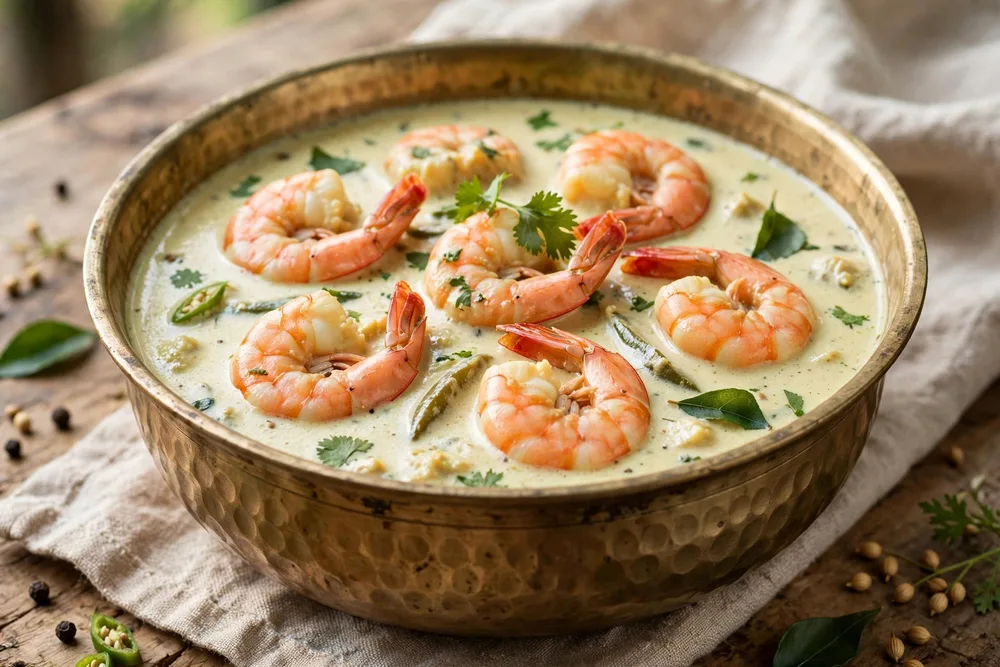
Large prawns simmered in a rich coconut-milk gravy with whole spices — the Bengali wedding prawn curry, mild, creamy and festive.
Base Batch
10 Pax
2 large prawns (about 150 g) + gravy
Prep / Cook
55m
30 min
Difficulty
medium
Commercial Standard
Cost / Portion
₹103.47
Illustrative Book Rate
Section 1 · At a Glance
Ingredients & Dynamic Pax Scaling Lab
Base formulated for 10 portions. Calibrate guest count, adjust catering buffer, or search specific ingredients below.
Batch Ingredient Cost
₹1,035
10 portions @ ₹103.47
Raw Batch Weight
~1.98 kg
Total raw commodities
Equipment Capacity
1 × GN 1/1
Standard chafing inserts
Scaling Factor
1.0× Base
10 Pax reference base
* Salt, spice and chilli: taste and adjust to your own ingredients — they do not scale perfectly. Water: adjust to your rice, dal and vegetables.
* Scaling — linear from base 10 (×5, ×10, ×50). Above 1,000 g shown as kg; above 1,000 ml as L.
Step-by-Step Method & Critical Control Points (CCP)
Standard operating procedures with highlighted CCP warnings where execution failure compromises texture or food safety.
Marinate the prawns. Rub prawns with turmeric and half the salt; rest 15 minutes.
Fry lightly. Heat half the ghee; fry the prawns 1 minute a side until just pink. Lift out. **⚠ CCP—** prawns: do not cook them through here; they finish in the gravy and overcooking makes them rubbery.
Build the gravy. In the same pan add the remaining ghee, bay leaves, cardamoms and cinnamon; fry onions until soft and golden. Add ginger paste, red chilli powder and sugar; cook 2 minutes.
Add the coconut milk and 100 ml water. Simmer gently 5 minutes until slightly thick. **⚠ CCP—** coconut milk: keep the heat low; hard boiling splits coconut milk.
Finish. Return the prawns with green chillies and the remaining salt. Simmer 4–5 minutes until the prawns are opaque and curled. Stir in coriander. Serve 2 prawns per portion with gravy. Done when: prawns pink and tender, gravy creamy and lightly sweet.
ℹ CCP = critical control point — the moment where getting it wrong spoils the dish or makes it unsafe.
Tips & Tricks + Common Mistakes to Avoid
- •Use large prawns — small prawns shrink and disappear in the gravy.
- •Fry prawns briefly only; the gravy does the cooking.
- •Keep the coconut milk simmering, never boiling hard.
- •Overcooked prawns — rubbery and shrunken.
- •Boiled coconut milk — split, grainy gravy.
- •Too much chilli — this curry should be mild and creamy.
Section 5 · Nutrition — (2 large prawns (about 150 g)
Standard food-composition estimates derived from the raw ingredient list.
Energy
320 kcal
Avg: 259 kcal
Protein
24 g
Avg: 10 g
Carbohydrate
8 g
Avg: 33 g
Fat
20 g
Avg: 10 g
Fibre
1 g
Avg: 2 g
Sodium
560 mg
Avg: 434 mg
10%
8 g
31%
24 g
58%
20 g
Energy split: carbohydrate 10% · protein 31% · fat 58%.
Section 6 · Fun Fact & Origin
Origin: not documented — no reliable source found.
Section 7 · Regional Traditions
Chingri malai curry is a festive Bengali curry from West Bengal, served at weddings and celebrations with steamed rice; malai (cream) here means the rich coconut milk, not dairy cream.
Three Commercial Variations
Use jumbo prawns, add a little more ghee and serve in a brass bowl.
Use medium prawns and increase the gravy share per portion.
Use light coconut milk and half the ghee.
Production Intelligence & Banquet Logistics
Batch Yield
20 prawns + about 800 ml gravy.
Prep Schedule
clean prawns the morning of the event; make the gravy base ahead and chill; fry and finish prawns within 30 minutes of service.
Portion Control
count 2 prawns per plate; ladle gravy over.
Holding Limits
holds covered for 1 hour; prawns toughen on long holding.
- Yield: 20 prawns + about 800 ml gravy.
- Prep schedule: clean prawns the morning of the event; make the gravy base ahead and chill; fry and finish prawns within 30 minutes of service.
- Portion control: count 2 prawns per plate; ladle gravy over.
- Holding: holds covered for 1 hour; prawns toughen on long holding.
- Service risk: coconut milk splitting on reheating — reheat gently, never boil.
Food Safety, Allergens & Thermal Holding
Allergen Classification (Chapter 4 Matrix)
Contains — Milk, Fish, Nuts. Not present — Wheat, Egg, Soy, Mustard, Sesame. Diet: Non-veg.
Ingredient Costing, Pairings & Waste Reduction
Per Portion Cost
₹103.47
Cost per portion = (sum of ingredient quantity × rate) ÷ portions. Ingredient cost only — water, cooking fuel, transport, labour, and commercial overheads are not included. All rates are illustrative book planning benchmarks; replace with your live mandi rates.
Cost Driver Composition
Interactive Margin & Profit Simulator
Calibrate your catering client quote to verify commercial profit margins.
Quoted Revenue
₹31,000
Food Cost
₹10,347
Gross Profit
₹20,653
Profitable Menu Pairings
Kitchen Waste Reduction & Yield Strategy
Prawn shells are simmered into a stock for the gravy base; leftover gravy is served over rice the next day, not discarded.